If you have been following this group for a while, you know that we are really trying hard to find new ways for localising binary black holes (dark sirens) in redshift space. This is crucial for gravitational-wave cosmology, as with a redshift measure we can measure the cosmic expansion.
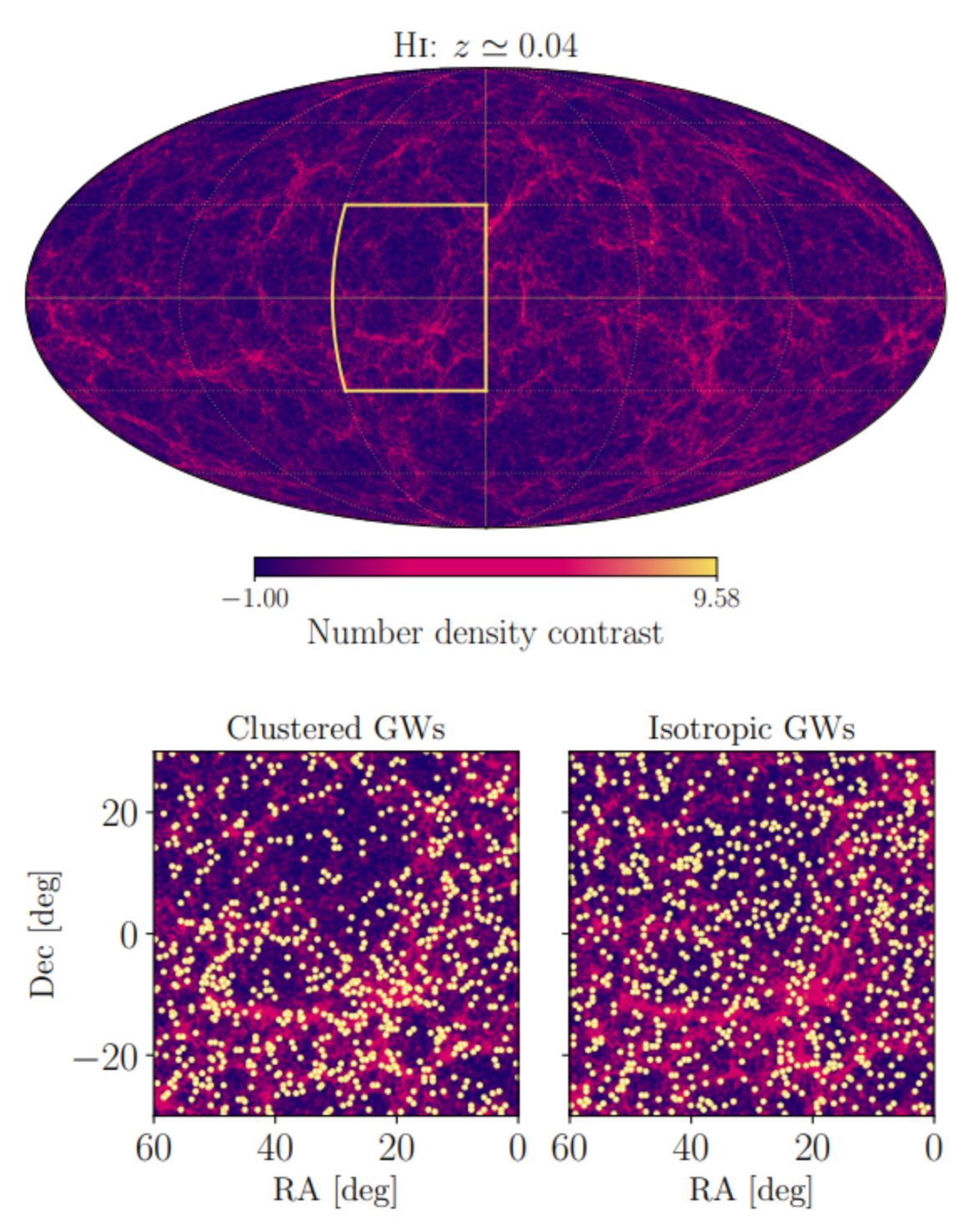
In a recent collaboration led by Ulyana Dupletsa, we built a new methodology to use neutral hydrogen intensity maps that will be observed by radio telescopes such as the Square Kilometre Array Observatory to identify the possible redshifts of binary black holes detected from their gravitational emission.
We have shown that this methodology can be used to probe the cosmic expansion. We have also seen what the effect on gravitational wave cosmology is of assuming a homogeneous and isotropic universe when actually it isn’t. If you want to know more, check out our latest preprint.
Figure: Density contrast of neutral hydrogen at low redshifts. You can see that the hydrogen density (might) track(s) the dark matter filaments, and in these filaments, it is more likely to find gravitational wave sources.