EUROPEAN RESEARCHERS’ NIGHT 2026 · 25–26 SEPTEMBER 2026
Avezzano
INSTITUTION
Italian National Institute for Nuclear Physics
VENUE
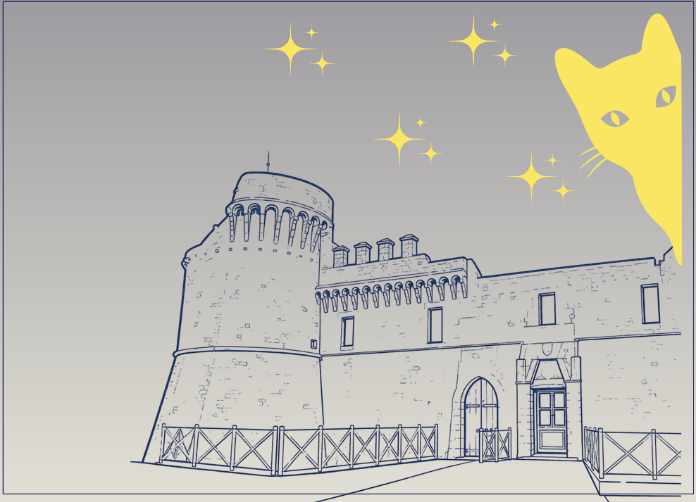
Palazzo Orsini
TIME
17–23
ACTIVITIES
An open exploration environment
There is no predefined path: visitors can start anywhere and move through the space according to their interests and curiosity. Every activity contributes to one shared investigation.
Activity programme
-

Entrance
At the entrance, visitors receive their ERNEST passport and a very brief introduction to the event. This area establishes the visual identity and narrative tone, with the cat as symbolic guide.
-

INFN Game
Discover physics through play with INFN Game. Visit the project website to explore its games, including I primi 20 minuti, Neutrino Arena and Labirinto di barioni.
-

HEPscape!
Enter the control room of a major CERN experiment and become part of the research team. Work with your team to solve puzzles, analyse real data, reconstruct a particle detector and complete a mission inspired by the work of physicists. An immersive experience combining play, logic and scientific research to discover how discoveries in physics are made.
-

INFN Kids
An area for young children with games, experiments and interactive activities to discover science through play. Hands-on workshops and challenges invite children and families to explore the principles of physics and learn about the work of INFN researchers.
-

ESA Quiz
Discover how Europe explores space with the European Space Agency (ESA). Educational materials, interactive activities and conversations with researchers and experts introduce European space missions, technologies for exploring the Universe and their impact on everyday life. An opportunity to discover space and the research challenges of the future.
-

Discover great scientific experiments through virtual reality
Put on a virtual reality headset and explore some of the world’s largest scientific experiments. Enter research laboratories, see extraordinary instruments up close and discover how thousands of researchers collaborate internationally to study the Universe, from elementary particles to the cosmos.
-

Listen to the Universe: discovering gravitational waves
Discover how scientists listen to the Universe through gravitational waves: tiny ripples in spacetime produced by the most violent events in the cosmos. Explore how giant detectors work, what collisions between black holes and neutron stars reveal, and how this extraordinary discovery opened a new window on the Universe.
-

LHC seminar: a journey into the secrets of the Universe
What happens when particles collide at almost the speed of light? Discover LHC, CERN’s great accelerator, and the experiments investigating the building blocks of matter. From the Higgs boson to unanswered questions about the Universe, this seminar takes you on a journey through giant instruments and discoveries about the very small.
-

CSI – The hunt for the Higgs boson
A team investigation in which participants analyse clues, form hypotheses and tackle simple experiments to reconstruct the traces of the mysterious Higgs boson and discover how particle physicists really work.
-

Dice Hide a Secret
Two giant dice, many rolls and a signal to decode. Some sums seem to appear more often: is the detector broken, or does chance hide a regularity? A collective experiment begins. Each participant rolls two dice and adds the sum to the board. We predict the shape of the graph before the rolls reveal it.
-

CSI – Operation Gold: the Secret Is in the Nucleus
You have a model of a lead nucleus in front of you. Your mission: turn it into gold by removing some balls. Which ones? The periodic table holds the crucial clue. Observe, form a hypothesis and test it, then discover with the facilitator how the ALICE experiment observed the transformation of lead into gold at the LHC.
-

Tutti Quantum
A short card and board game inspired by elementary particles. Players compete or cooperate to connect particles, build Feynman diagrams and discover, through play, simple rules behind quantum mechanics, relativity and real particle-physics phenomena.
-

Demonstrations/Experiments by local schools
Science comes to life with local schools! Meet those who learn and experiment every day, explore scientific phenomena and discover demonstrations and experiments. Bring your questions and enjoy observing, reasoning and looking for explanations together.
-

Torre delle Stelle: demonstration
Look up at the sky with Torre delle Stelle! A demonstration to discover astronomy and learn how a telescope helps us explore the Universe. Bring your curiosity and questions, and find out how light from celestial objects reveals what happens in space: an invitation for all ages to see the sky in a new way.
-

NAND and AI: an essential partnership
Artificial intelligence needs vast amounts of data to learn and operate. NAND memory stores the large datasets used to train AI models and provides rapid access to information during inference. From cloud data centres hosting large language models to devices such as smartphones and autonomous cars running AI locally, high-performance NAND memory is essential. Faster, higher-capacity storage supports more complex and powerful AI models. These memories are also designed at the Avezzano site, a centre for research and development that contributes to technological innovation and scientific culture in the local area.
-

Threads of science: girls and women in research
Who do we imagine when we think of someone working in research? A participatory activity exploring perceptions of girls and women in science. Through questions, choices and coloured threads, participants build a large map of their ideas together, revealing associations, expectations and gender stereotypes about research. A simple visual way to reflect on who can do science and how we imagine today’s scientists.
-

EU Explorer
An area that connects the experience to the wider context of European research, showing how ERNEST activities belong to a larger collaborative scientific effort.
-

Debrief Area
A quieter but visible space where visitors can interact with researchers, reflect on what they experienced and connect the activities to real scientific concepts.