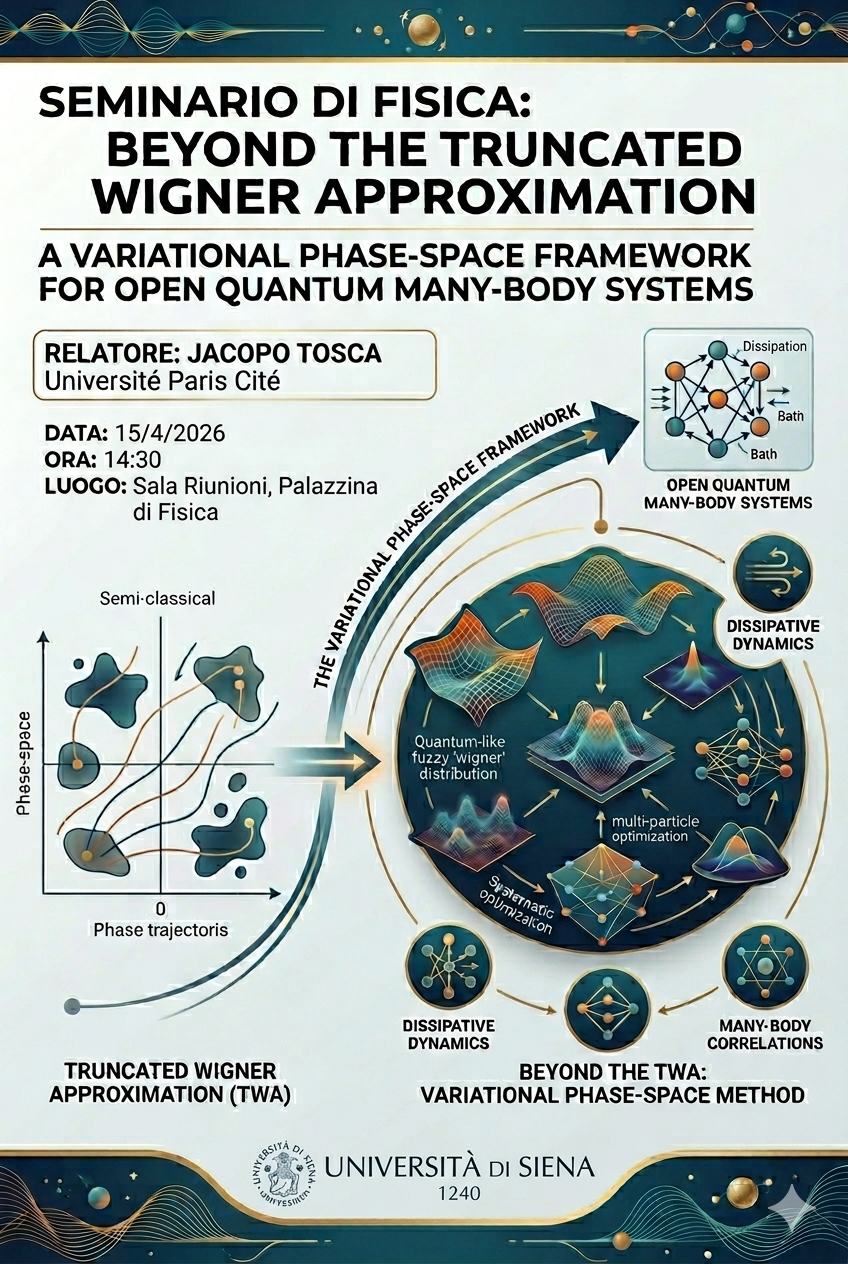
On wednesday 15th Dr. Jacopo Tosca, Université Paris Cité, will give a seminar in Sala Riunioni at 14:30.
Beyond the Truncated Wigner Approximation: A Variational Phase-Space Framework for Open Quantum Many-Body Systems
fai un riassunto di poche righe del seguente test
Simulating the non-equilibrium dynamics of open quantum many-body systems is a central challenge for the theoretical understanding of quantum platforms. However, semiclassical phase-space methods, such as the truncated Wigner approximation, become unreliable in deeply quantum regimes where Wigner negativities and quantum correlations are prominent.
We introduce a unified variational framework that overcomes this limitation for both bosonic and spin systems. For bosonic lattices, we develop the Variational Multi-Gaussian (VMG) ansatz for the Wigner function — a systematically improvable superposition of complex Gaussians whose accuracy is controlled by the number of components. For spin lattices, we construct the variational Multi-Coherent State (v-MCS) ansatz in the Husimi-Q representation, based on a mixture of spin-coherent states. In both cases, the equations of motion are derived from the Dirac-Frenkel variational principle and evaluated fully analytically — without stochastic sampling — by exploiting automatic differentiation. Crucially, these two new phase-space variational methods can represent strongly non-classical states with negative quasi-probability distributions, enabling the faithful capture of genuine quantum correlations in the full quantum regime.
We benchmark both methods against exact results on paradigmatic models. For the driven-dissipative dynamics of the transverse-field Ising model, the v-MCS approach achieves excellent accuracy on 2D lattices up to 8×8 spins, outperforming state-of-the-art neural-network methods. For a 2D Bose-Hubbard lattice with two-boson driving and dissipation, the VMG method provides the first characterization of the associated quantum critical dynamics, extracting Liouvillian spectral gap exponents consistent with the 2D quantum Ising universality class, for systems comprising up to 144 strongly coupled bosonic modes.
