Author: Simone Mastrogiovanni

  • Machine-learning-based models for gravitational wave cosmology

    Machine-learning-based models for gravitational wave cosmology

    One of the most crucial problems for gravitational wave (GW) cosmology is how to parametrize the distribution of masses and redshift for binary black holes. This is a very serious problem, as we know that the mismodeling of these distributions might introduce some bias when inferring the Hubble constant.

    In a recent study led by the PhD student Leonardo Iampieri, we considered normalizing flows as a possible baseline population model for gravitational wave cosmology. The trick here is to find the best configuration of the normalizing flow that is able to fit the population of binary black holes, while keeping the cosmological parameters, such as the Hubble constant. This is not as easy as it might be any seems, and Leonardo had to overcome many intrinsic limitations introduced by machine learning and data censoring. If you want to know more, feel free to check out our preprint.

    Figure: A metric developed by Leonardo used to quantitatively state whether there is a correlation in the mass and redshift distribution of binary black holes when using non-parametric population models. If the points lie on the bisector, then there is no evolution. Below we show two test cases: Model A without any evolution in redshift and Model B with an evolution.

  • To be bright or to be dark?

    To be bright or to be dark?

    To be or not to be, said a very famous character. Even for gravitational wave cosmology, this question is becoming more and more crucial. We have been observing hundreds of gravitational waves from compact binaries, and we think that those binaries are made of black holes and neutron stars. So far, it is was common in our field to say that a compact object with masses above 5 solar masses is a black hole and with masses between 1 and ~3 solar masses is a neutron star. However, we do observe objects with masses between 3 and 5 solar masses! What are they?

    In this preprint, Alberto Colombo, Sonia Triscari-Benimavo, and I developed a framework for gravitational wave cosmology that can help us when dealing with this problem. We have shown that neglecting the nature of the compact objects might result in a biased reconstruction of the compact objects’ masses, and maybe even a little bit of bias in the inference of the Hubble constant.

    With this study, we also release two major software packages that we developed: mocking-gw and bright-sirens-tools. The former is used to quickly simulate the observed population of GW sources, and the latter to calculate what type of electromagnetic emission the binaries might have. Check below for our preprint and on the software page for our release.

    Figure: Probability of emitting an electromagnetic counterpart (gamma-ray burst and Kilonova) as function of the masses of the two compact objects.

  • What do a pair of black holes and a hydrogen cloud have in common?

    What do a pair of black holes and a hydrogen cloud have in common?

    What do a pair of black holes and a hydrogen cloud have in common? It seems like one of the bad jokes a physicist might say during a stand-up, but it is not. Both are biased tracers of Dark Matter in our universe. In other words, the Dark Matter distribution in the universe is the invisible link that connects the spatial distribution of hydrogen and binary black holes. As such, we expect gravitational wave sources (pairs of black holes) and neutral hydrogen to cluster in the same way.

    In this work, led by PhD student Matteo Schultz at the Gran Sasso Science Institute, we study how cosmic expansion can be probed by matching the clustering of gravitational-wave sources with neutral hydrogen radio intensity maps. We have found that cross-correlating gravitational waves with neutral hydrogen is a viable method to reach sub-percent precision on the Hubble constant using the Einstein Telescope and the Square Kilometer Array Observatory. Check out more below!

    Figure: Integrated Cross-correlation Power Spectrum as function of redshift and luminosity distance. The Figure can be understood as a matrix, where each row represents the luminosity distance bin and each column represents the redshift bin for the neutral hydrogen.

  • Bright sirens in the radio

    Bright sirens in the radio

    The Square Kilometre Array Observatory (SKAO) is an array of radio telescopes that are being built in South Africa. SKAO will be able to detect very faint radio signals, and you might wonder how this type of signal can be related to Gravitational Waves, and cosmology in particular.

    If you have been following this blog, you might have noticed that gravitational wave signals with electromagnetic counterparts are the Holy Grail for gravitational wave cosmology. In 2017, we detected one, but it has been almost 10 years have passed…

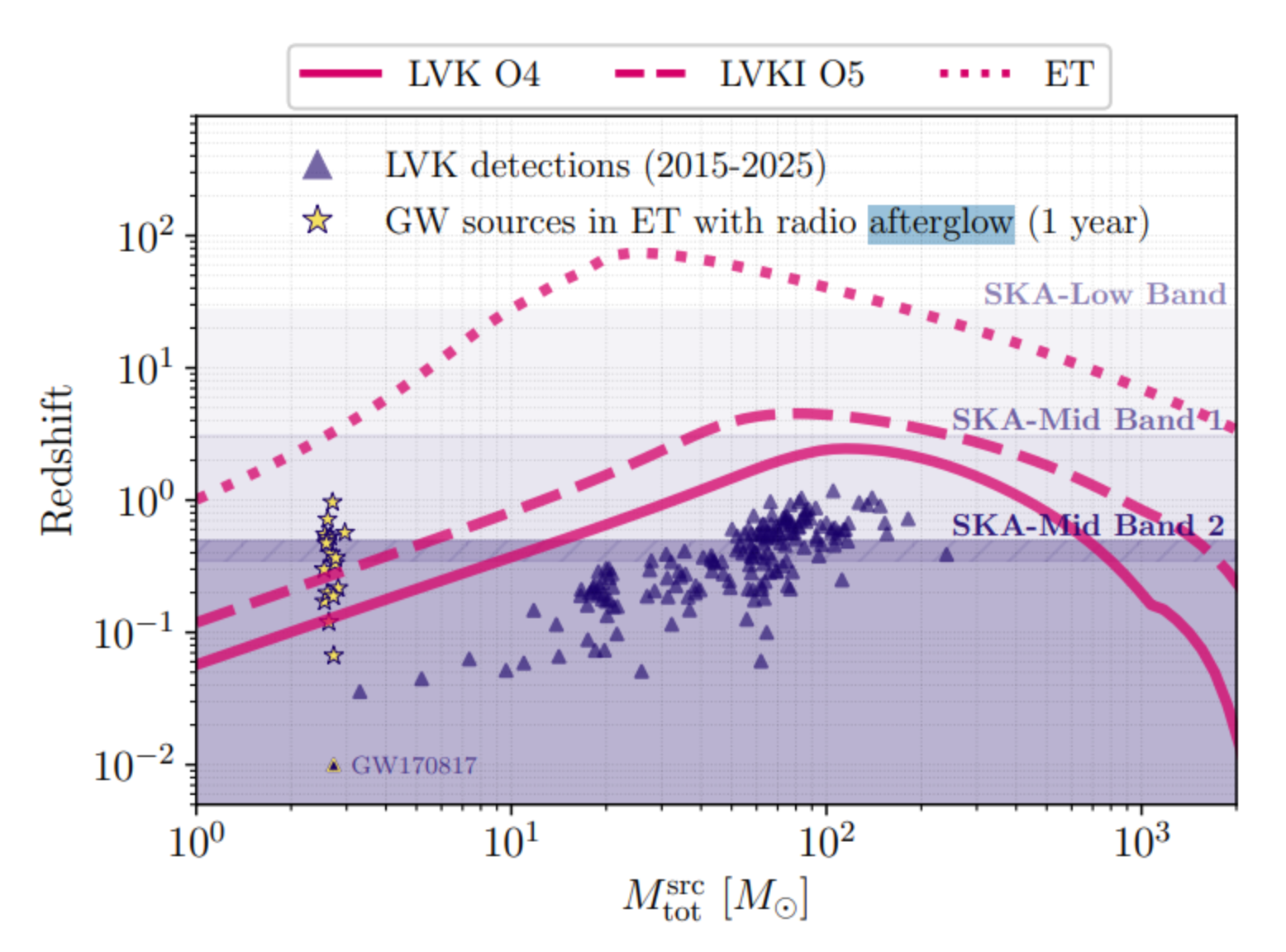
    In this publication, published in Advancing Astrophysics with the SKA – II, my group and I tried to contribute to understanding whether it could be possible to detect the Gamma-ray burst afterglow prompted by binary neutron star mergers in the radio. We have found that this is a viable electromagnetic emission in the era of the Einstein Telescope, and it can help us achieve precision cosmology! Check below for more details.

  • Tracking Black Holes with the radio

    Tracking Black Holes with the radio

    If you have been following this group for a while, you know that we are really trying hard to find new ways for localising binary black holes (dark sirens) in redshift space. This is crucial for gravitational-wave cosmology, as with a redshift measure we can measure the cosmic expansion.

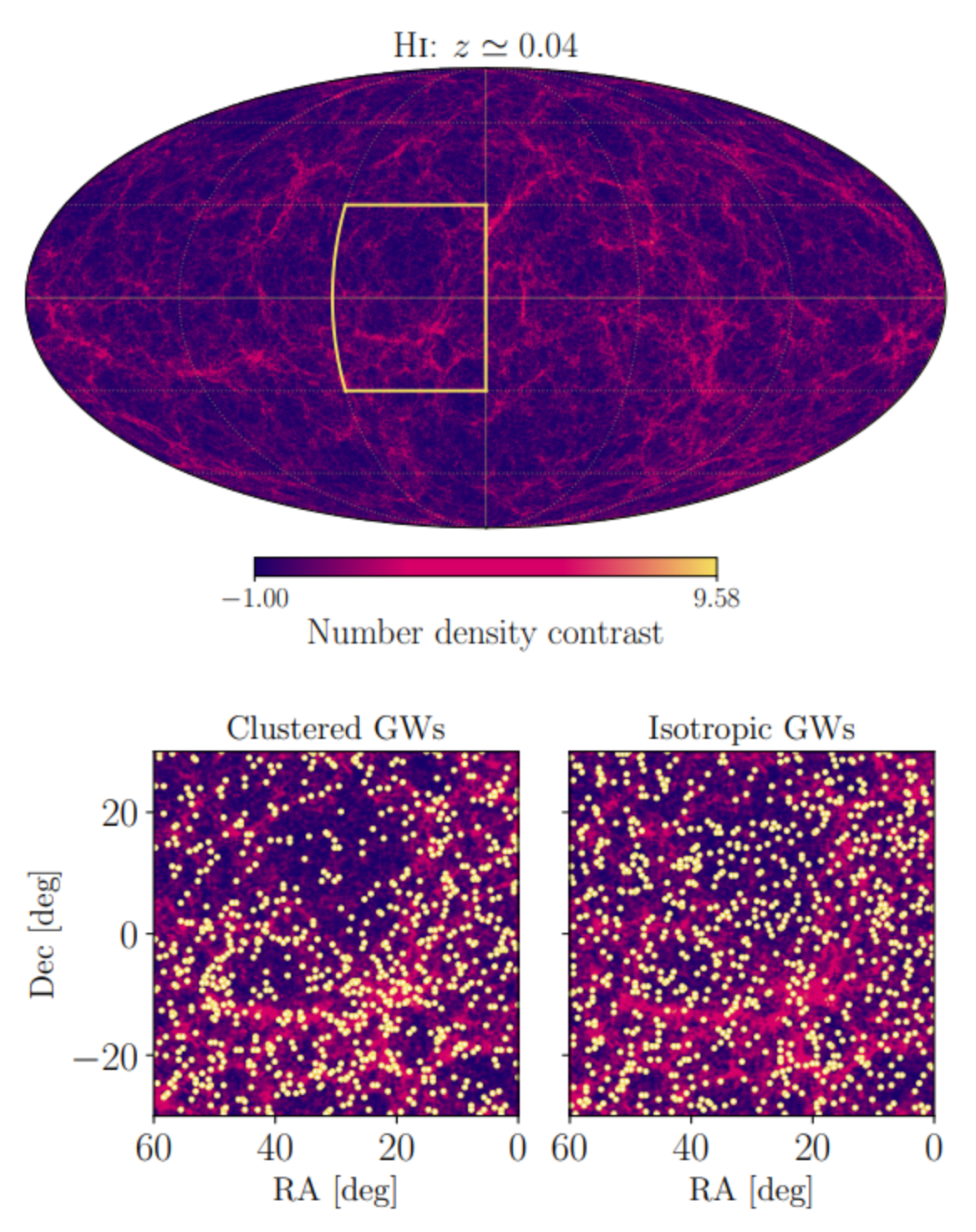
    In a recent collaboration led by Ulyana Dupletsa, we built a new methodology to use neutral hydrogen intensity maps that will be observed by radio telescopes such as the Square Kilometre Array Observatory to identify the possible redshifts of binary black holes detected from their gravitational emission.

    We have shown that this methodology can be used to probe the cosmic expansion. We have also seen what the effect on gravitational wave cosmology is of assuming a homogeneous and isotropic universe when actually it isn’t. If you want to know more, check out our latest preprint.

    Figure: Density contrast of neutral hydrogen at low redshifts. You can see that the hydrogen density (might) track(s) the dark matter filaments, and in these filaments, it is more likely to find gravitational wave sources.

  • Calibrating spectral sirens

    Calibrating spectral sirens

    Measuring the cosmic expansion by calibrating the source mass of binary black holes is one of our main activities. Yet, it is super difficult as we do not know how to model the mass of these black holes.

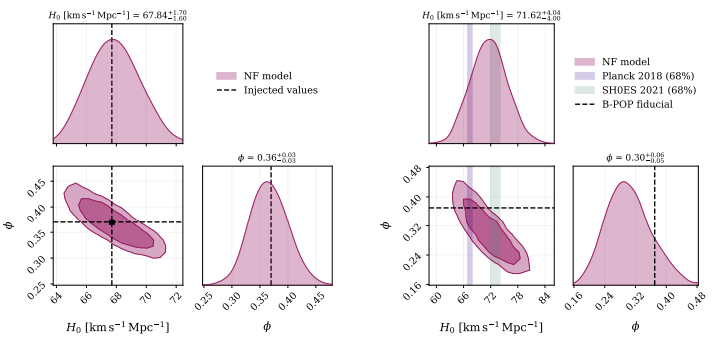
    In her master’s thesis, Arianna Scarpa came up with a method to use simulated catalogues of binary black holes to calibrate gravitational wave cosmology. The basic idea is to train a normalizing flow, a type of machine learning, to mimic the complex distribution of binary black hole sources reported inside the simulated catalogues.

    Arianna also showed that this methodology can be used to infer the relative mixture coefficients between different formation channels, such as black holes formed from isolated binaries and black holes formed from dynamical assembly. Of course, there is still work to be done; mock catalogues of binary black holes also have their uncertainties that should be included.

    Feel free to read our latest paper and check the software release to use normalizing flows for gravitational wave cosmology!

    Figure: Joint posteriors on the Hubble constant and the mixture fraction between two populations of binary black mergers for simulated data and GWTC-4 data.

  • Pushing spectral sirens cosmology to the limit

    Pushing spectral sirens cosmology to the limit

    The Einstein Telescope is an amazing opportunity for gravitational-wave cosmology. The next-generation detector will be able to detect hundreds of binary black holes at distances that are at least 1 order of magnitude better than current detectors. And the question is, would we be able to study cosmology with the current algorithms?

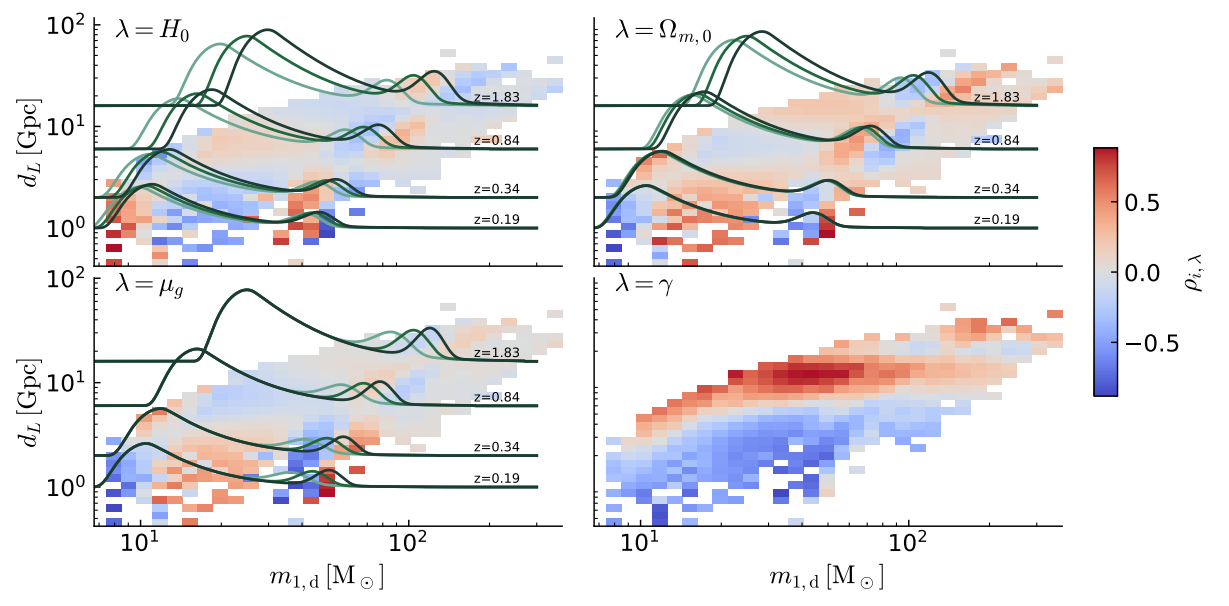
    In a recent publication led by Matteo Tagliazucchi, we undertook an end-to-end mock data challenge with 3 of the pipelines that are currently used for gravitational-wave cosmology. We benchmarked the pipelines and their limitation, and we understood that with the number of detections that the Einstein Telescope might provide in one year, we could be at our limit.

    It has also been fun to understand some other aspects of spectral sirens. In the Figure below, you can see my favourite plot of the paper where we quantify how much certain regions in the binary parameter space correlate with the population parameters. It is very interesting to see that, contrary to what one can expect, a lot of information on the Hubble constant might actually come from very distant gravitational-wave sources!

  • Gravity, the universe and Everything – Looking at the cosmic expansion, March 4th

    Gravity, the universe and Everything – Looking at the cosmic expansion, March 4th

    On March 4th, from 16.00 to 18.00 in the Conversi lecture room at the Sapienza Physics department, we will host a mini-workshop on Gravitational Wave Cosmology.

    The mini-workshop is part of a series of workshops meant to connect students and researchers interested in GW science at Sapienza.

    The first mini-workshop will feature talks from international researchers in the field. The program is

    16.00 – 16.30: K. Leyde (CCA/Flatiron Institute) – Machine Learning for gravitational wave cosmography
    16.30 – 17.00: U. Dupletsa (Austrian Academy of Sciences) – The present and future of GW cosmology
    17.00 – 17.30: L. Piccari (Sapienza University) – Enabling multi-messenger observations
    17.30 – 18.00: Coffee, cookies and open discussion with the speakers

    Registrations at this link

  • A heavy matter for gravitational-wave cosmology

    A heavy matter for gravitational-wave cosmology

    Not long ago, we published a study exploring a new way to measure how fast the Universe is expanding, not only today but also in the past. This method relied on sources of gravitational waves (GWs) emitted by the coalescences of black holes.

    Some of these sources emit no light at all. We call them spectral sirens. Even without light, they can still tell us about the expansion of the Universe. In our previous work, we showed that the key information actually comes from how the mass distribution of BHs changes with distance. Certain characteristic mass scales act like landmarks, allowing us to trace how the Universe expands.

    In our new preprint, we exploit this idea by introducing a new model designed to track an additional mass scale in the BH mass spectrum, around 60 times the mass of the Sun. We applied this model to the latest GW catalog released by the LIGO–Virgo–KAGRA collaboration.

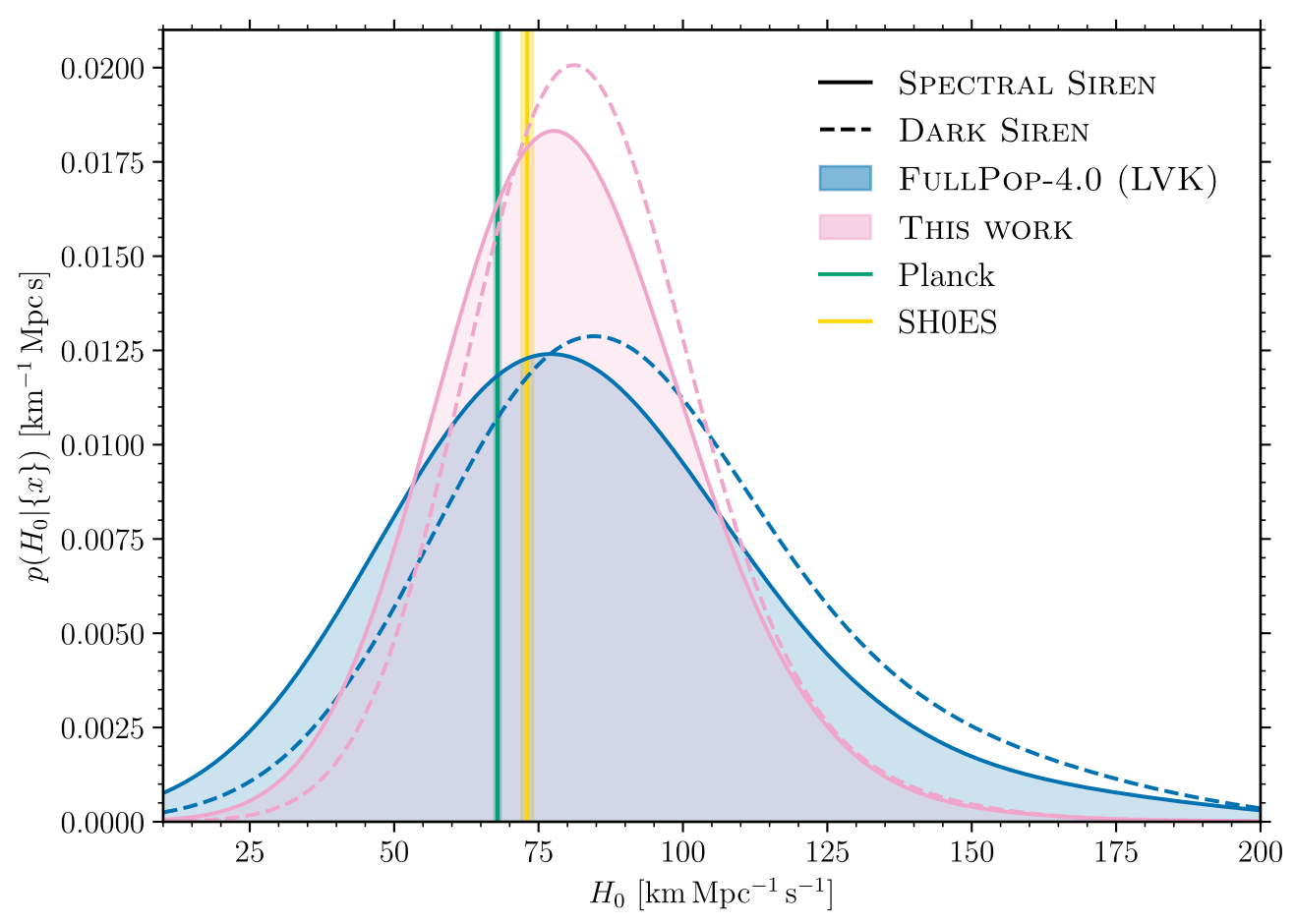
    The result is pretty nice: using spectral sirens alone, we obtained the tightest measurement of the Hubble constant to date, improving the error budget of previous analyses by 36%!
    We also show that this gain in precision comes directly from our ability to measure this new high-mass feature, which complements the already known mass scales around 11 and 27 solar masses. This clearly demonstrates an important point: the most massive BHs play a crucial role in spectral siren cosmology.

    In short, by better understanding how BH masses are distributed across the Universe, we can learn how fast the Universe itself is expanding, even when no light is involved.

    Figure: Probability distribution of the Hubble constant inferred from GWs. Our new result (pink) is compared with the standard LIGO–Virgo–KAGRA analysis (blue). The vertical lines show the latest measurements from Planck and SH0ES defined the so-called Hubble tension.

  • Catching the spin/mass correlations with physics

    Catching the spin/mass correlations with physics

    Sometime ago, Gregoire and I argued for the possible evidence of a spin magnitude/mass correlation for binary black holes observed via Gravitational Waves. In a recent preprint, with colleagues from the University of Rome Sapienza, CERN and Johns Hopkins University, we tried to better understand this correlation by modelling the astrophysical formation channels that can create it.

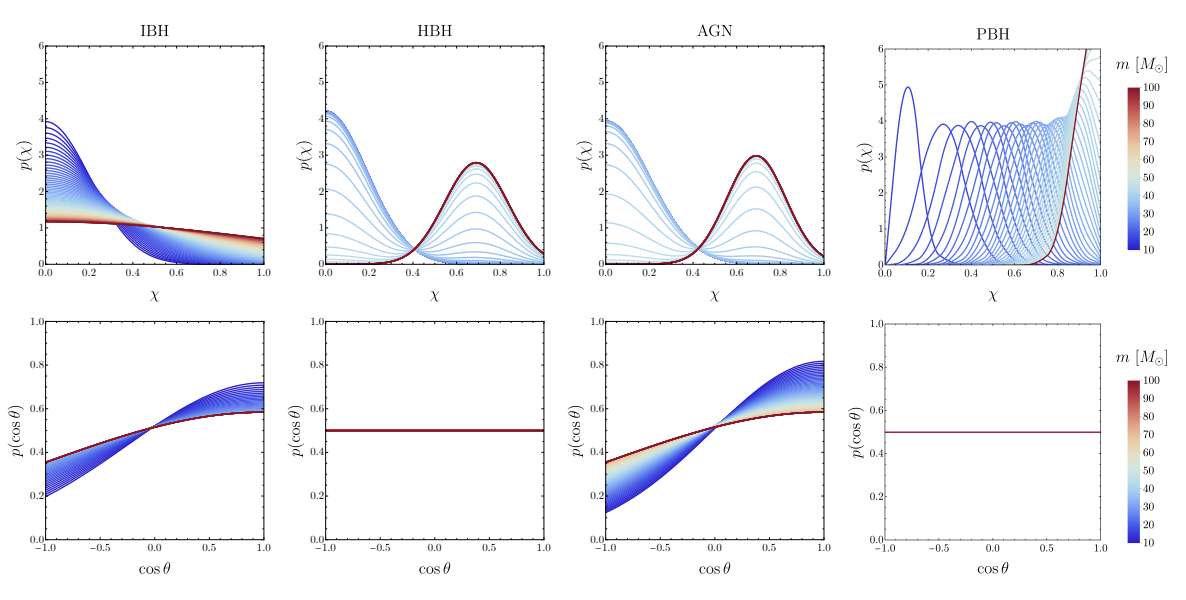
    We looked at possible spin/mass correlations introduced by black holes formed from isolated binary stars, dynamical formation in dense star clusters or in Active Galactic Nuclei (AGN), and primordial black holes. The main result of this study is that we still find this spin magnitude/mass correlation, but now we know a bit

    We have found that Primordial black holes alone can definitely not be the only formation channel of black holes; instead, we need at least two formation channels to describe the data. Unfortunately, we can not say who these channels are at the moment.

    Figure: Top row – spin magnitude distribution as a function of the source mass (colorbar). Bottom row – distribution of the cosine of the tilt angle of the black holes from the orbital angular momentum.