The Einstein Telescope is an amazing opportunity for gravitational-wave cosmology. The next-generation detector will be able to detect hundreds of binary black holes at distances that are at least 1 order of magnitude better than current detectors. And the question is, would we be able to study cosmology with the current algorithms?
In a recent publication led by Matteo Tagliazucchi, we undertook an end-to-end mock data challenge with 3 of the pipelines that are currently used for gravitational-wave cosmology. We benchmarked the pipelines and their limitation, and we understood that with the number of detections that the Einstein Telescope might provide in one year, we could be at our limit.
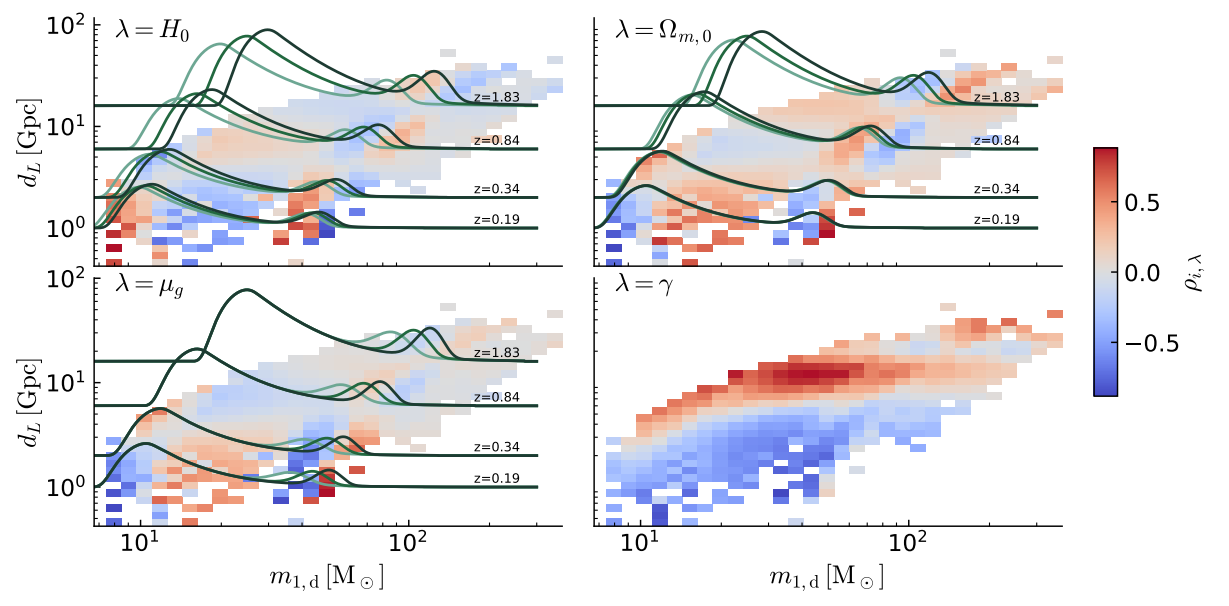
It has also been fun to understand some other aspects of spectral sirens. In the Figure below, you can see my favourite plot of the paper where we quantify how much certain regions in the binary parameter space correlate with the population parameters. It is very interesting to see that, contrary to what one can expect, a lot of information on the Hubble constant might actually come from very distant gravitational-wave sources!