Category: Publications

Posts related to scientific publications

  • Spinning Exotic compact objects

    Spinning Exotic compact objects

    With Elisa Maggio and Adriano Frattale-Mascioli we looked at the detected gravitational waves populations as if composed of exotic compact objects.

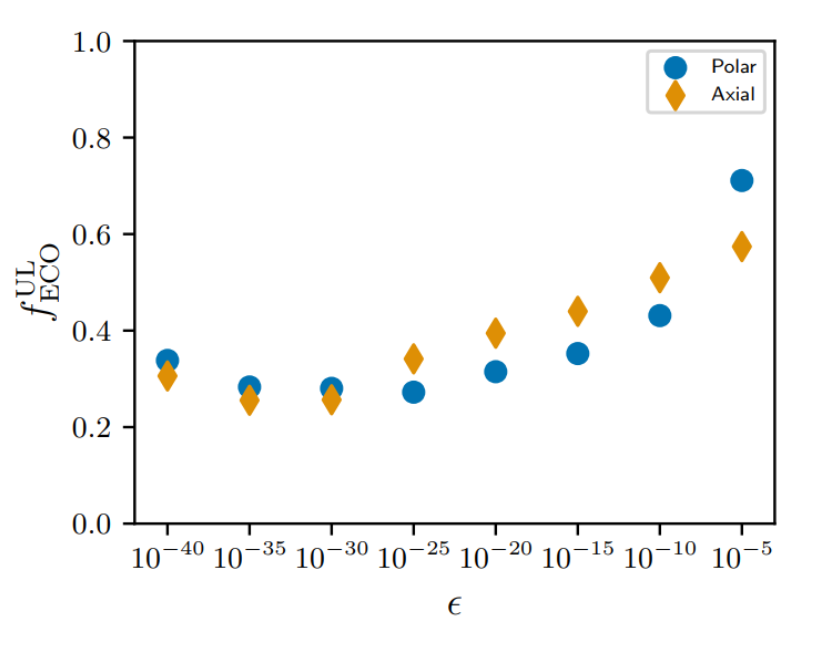
    Exotic compact objects (ECOs) are proposed alternatives to black holes (BHs) that can mimic their behaviours while removing the event horizon. However, ECOs are subject to ergoregion instability; namely, if their spin is too high, they are unstable. We infer that no more than 20% of the compact objects could be ECOs by looking at the spin distribution of detected GW sources. We also demonstrate that the Einstein Telescope will obtain far better results with just a few days of data-taking.


    Please, feel free to read our paper and reach out to us for any question or suggestion.

    Title: Limits on the existence of totally reflective exotic compact objects with current and future gravitational-wave detectors

    Authors: S. Mastrogiovanni, E. Maggio, A. Frattale-Mascioli

    Figure: Upper limits on the fraction of ECOs as function of the compactness (position of the ECO’s surface from the would-be event horizon).

  • Making the point: GW cosmology in 2025

    Making the point: GW cosmology in 2025

    Myself and Prof. Antonella Palmese recently drafted a 2025 review of gravitational wave cosmology.

    It is a gentle introduction and review to standard sirens cosmology is a contribution to the Encyclopedia of Astrophysics (edited by Springer). The review covers in details methods for gravitational-wave cosmology with the mass spectrum, galaxy catalogs and electromagnetic counterparts.


    Please, feel free to read our paper and reach out to us for any question or suggestion.

    Figure: Depiction of the source mass method to infer the Hubble constant.

  • Cosmology with a flashing siren

    Cosmology with a flashing siren

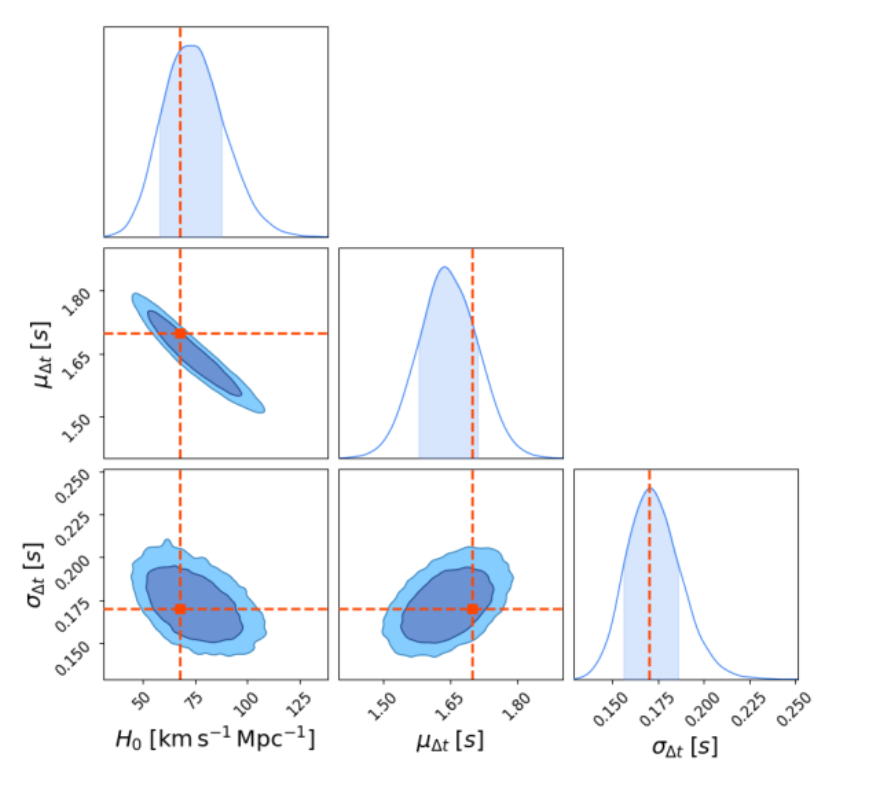
    Leonardo Iampieri presented a new paper where we develop a novel strategy to study cosmic expansion with Gravitational Wave (GW) sources without an identified host galaxy but with an associated electromagnetic (EM) counterpart. We show that the relative time delay between the GW luminosity peak and the arrival of the EM counterpart can be used to measure the cosmic expansion and also fit the distribution of gamma-ray bursts prompt time delays.


    Please, feel free to read our paper and reach out to us for any question or suggestion.

    Figure: Posterior on the Hubble constant and mean and standard deviation of the GW-GRB prompt time delay distribution with 100 binary neutron star events.