Category: Uncategorized

  • Calibrating spectral sirens

    Calibrating spectral sirens

    Measuring the cosmic expansion by calibrating the source mass of binary black holes is one of our main activities. Yet, it is super difficult as we do not know how to model the mass of these black holes.

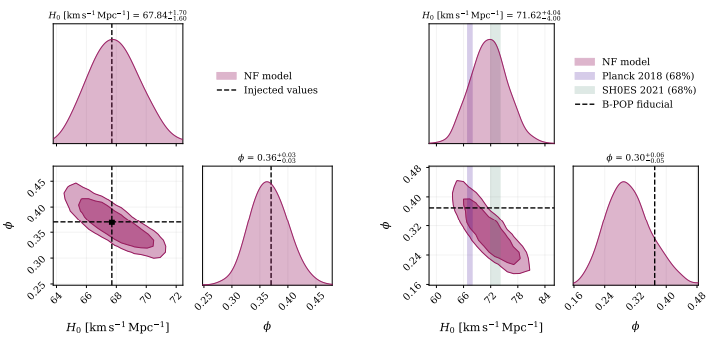
    In her master’s thesis, Arianna Scarpa came up with a method to use simulated catalogues of binary black holes to calibrate gravitational wave cosmology. The basic idea is to train a normalizing flow, a type of machine learning, to mimic the complex distribution of binary black hole sources reported inside the simulated catalogues.

    Arianna also showed that this methodology can be used to infer the relative mixture coefficients between different formation channels, such as black holes formed from isolated binaries and black holes formed from dynamical assembly. Of course, there is still work to be done; mock catalogues of binary black holes also have their uncertainties that should be included.

    Feel free to read our latest paper and check the software release to use normalizing flows for gravitational wave cosmology!

    Figure: Joint posteriors on the Hubble constant and the mixture fraction between two populations of binary black mergers for simulated data and GWTC-4 data.
  • Pushing spectral sirens cosmology to the limit

    Pushing spectral sirens cosmology to the limit

    The Einstein Telescope is an amazing opportunity for gravitational-wave cosmology. The next-generation detector will be able to detect hundreds of binary black holes at distances that are at least 1 order of magnitude better than current detectors. And the question is, would we be able to study cosmology with the current algorithms?

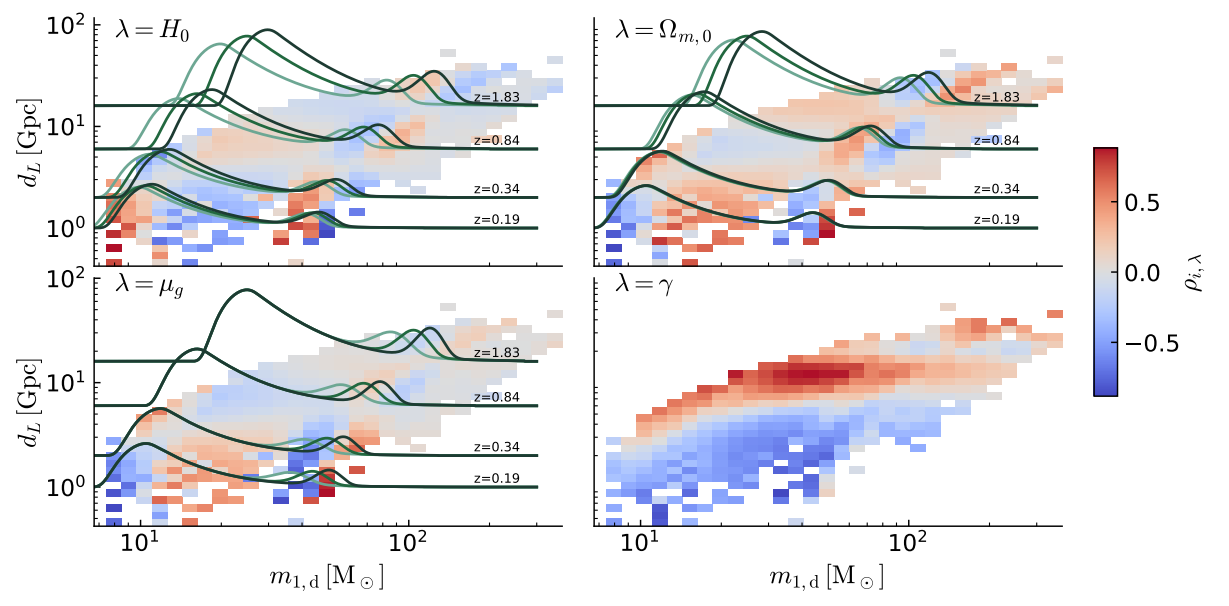
    In a recent publication led by Matteo Tagliazucchi, we undertook an end-to-end mock data challenge with 3 of the pipelines that are currently used for gravitational-wave cosmology. We benchmarked the pipelines and their limitation, and we understood that with the number of detections that the Einstein Telescope might provide in one year, we could be at our limit.

    It has also been fun to understand some other aspects of spectral sirens. In the Figure below, you can see my favourite plot of the paper where we quantify how much certain regions in the binary parameter space correlate with the population parameters. It is very interesting to see that, contrary to what one can expect, a lot of information on the Hubble constant might actually come from very distant gravitational-wave sources!