
Our research activity
Ground-based gravitational-wave detectors are highly complex instruments composed of many subsystems. The Rome group witnessed the birth of the Virgo gravitational-wave detector and has contributed to its construction and commissioning since 1997, across all its successive versions. Over time, this long-term involvement has enabled the group to accumulate extensive expertise and technical skills, establishing it as one of the most important and historically rooted groups within the Virgo Collaboration. The group continues to be deeply involved in several key activities aimed at improving the detector’s sensitivity and duty cycle.
The Payloads of Virgo
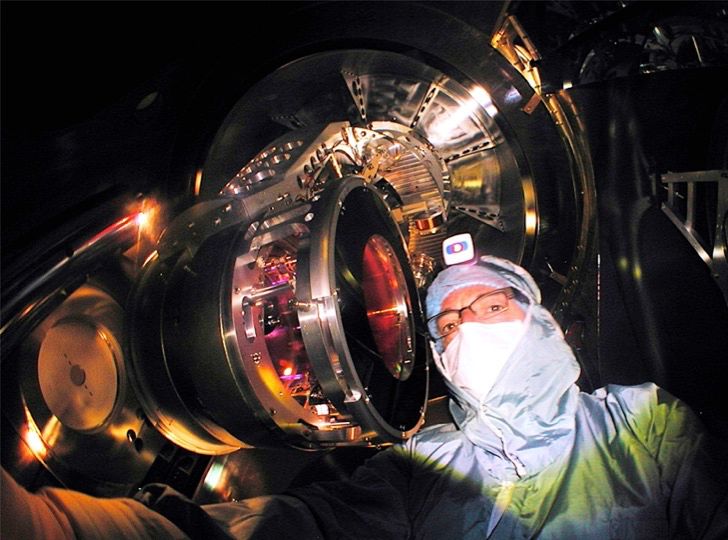
The Virgo suspension system is one of the experiment’s most delicate subsystems. Its primary objective is to isolate the mirrors from seismic noise, ensuring that the test masses remain in a state of near-perfect free fall. Our group is responsible for the development, characterization, and integration of the last suspension stage of the mirrors, known as the experiment’s Payload. In addition the Payload is designed to control the mirror position and orientation, keeping it at the interferometer’s operating point, while also protecting the mirror and minimizing suspension thermal noise. To this end, the mirror is suspended using thin fused-silica fibers.
Quantum Noise Reduction
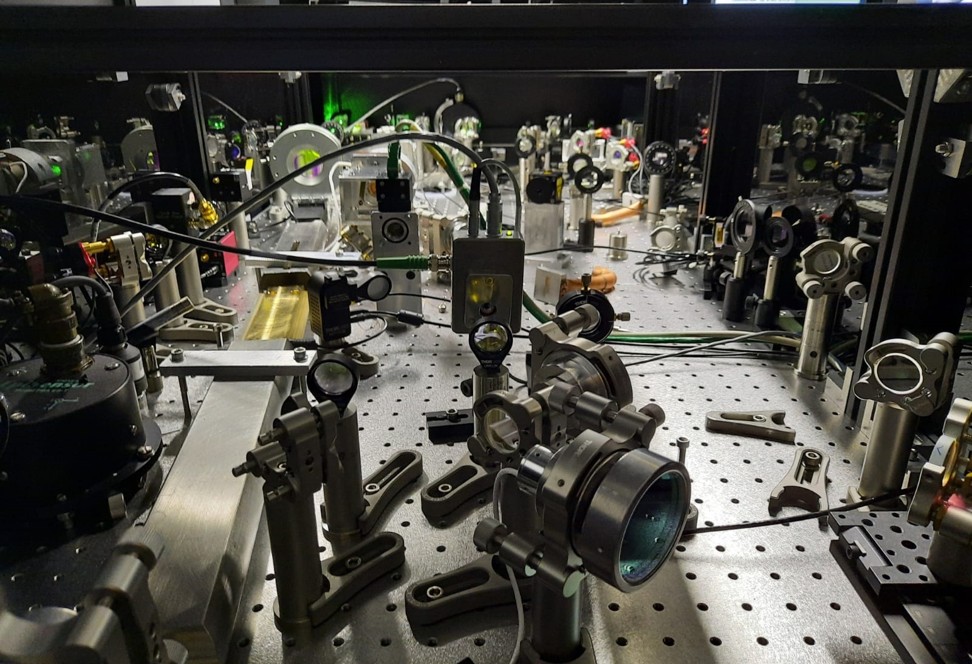
Quantum noise limits the sensitivity of gravitational wave detectors. Broadband quantum noise reduction is achieved via frequency-dependent squeezing (FDS), generated by an Optical Parametric Oscillator coupled to a Filter Cavity. Our group participates in the optical design and installation of the Virgo FDS system, specifically focusing on the development and integration of diagnostic homodyne detectors and low-loss Faraday isolators. Furthermore, we are exploring novel FDS techniques for future Virgo upgrades, such as the one based on Einstein-Podolsky-Rosen quantum entanglement.
Parametric Instabilities
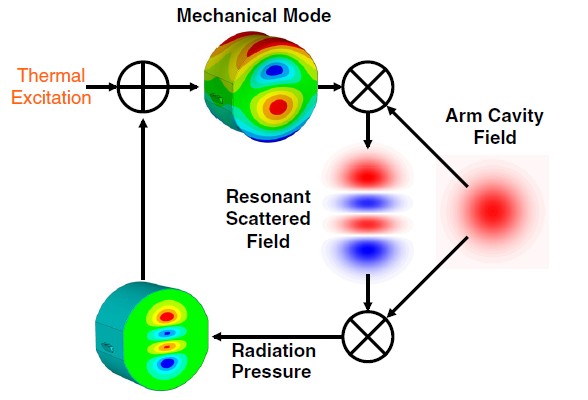
Parametric instabilities are a key opto-mechanical effect in advanced gravitational-wave interferometers operating at high optical power. They arise from the nonlinear interaction between the intense intracavity optical fields, the acoustic modes of the interferometer mirrors, and higher-order transverse optical modes of the resonant cavities. When specific resonance conditions are satisfied, energy can be transferred from the fundamental optical mode to a mechanical mode of the mirror via radiation pressure, leading to an exponential growth of the mechanical oscillation. If not properly controlled, these instabilities can compromise interferometer operation by increasing noise. Here in Rome, we coordinate the activities aimed at predicting and mitigating this effect, which represents a severe limitation on the achievable increase in optical power and can compromise the interferometer duty cycle by driving the system out of its operating point.