BridgeQG@Paris 2025
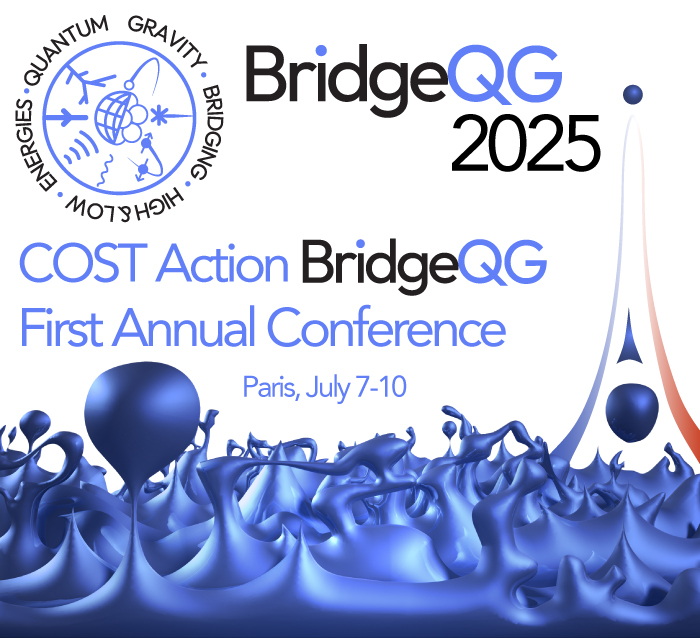
The first annual conference of the COST Action CA23130 will be held in Paris, France from 7 to 10 July 2025. It is fully funded by COST Association through COST Action CA23130.
For more information, please visit: https://indico.in2p3.fr/event/34939/
Quantum Systems in Free Fall
May, 6.-8. 2025, Bremen, Germany, website
There are several open fundamental questions in physics related to the interface of quantum mechanics and gravity. Examples are: How do quantum systems interact with gravity and is gravity quantized or not? How should the weak equivalence principle be formulated for quantum systems?
Different models predict a different behaviour of quantum systems in free fall, and thus the observation of such system can give insights about the structure of spacetime.To test different models and their predictions, experiments are imperative. The corresponding experimental techniques have developed significantly during recent years, in particular, matter wave interferometry in free fall. Bremen with the Drop Tower at ZARM, Hannover with the infrastructure at HiTec and space projects of groups at the Leibniz University Hannover represent a large cluster of experience in this direction.
This workshop will bring together experimentalist from the region and beyond as well as theoreticians working on the interaction of quantum systems and gravity. The goal is to discuss which aspects of the theoretical models can be tested in realistic experiments in free fall and with what technical specifications .
The workshop is organized in collaboration of two European research networks, called COST Actions, whose goal is to search for traces of Quantum Gravity on largest and smallest scales (BridgeQG) and to find a consistent framework of relativistic quantum information theory (RQI). Both topics are closely related to the research of Quantum Frontiers, where quantum sensors are developed which will be able to measure the effect of gravity on quantum systems, and the theoretical foundations are developed to predict the behavior of quantum systems under the influence of gravity from different models which can be tested.
Searching for Quantum Gravity in the Sky
Bad Honnef Physics School /official webpage/
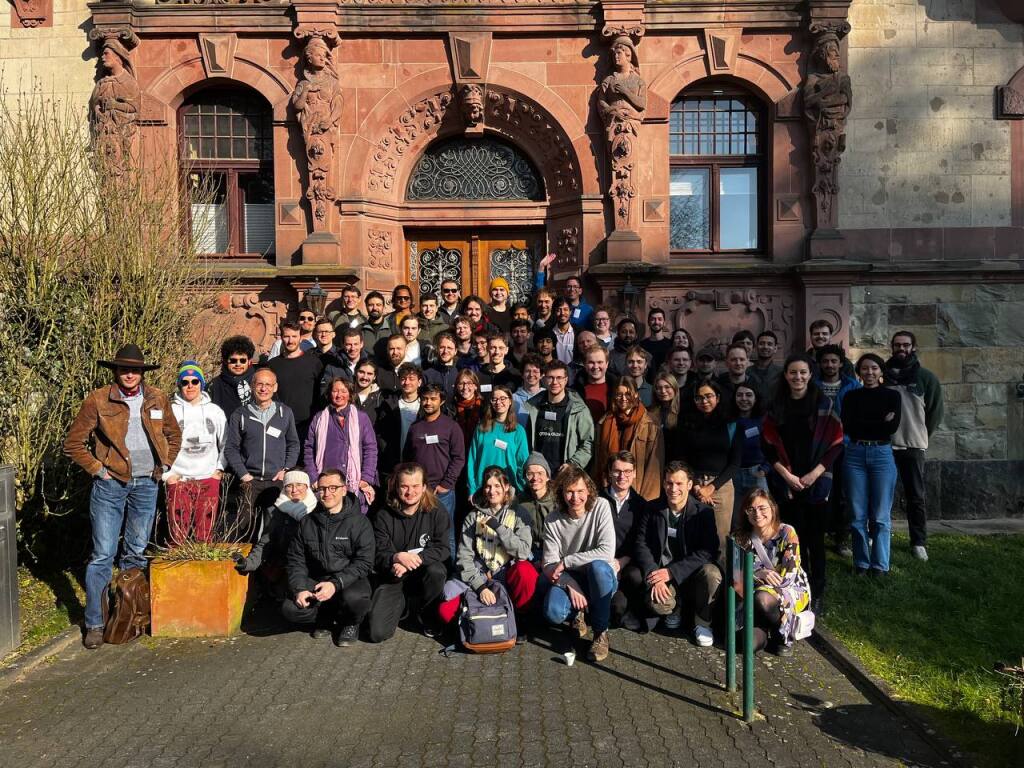
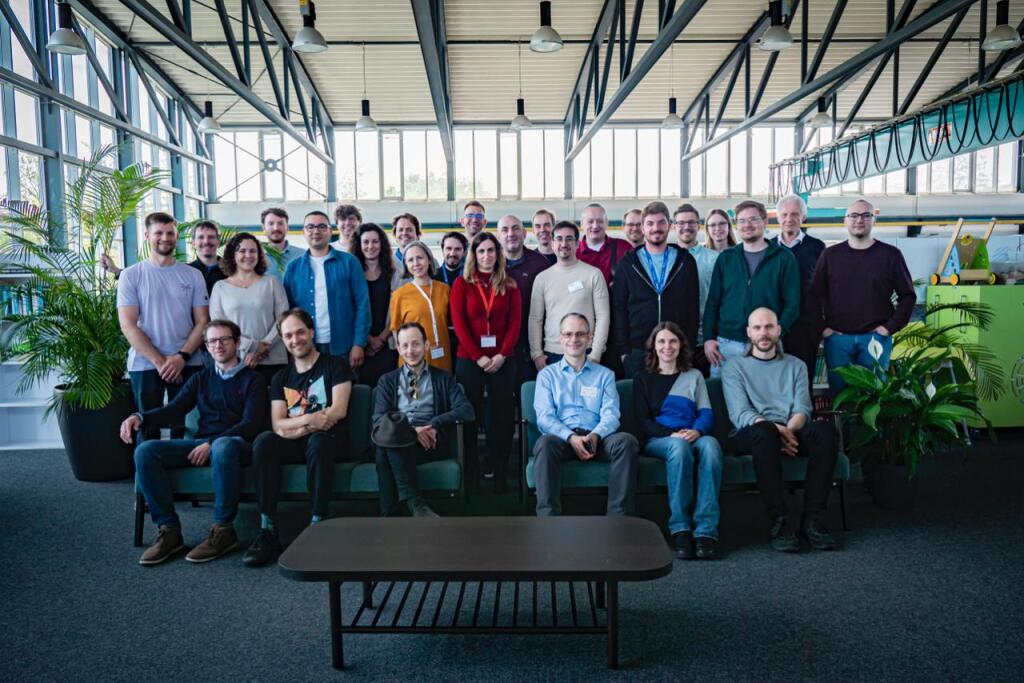
From February 16 – 21, 2025, in Physikzentrum Bad Honnef, Germany, the BridgeQG COST Action supported by the Wilhelm und Else Heraeus-Stiftung foundation, organized the Searching For Quantum Gravity in the Sky winter school. The goal of this physics school was to offer master and Ph.D. students from the field of experimental and theoretical physics as well as mathematics and philosophy, a coherent introduction to the subject of quantum gravity phenomenology from both theoretical and experimental perspectives.
The participants received a training in the language of theoretical phenomenology of quantum gravity and how to predict signatures that can be observed. They learned how observatories collect data and how this data can be used to consistently test theoretical predictions. This education equips the participants with the skills to bridge the gap between theory and experiment in quantum gravity phenomenology research in the future.
These topics were: modified particle propagation through the cosmos and modified relativistic interactions in the cosmos covered in four lectures. These four in-depth main lectures of the school were accompanied by a general overview and an outlook on future perspectives in quantum gravity phenomenology. The school began with an introductory talk on the history and future of quantum gravity phenomenology in general, and concluded with a final outlook lecture on the search for quantum gravity in laboratory experiments.
As an outreasch event, an evening talk was presented by Jackson Levi Said on the topic of the challenges in cosmology, placing research on quantum gravity phenomenology within the context of cosmolgoical tensions.
Lectures & Topics
Kick-Off Lecture:
- Christian Pfeifer (University of Bremen) – Quantum gravity phenomenology: The past, the now and the future
Main Lectures:
- Giacomo Rosati (University of Wrocław) – Theory and observables within deformed relativity
- Jelena Strišković (Josip Juraj Strossmayer University of Osijek) – The search for time delays in GRB and AGN observations
- Rafael Alves Batista (Sorbonne Université, Paris) – Quantum gravity effects on astroparticle propagation: interaction threshold effects
- Caterina Trimarelli (University of Geneva) – Data analysis for anomalous threshold reactions
Evening Lecture:
- Jackson Levi Said (University of Malta) – Reaching the boundaries of general relativity: Tensions in Cosmology
Closing Lecture:
- Flaminia Giacomini (ETH Zürich) – Gravitating quantum systems: a low-energy perspective on quantum effects in gravity
Scientific organizers:
Dr. Christian Pfeifer (ZARM Bremen), Prof. Dr. Giulia Gubitosi (U Napoli), Prof. Dr. Tomislav Terzić (U Rijeka), Prof. Dr. Jose Manuel Carmona (U Zaragoza)