Activities
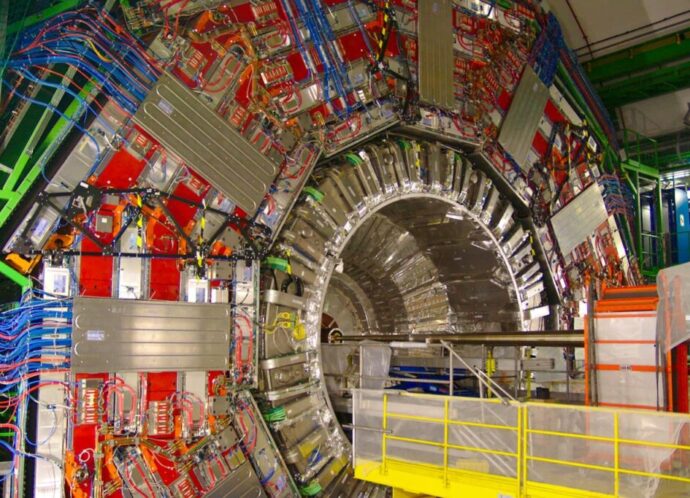
CMS (Compact Muon Solenoid) is a particle physics experiment that studies frontal collisions of protons and operates at the high energy frontier. The experiment is located in an underground cavern about a hundred meters deep in Cessy, in France, not far from the city of Geneva in Switzerland, in one of the four interaction points of the two proton beams accelerated by the Large Hadron Collider (LHC, CERN).
LHC is the most powerful accelerator machine built up to today, it develops along a circular tunnel of 27 km and reaches a maximum energy of 14 TeV in the impact of two protons, allowing a remarkable step forward in the ability to discover new particles and explore possible new particle structures that we now consider elementary. In fact part of the collision energy is transformed into mass, creating new particles. CMS is a large-scale apparatus (15 meters high, like a 5-storey building, for about 14,000 tons of weight) and extremely complex, where the most modern technologies in the field of detectors, electronics, data acquisition systems and computing are applied. CMS has been explicitly designed to discover new phenomena and new particles.

Detector and Hardware R&D
- Drift Tubes (DT)
Muon Chambers - Silicon Tracker
The LHC is now in shut-down for a few years and the group activities are focused on the detector upgrade for High Luminosity LHC running.

Physics Analyses
The Padova group has a wide range of expertise in physics analyses topics. In particular, currently active topics for data analyses concern:
- Flavour Physics
- Higgs Physics
- EWK & Top Physics
- Searches Beyond the Standard Model

Trigger and Software Activities
- L1 Trigger for 40MHz data scouting
- HLT Trigger and Validation
- Track Reconstruction Development

OUTREACH
The group is active in several activities of outreach and communication. Here the link to a few of them:
- HEPSCAPE: a high energy physics escape room experience
- IPPOG: International MasterClass
- Science4All: Open air Science laboratories in Padova
Theses Information
You can consult the UniPd bachelor (triennale) and master (magistrale) thesis website at the link below.
If you are a professor you can add your proposal.
If you are a student you can browse the available thesis.
Thesis Consultation and Reservation
You can consult the past theses via the following site:
INFN Thesis (need INFN Access)