
On August 17, 2017, we detected the first gravitational-wave signal from a binary neutron star merger, GW170817. For the first time in history, this event was also accompanied by an electromagnetic counterpart, marking the beginning of the multi-messenger astronomy era. Since then, only one additional binary neutron star merger has been observed—without an electromagnetic counterpart—suggesting that multi-messenger astronomy is currently experiencing a rather quiet phase. However, in about ten years, next-generation gravitational-wave detectors such as the Einstein Telescope and Cosmic Explorer will revolutionize the field, allowing us to detect tens of thousands of sources each year.
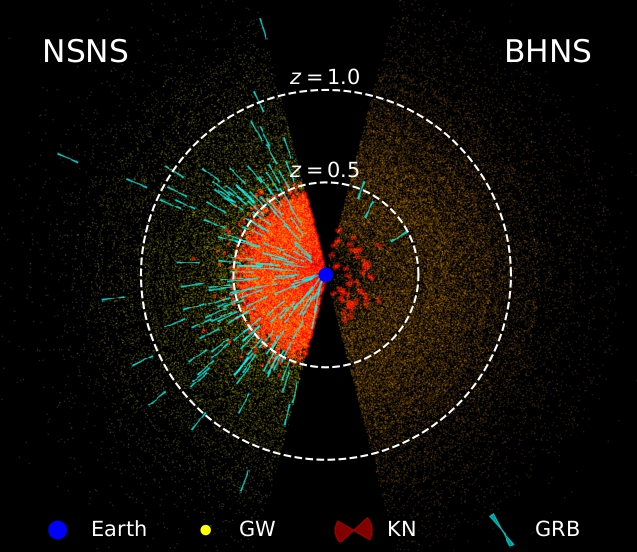
In this work accepted for publication in Astronomy and Astrophysics, Alberto has simulated populations of BNS and BHNS mergers to provide forecasts of what the multi-messenger universe will look like in the ET era. While the present may seem less promising, the future of this field is extraordinarily bright, with the potential to observe dozens of gamma-ray bursts and hundreds of kilonovae.
Figure caption: Geocentric universe in the ET era. Points represent gravitationally detected events after five years of ET observations. Red markers indicate potentially detectable kilonovae, while blue markers indicate gamma-ray bursts. Left: BNS mergers. Right: BHNS mergers (in the most pessimistic scenario).
Leave a Reply