
Directional dark matter experiment
Dark matter is invisible. Its direction does not have to be.
CYGNO images particle tracks in gas and reconstructs their direction, searching for the characteristic recoil pattern expected from Galactic dark matter.
Directional dark matter
A directional signature hidden in rare events.
CYGNO reconstructs faint recoil tracks and looks for a preferred direction across a population of events: the signature expected from the motion of the Solar System through the Galactic dark-matter halo.
The detection problem
Rare events are not enough
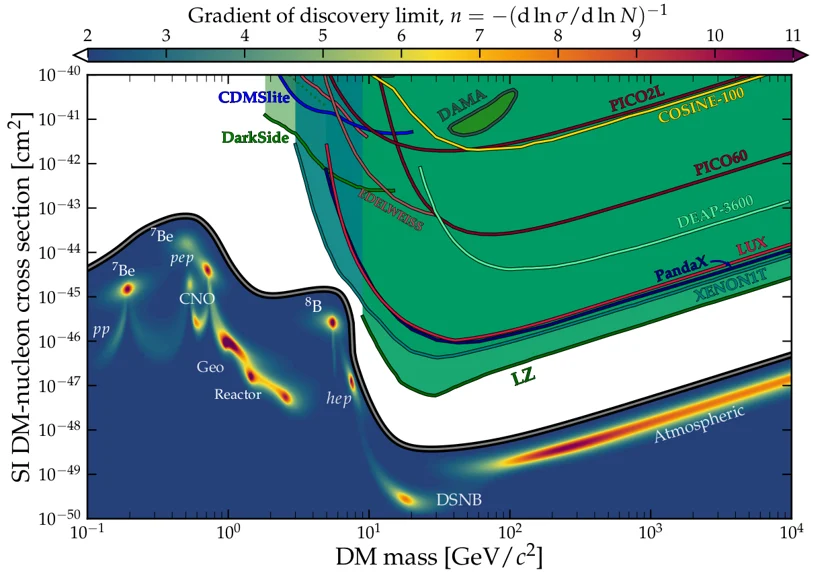
A possible dark-matter interaction would be rare, faint, and difficult to distinguish from radioactive, environmental, and neutrino backgrounds. CYGNO adds a crucial observable: the direction of the recoil track.
Directionality
A Galactic signal should leave a directional pattern
As the Solar System moves through the Milky Way halo, dark-matter interactions should produce a preferred recoil pattern. Most detector backgrounds do not follow the same Galactic direction. The evidence emerges statistically from many reconstructed events, not from one track alone.

How it works
From ionization to a three-dimensional track
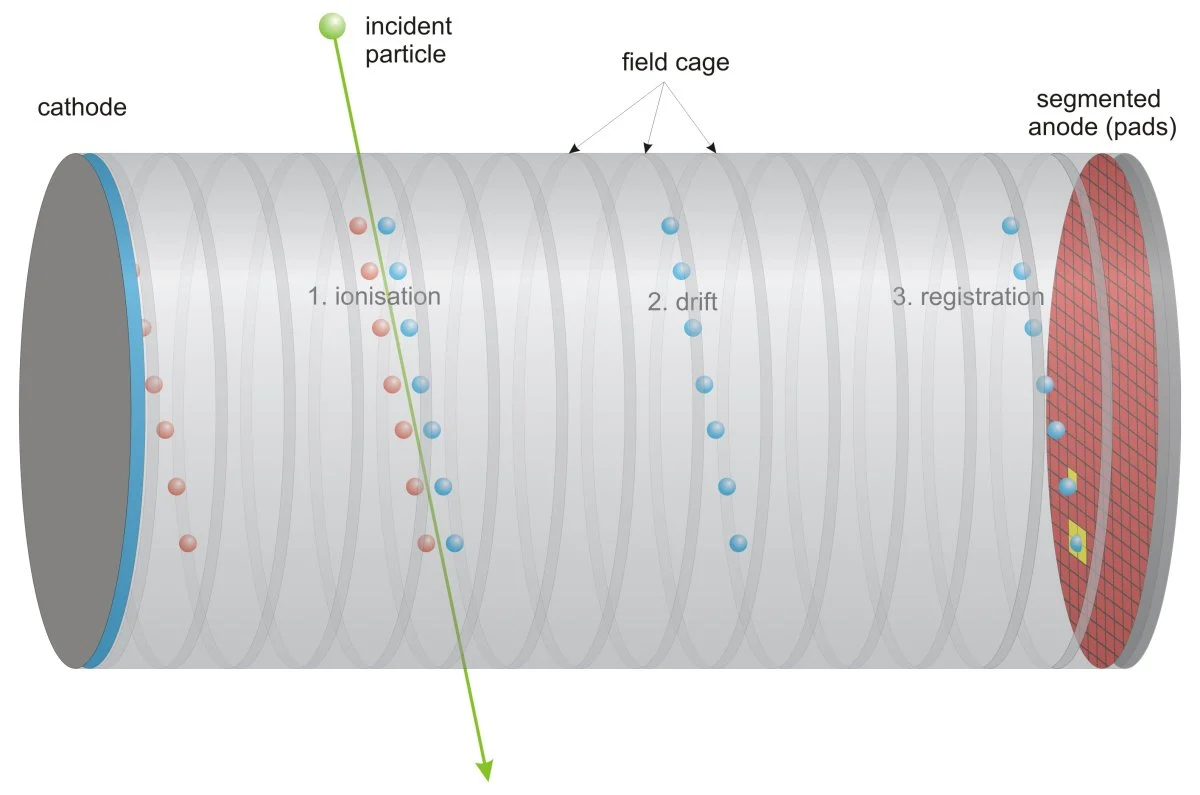
A recoil ionizes the He/CF4 gas. Electrons drift toward triple-GEM structures, where the signal is amplified and converted into light. Six cameras image the track topology, sixteen PMTs measure its time development, and online machine learning identifies interesting events within the large optical data stream.
The main experiment
CYGNO04: the largest directional detector of its kind
CYGNO04 is designed to be the largest and most powerful directional dark-matter detector built to date, while remaining a technology demonstrator. Its purpose is to prove that optical directional detection can operate at unprecedented scale, precision, stability, and exposure.
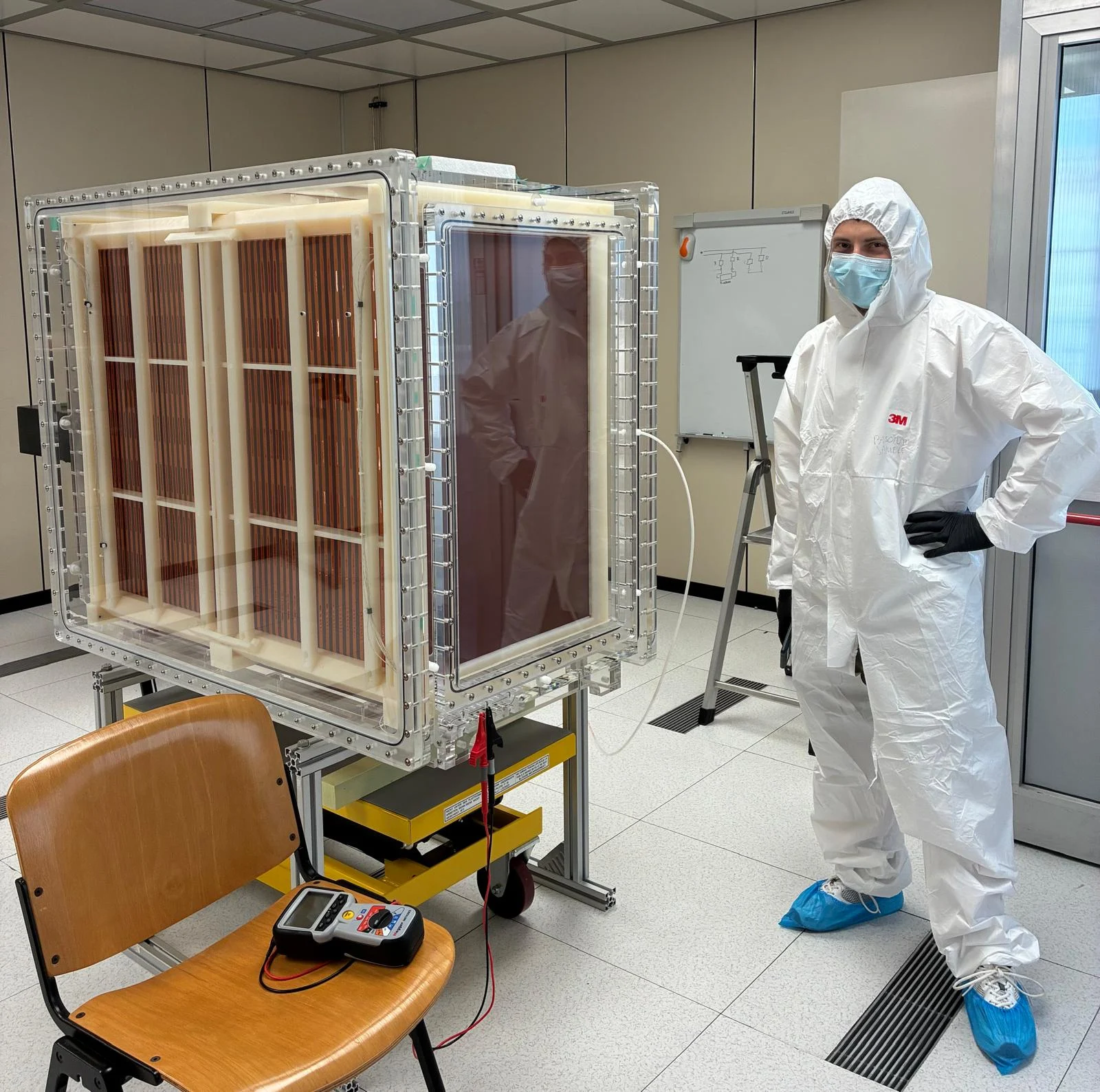
CYGNO04 will establish the technology required for future larger directional detectors and searches in unexplored low-mass dark-matter parameter space.
Thesis opportunities
Build, operate, reconstruct, simulate, analyze, discover
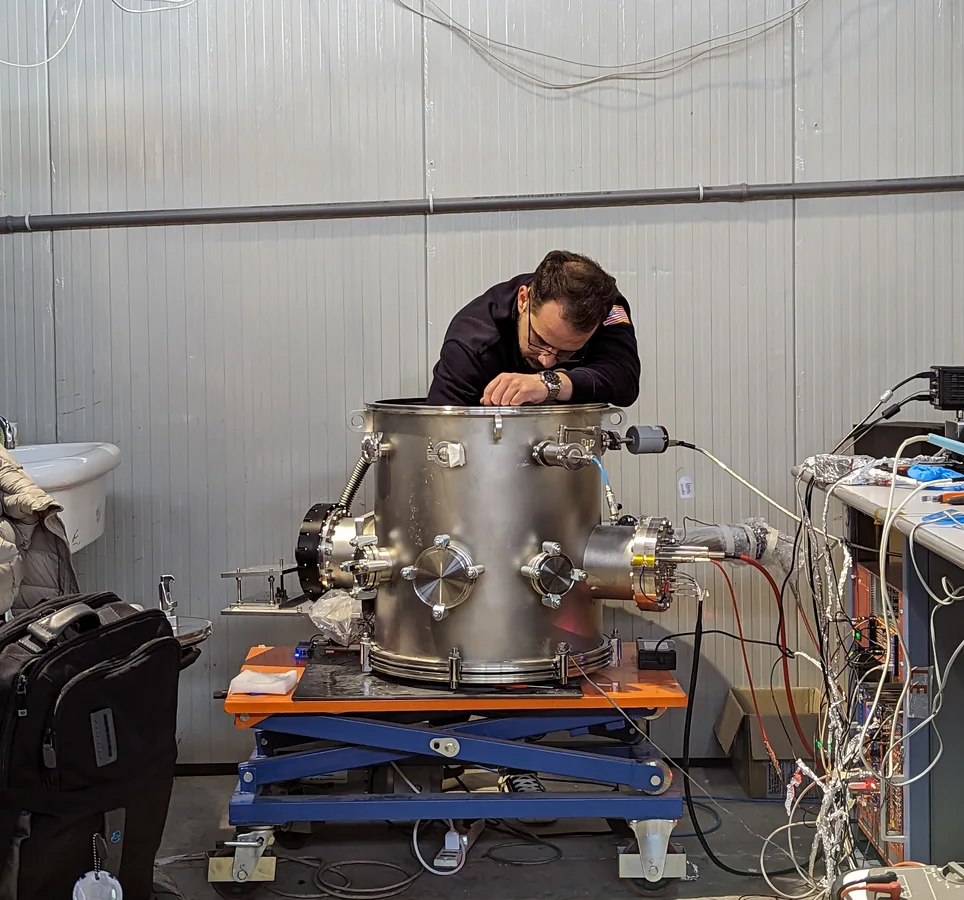
Students can join real detector work now, from commissioning and operations to advanced reconstruction, artificial intelligence, machine-learning analysis, simulations, and physics interpretation.
Who we are
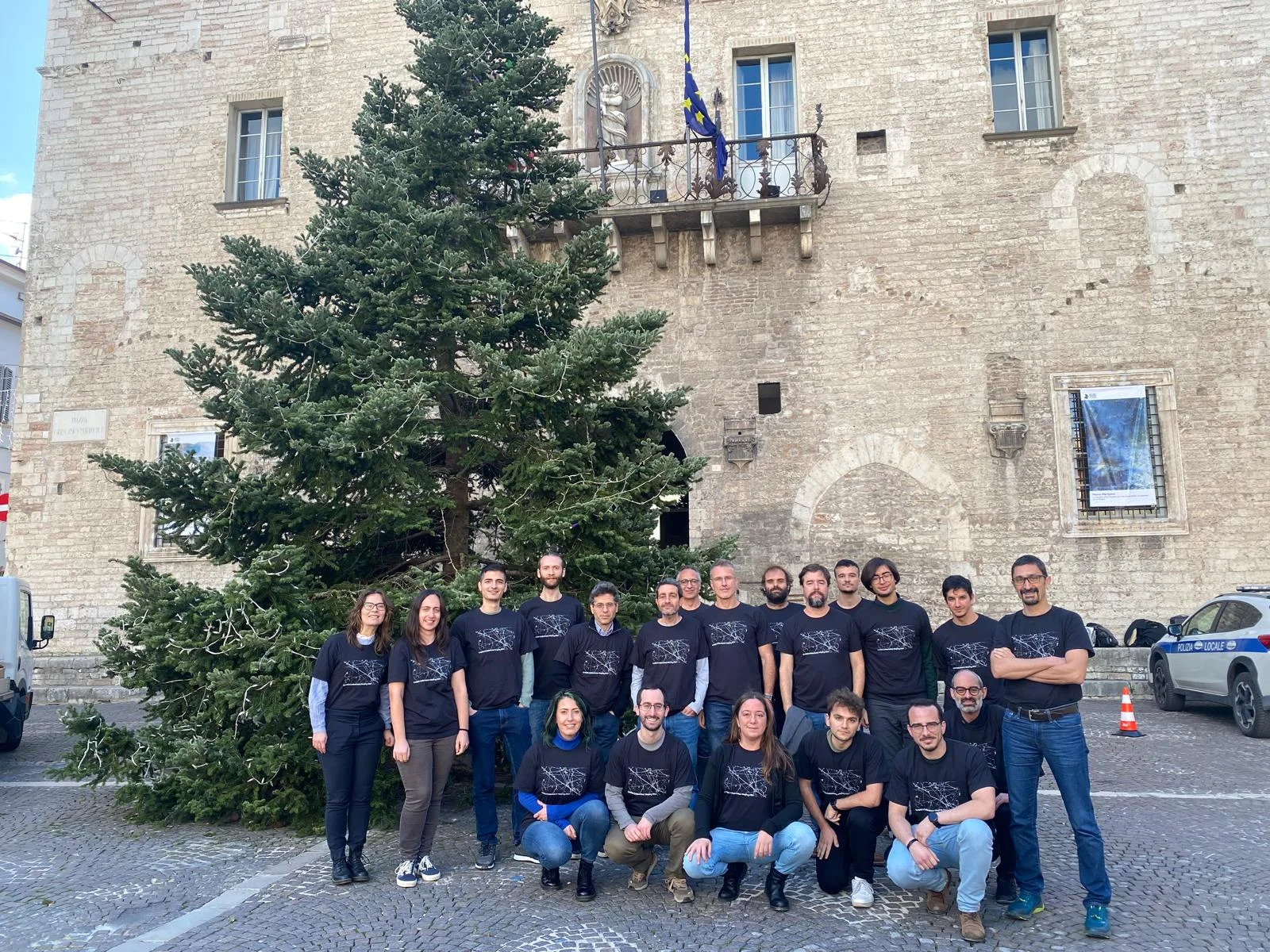
An international collaboration building the next detector
The collaboration brings together detector builders, analysts, simulation experts, software developers, and local teams across institutions in Italy, Portugal, Brazil, and the UK.