
On August 26th, the LIGO-Virgo-KAGRA collaboration released its fourth Gravitational Wave Transient Catalog (GWTC-4), reporting more than two hundred GW signals. This is an impressive number of GW sources, if you consider that the first GW detection was only 10 years ago. And with such and impressive number of sources comes an amazing potential for science.
One of the flagship studies to which myself the GravitySirens group contributed is the measurement of the cosmic expansion with these sources. This herculean effort has been carried on the shoulders of Gregoire Pierra (GravitySirens postdoc) and Ulyana Dupletsa (postdoc in Vienna and a close collaborator of us). Kudos to them for all the patience and enthusiasm shown in these crazy two years.
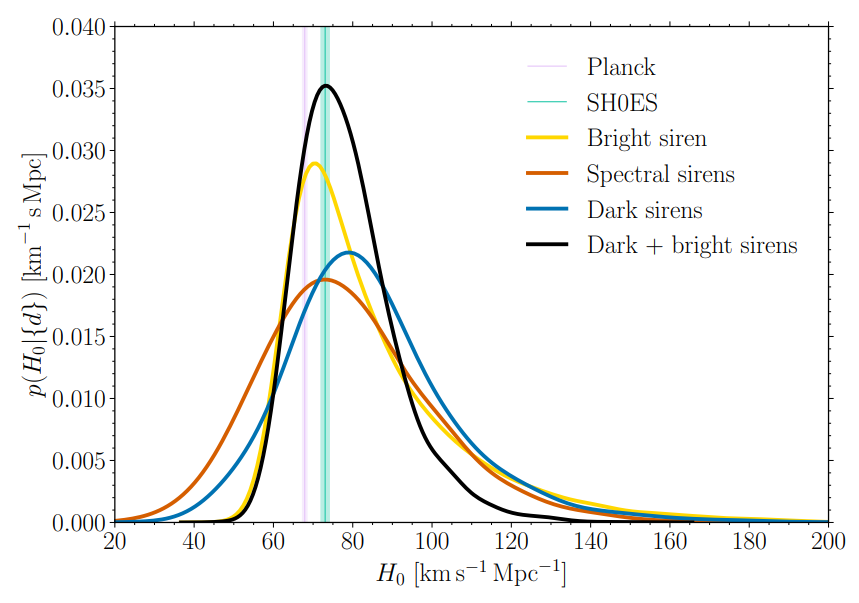
Going to science now, what we can learn from this latest study is that GW sources without an electromagnetic counterpart are almost as precise in measuring the Hubble constant (cosmic expansion today), almost at the level of GW170817, the only GW source with an electromagnetic counterpart. We should start wandering about systematics for these sources. I am feeling like we are finally becoming real observational cosmologists!
The cherry on top of all of this is that we released a new version of icarogw, the code used to make the inference. The new release includes updated mass models for binary black holes and also modified gravity models of cosmology!
Check out the study below
Figure: Marginalized Hubble constant posteriors generated with GWTC-4 using several sources and models. Check the publication for more details.
Leave a Reply