

Physics motivation
A directional search for a Galactic signal.

Most of the matter in the Universe does not emit or absorb light. We infer it from gravity: galaxies rotate too fast, galaxy clusters hold together too strongly, and the large-scale structure of the Universe requires more mass than ordinary atoms can provide.
Direct detection is hard because a dark-matter particle, if it interacts at all, would leave a small and rare signal. Radioactivity, cosmic activation, detector materials, electronics, and environmental effects can also create events in the same energy range.
This is why rare-event counts are not enough on their own. A count can reveal an excess, but it cannot prove that the excess is Galactic rather than local. CYGNO adds another observable: the shape and direction of the recoil track.
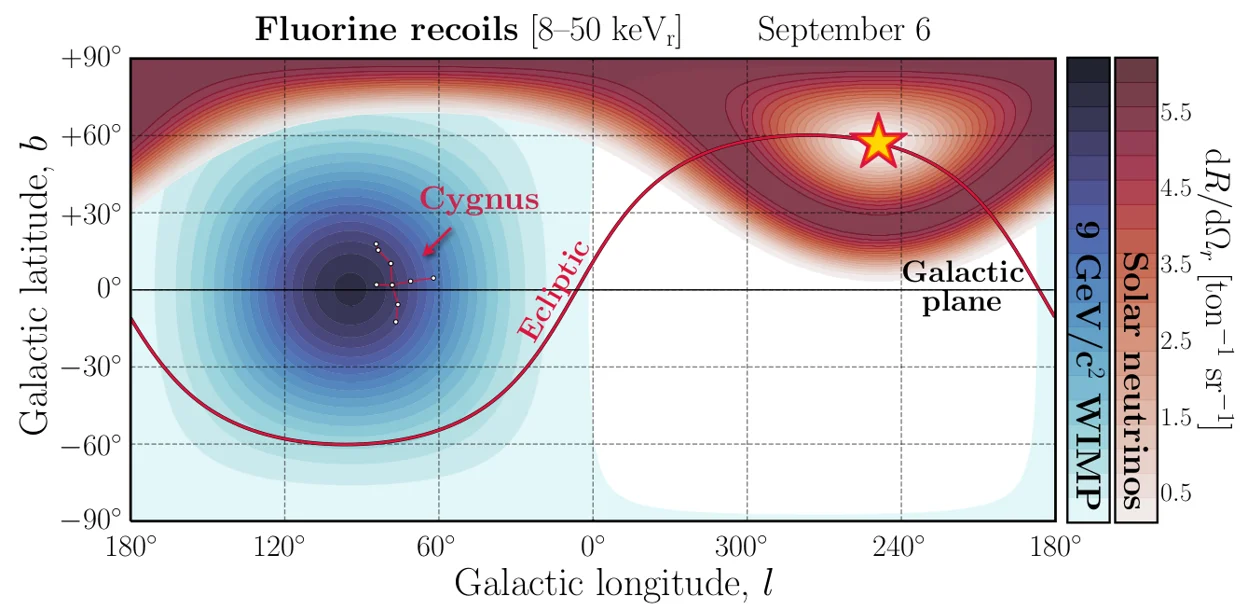
If dark matter forms a halo around the Milky Way, the Solar System moves through that halo as it orbits the Galactic center. In the laboratory this motion should appear as a dark-matter wind, producing nuclear recoils with a preferred direction rather than a purely random orientation.
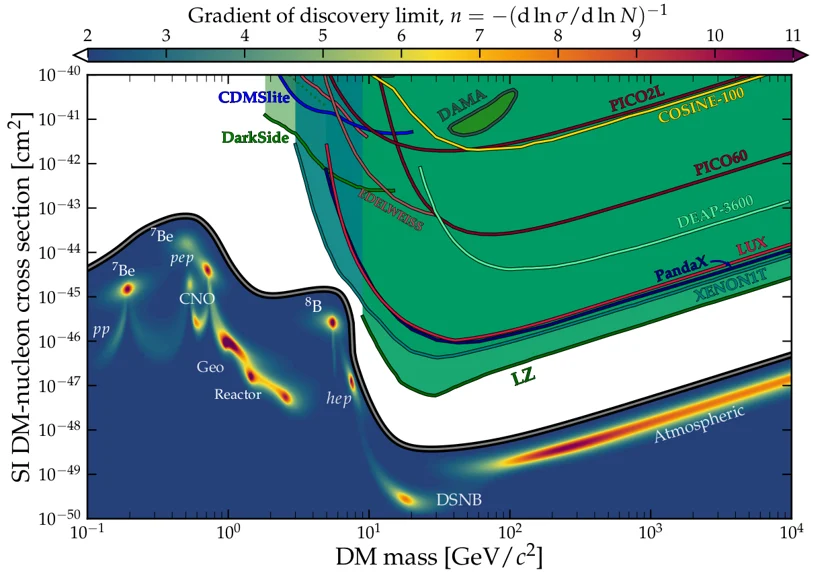
Measuring recoil direction can separate a Galactic pattern from isotropic backgrounds and from backgrounds fixed to the laboratory. Directional information may also help searches keep working in the region affected by the neutrino floor, where neutrino interactions become an irreducible source of events for non-directional detectors.
CYGNO uses low-density gas and optical readout to preserve enough track topology to probe low-mass dark matter. Its large optical-image datasets require advanced reconstruction, artificial intelligence, and machine-learning methods for event selection, background rejection, and detector monitoring. INITIUM explored how negative ions can preserve that topology over longer drift distances.
Why directionality?
A track can carry information that a count alone cannot.
Directionality turns a rare-event search into a question of origin. A dark-matter recoil should remember the motion of the detector through the Galactic halo; many backgrounds should not.
The dark-matter wind
The Solar System moves through the Milky Way halo. In the detector this should create a preferred recoil direction, like a wind seen from a moving laboratory.
Beyond a simple excess
An excess of counts can be ambiguous. A population of tracks aligned with a Galactic direction would carry a more specific signature.
Against local backgrounds
Radioactive and instrumental backgrounds are tied to detector materials, shielding, cavern conditions, or electronics. A Galactic signal should not stay fixed to those sources.
Past the neutrino floor
Neutrinos eventually become an unavoidable background. Directional information can help distinguish dark-matter recoils from neutrino-induced events and keep the search moving into new territory.