

CYGNO04 build phase
CYGNO04 is where directional dark matter gets real.
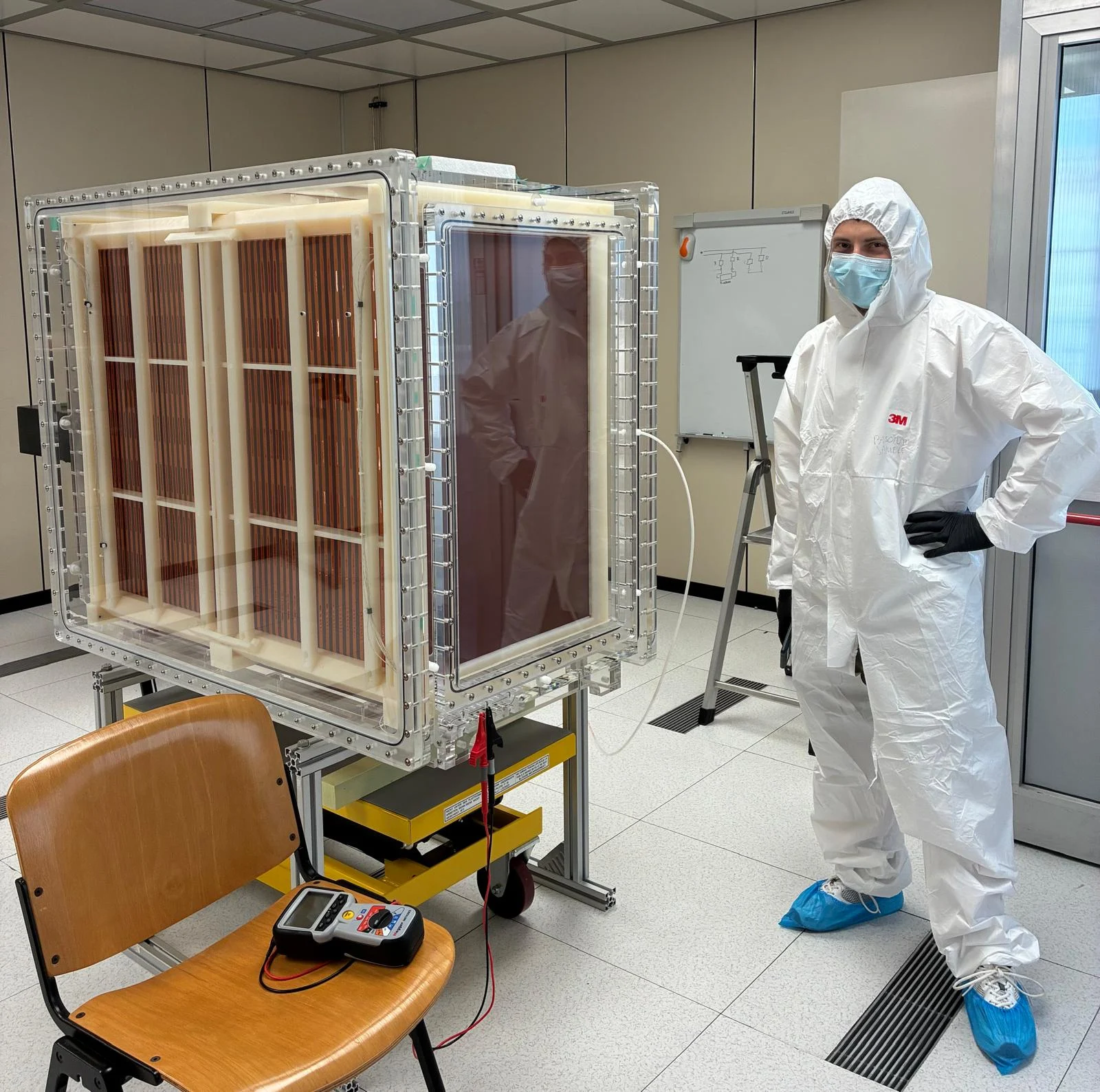
CYGNO04 is a 400 L underground technology demonstrator for directional dark matter. It is designed to turn optical-readout tracking into one of the largest and most precise directional detector systems of its kind, and to prepare the scale-up to CYGNO30.

Optical TPC technology
How CYGNO04 turns light into direction.
A dark-matter candidate event is not treated as a single flash. CYGNO04 records the track image, adds depth information, and reconstructs the event direction.
The detector is also a data-intensive instrument: online machine learning detects tracks and triggers acquisition, while reconstruction and machine-learning analysis classify events and extract physics observables.
01
Ionization track
A particle produces an ionization track in the He/CF4 gas.
02
Drift
Electrons drift up to 50 cm toward the triple-GEM amplification stage.
03
Light production
The GEMs amplify the signal and produce light near the readout plane.
04
Camera image
Six cameras image the track topology with almost 60 million pixels.
05
Online trigger
An online machine-learning algorithm detects tracks and triggers data acquisition.
06
Third coordinate
Sixteen PMTs resolve the time development of the light signal, adding depth to the 2D projection.
07
Classification
Reconstruction and machine learning classify the event and extract its direction.
Detector evolution
From optical-readout prototypes to CYGNO30.
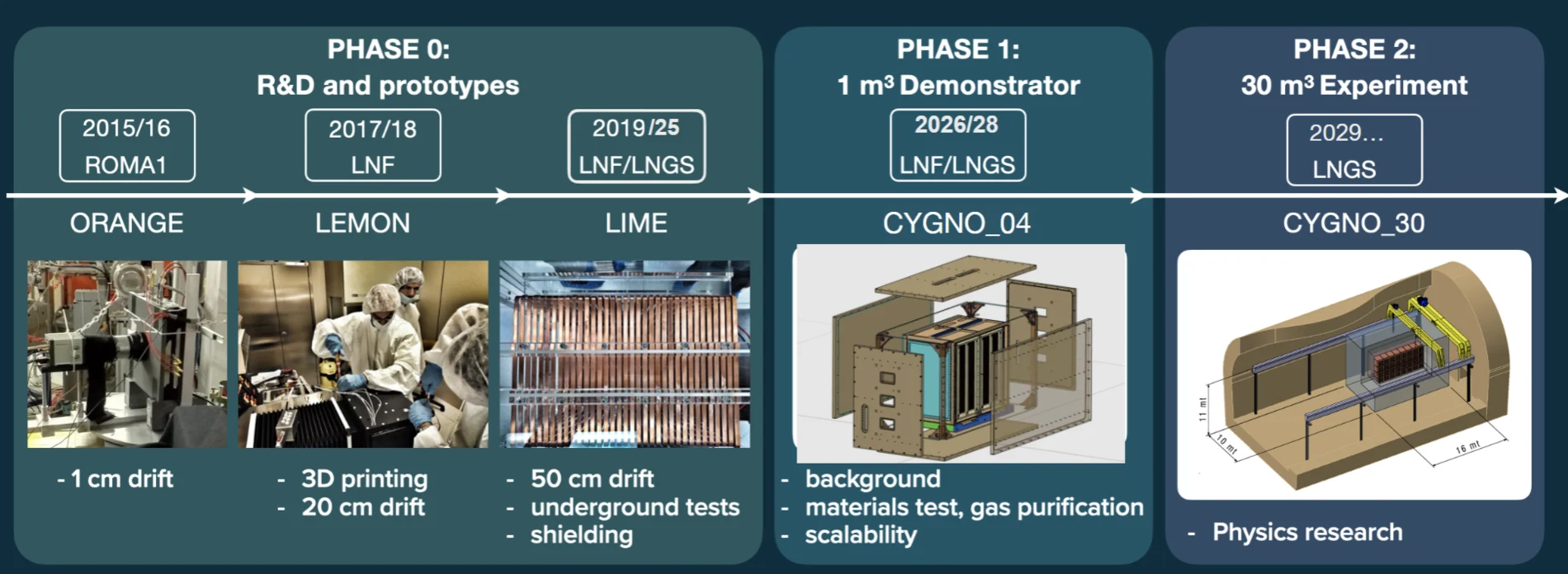
A decade of optical-readout R&D is converging on CYGNO04, the technology demonstrator that bridges prototypes and a future CYGNO30 detector with an approximately 30 m3 target volume.

ORANGE
Early prototype detector for CYGNO technology development.
LEMON
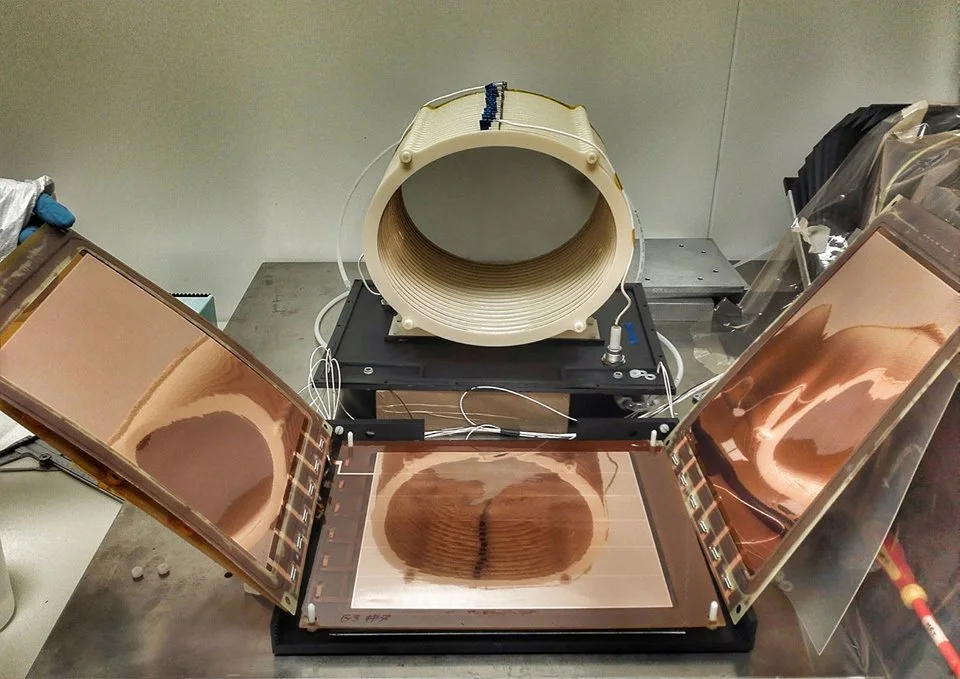
Prototype stage in the detector evolution toward larger optical TPC systems.

LIME
First CYGNO prototype operated underground at LNGS, used to test materials, shielding, and detector operation.
CYGNO04
The current scale-up: a radiopure optical TPC build that turns the prototype chain into a world-leading directional detector.