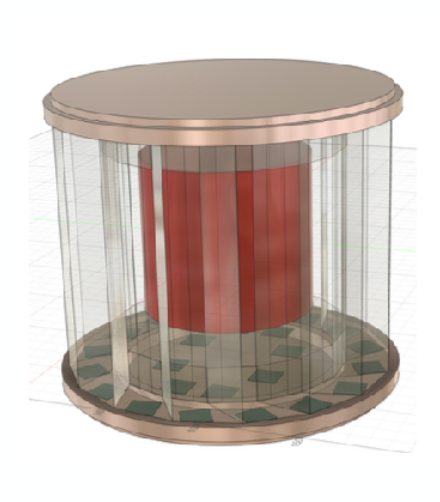
Achieving such low particle background rates is extremely challenging. Reducing the rates by simply passively shielding the active volume of the detectors is not sufficient. In order to further reduce the backgrounds, a cryogenic anti-coincidence detector (veto) needs to be deployed along the BULLKID-DM dectors.
The cryogenic veto system encloses the active volument of the BULLKID-DM experiment with scintillating crystals, i.e. crystals that emit visible radiation upon energy deposition, by, for instance, a particle. The light emitted by these crystals is then read out by an array of Kinetic Inductance Detectors totally alike the ones that constitute the dectors of BULLKID-DM.
While the final decision on the crystals that will be deployed in the BULLKID-DM veto detector is yet to be finalised, two main options have arisen from preliminary studies: Bismuth Germanate (BGO) and Gadolinium Alluminium Gallium Garnet (GAGG). The trade off betweeo the two is still under investigation. BGO exhibits an enhanced light-emission at low temperatures, but GAGG contains Gadolinium which exhibits the highest interaction cross-section with thermal neutrons.
The Kinetic Indutance Detectors of the veto are deposited on a, 0.5 mm thick, 2cm x 2cm Silicon tile. Each crystal of the veto system is read out simultaneously by two identical KIDs.