The interaction of Dark Matter particles with ordinary matter is extremely rare and produces signal of faint intensity. In order to detect such small and rare signals, it is of critical importance to reduce the background signals as much as possible. The rate with which a signal is detected at a certain energy is usually defined in differntial rate units (d.r.u.) which represents the counts per day in each energy bin of 1keV width read out by the detector per each kg of its mass. BULLKID-DM aims to operate at a rate of 10-2 d.r.u.
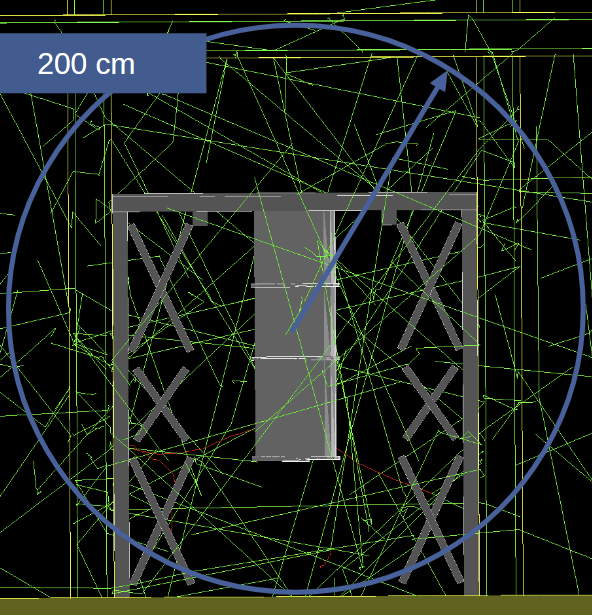
In order to achieve such low backgrounds, the experiment is carried out in the cryogenic lab in the Hall-B of the Gran Sasso National Laboratories, in a gallery carved under over 1km of solid rock. This reduces the rate of cosmic rays by over 100 times. Unfortunately, further background mitigation strategies are necessary. A simulation team is currently working at the optimisation of two shields: a lead one that encompasses the cryostat and a smaller one made of copper, some of which of highest purity, that shields the experiment and that is kept at a temperature of 10 mK. An anti-coincidence cryogenic veto detectors is also being developed in order to further suppress the backgrounds.