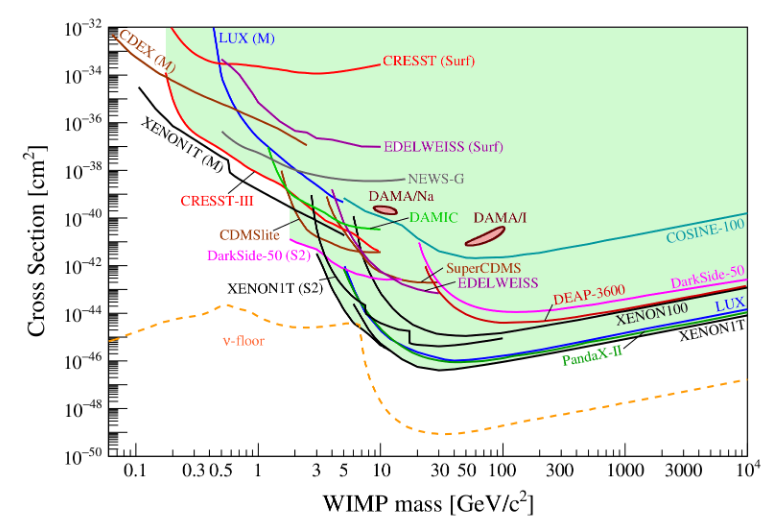
Even in the absence of a clear dark matter signal, experiments provide valuable information by setting exclusion limits. These limits are derived by comparing the observed data with the expected background from known sources. If no excess events are seen, the results can be translated into upper bounds on the likelihood of a WIMP-like dark matter particle of a given mass is to elastically interact with ordinary matter.
Experiments such as XENON, DarkSide, Edelweiss and Super CDMS have been looking for Dark Matter candidates in the mass-range above 3 GeV to a good extent. While there is plenty more room for further investigation, BULLKID-DM aims at the detection of lighter Dark Matter candidates. Light Dark Matter particles are extremely difficult to detect as their interaction only releases a very small amount of energy. In order to maximise the probabily of interaction, BULLKID-DM intends to develop a 1kg detector capable of detecting the signal of Dark Matter particles with masses as low as 1 GeV.