








Microchannel technology, applied to heat dissipation systems, allows both the use of high pressures of refrigerant fluid, improving the convection coefficient, and to obtain very thin channels, increasing the conduction contribution. The ease of construction also allows the creation of various geometries adaptable to the different configurations of the device to be cooled.
How does it work?
In order to cope with the need for increasingly high-performance electronic devices, use is made of high-power integrated circuits, which, while guaranteeing that their functions are performed in a short time, can generate heat fluxes that, if not adequately dissipated, cause damage to them.
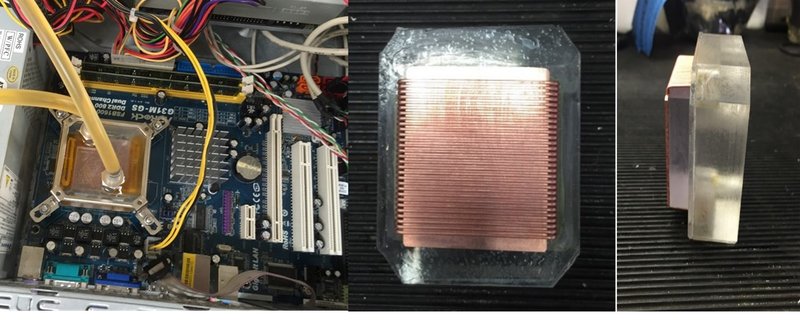
The developed technology concerns a high-efficiency heat exchanger production technique. The final product is provided with a series of microchannels arranged in configurations that can be adapted to the particular condition of use. Manufactured through EDM or milling techniques, the microchannels have sections with a diameter of a few µm, spaced less than 1 mm apart. This configuration gives the device a high cooling capacity. Made in small sizes, it can be placed in contact with or integrated into the devices to be cooled.
Applications
- Computer CPUs;
- X-ray, neutron or radioisotope production;
- Solar and photovoltaic energy;
- Welder and laser cooling systems;
- Electronic devices to be miniaturised;
- Automotive, both for thermal and electric traction.
Advantages
- Better heat conduction;
- High convection coefficient;
- Geometry adaptable to specific use;
- Possibility of creating integrated dissipation systems;
- Robustness of the system;
- Possibility of using different types of material to make the microchannels.
ADDITIONAL DETAILS
PATENT OWNERS
INFN
PRIORITY NUMBER
IT 102014902257227
TECHNOLOGY SECTOR
Energy
TT CODE
P_13.016
CONTACT US
For more information about this technology, WRITE TO US

