








Miniaturized gas proportional counter (mini-TEPC) for microdosimetric characterization of ion beams used in the treatment of tumours (hadrontherapy). The system is equipped with a user-friendly interface and automated calibration routines, so that it can be easily used in the field even by personnel without specific training in medical physics. Microdosimetry measures the random fluctuation of energy storage in a micrometric volume, which is closely related to the biological efficacy of radiation. The reference detectors are tissue-equivalent gas proportional (TEPC) counters, i.e. built with materials with an elemental composition similar to that of biological tissue.
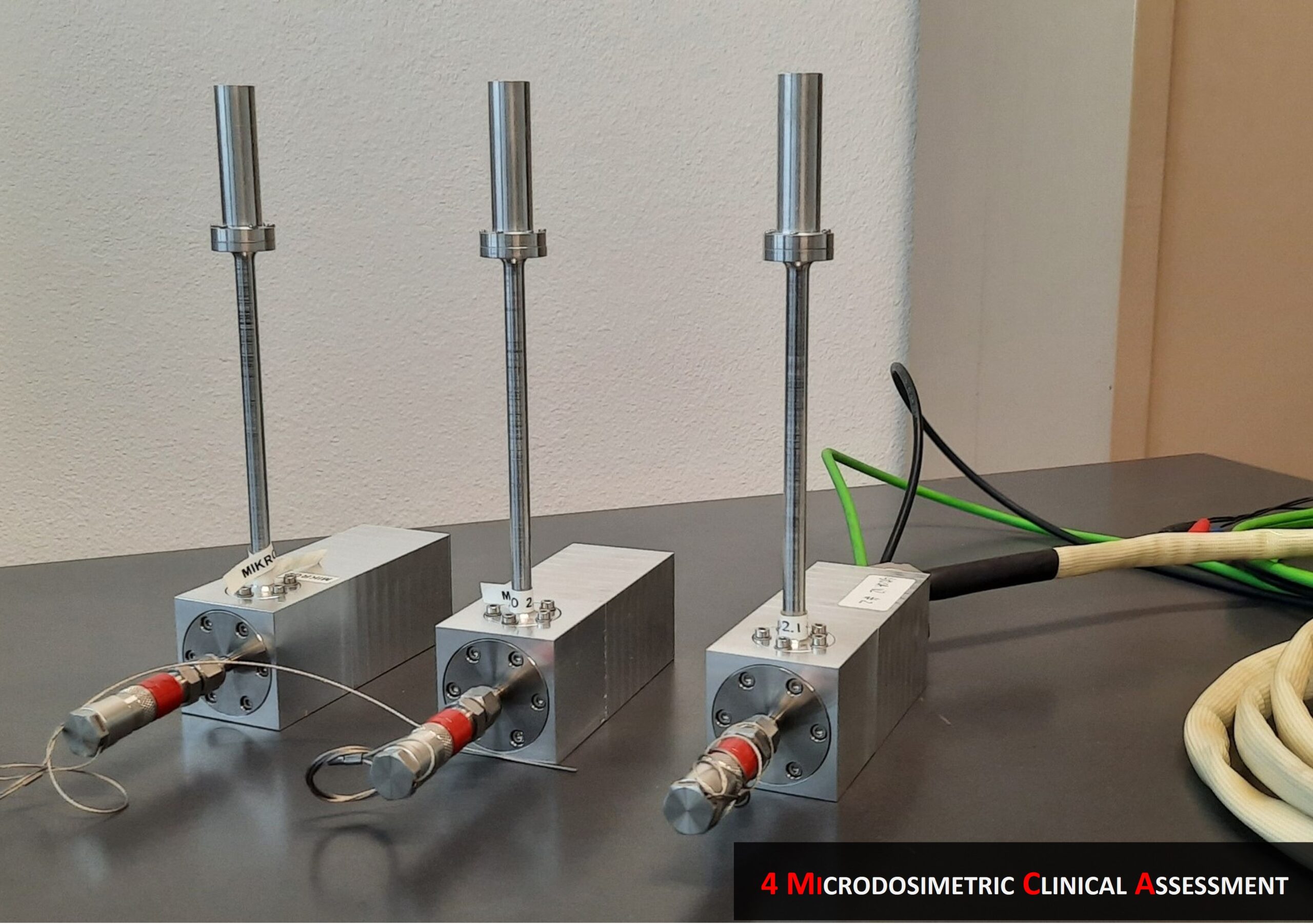
The two main advantages over solid-state detectors are the high sensitivity ensured by the avalanche process and the tissue-equivalence, which minimises disturbance to the radiation field. There is currently only one company that markets TEPCs, but the models produced are not suitable for use in radiotherapy centres, due to their size and/or because they are designed for a research environment and can therefore only be used by personnel with specific training in microdosimetry.
The miniaturized TEPCs (mini-TEPCs) developed by INFN can be used on intense beams; they have diameters such that they can be inserted into a cannula and allow measuring at intensities at least 200 times higher than the models on the market. In addition, they have an integrated low-noise preamplifier with a wide dynamic range (more than 4 orders of magnitude) to measure the entire spectrum of LET of interest in hadrontherapy (0.2 – 2000 keV/µm).
The detector was tested at the “A. Lacassaigne” proton therapy centre in Nice, at the CATANA facility of LNS, and on carbon ion beams at the CNAO in Pavia.
INFO
PROJECT MANAGER
Valeria Conte
ANNO
2021
FACILITIES INVOLVED
TECHNOLOGY SECTORS
Radiobiology
Particle therapy
CONTACTS
For more information about the project, WRITE TO US

