








DeepLook is a Computed Aided Detection (CAD) system, based on Deep Learning algorithms, for the automatic detection and classification of tumour lesions in digital tomosynthesis images. The purpose of DeepLook is to implement a procedure that helps the senologist in localising suspicious lesions.
Breast cancer is the most common form of cancer afflicting the female population and the most effective way to fight it is its early detection.
For this purpose, mammographic screening using digital X-ray mammography for diagnosis in the asymptomatic patient has been introduced. Mammography, however, is not an examination that allows an ideal diagnosis because diagnostic errors are possible due to the overlap of breast tissues in the direction of propagation of the x-ray beam.
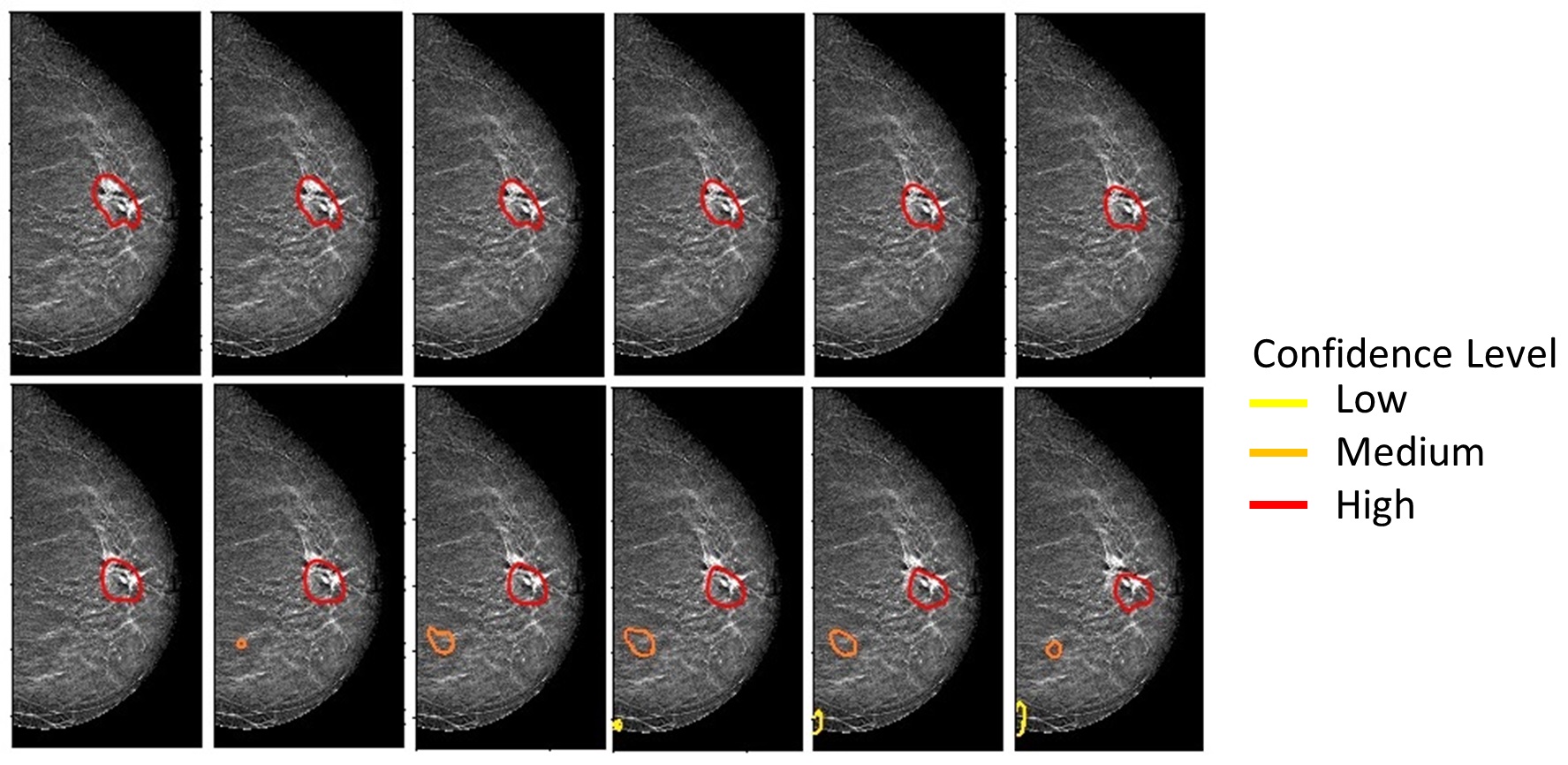
New three-dimensional X-ray imaging techniques, such as digital breast tomosynthesis (DBT), make it possible to overcome the limitation of the overlap of pathological and healthy tissue in the direction of the incident beam, a condition that can hide the visibility of malignant abnormalities or simulate the appearance of a lesion when it is not present. In fact, the DBT examination returns dozens of images of slices of breast tissue in planes orthogonal to the direction of the X-ray beam, with a separation between the slices of the order of 1 mm, thus allowing a more accurate localisation of any lesions.
Although the use of the DBT diagnostic technique in the clinical setting has shown very promising results in the field of mammography screening, the increase in the number of images to be viewed and reported by the radiologist may represent a limitation to its application: it has been shown that the time taken to report DBT images is approximately twice as long as the time taken to report conventional mammography. For this reason, and due to the intrinsic complexity of the tomographic diagnosis, the intra- and inter-observer variability is greater for a DBT examination than for mammography. Automatic methods for the interpretation of DBT images, through artificial intelligence algorithms that allow to recognize the presence and localization of a lesion, can have a significant impact in terms of significantly reducing the radiologist’s reading time, who will be able to make use of this diagnostic aid of automatic second reading of the examination, and improving the diagnosis, also reducing the variability between studies performed at different sites or by different radiologists.
INFO
PROJECT MANAGER
Giovanni Mettivier
YEAR
2022
FACILITIES INVOLVED
Naples Section
TECHNOLOGY SECTORS
Diagnostic imaging
RELATED TECHNOLOGIES
CONTACTS
For more information about the project, WRITE TO US

