








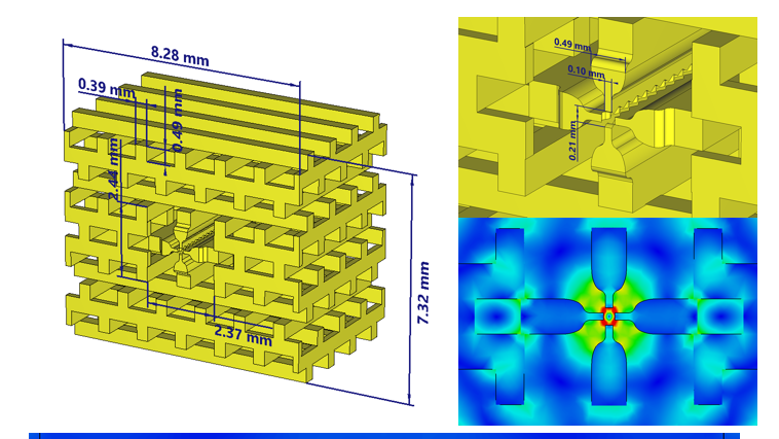
The invention consists of proposing a method for accelerating subatomic particles (protons and light ions) based on photonic crystal guides integrated on chips capable of guiding optical radiation inside them. These structures are made of dielectric materials that are perturbed to give rise to the axial field component capable of accelerating and bunching charged particles.
How does it work?
The invention concerns a dielectric structure for the confinement of a TE210 (TE210-like) electromagnetic field that is perturbed to give rise to an axial field component capable of accelerating and bunching charged particles. The devised dielectric structure gives the possibility of using dielectric accelerators operating at optical wavelengths for particle acceleration at sub-relativistic speeds, allowing for bunching and the first part of low-energy acceleration to take place between the integrated proton/hadron source and the subsequent high-energy accelerating sections. Such a structure allows for greater miniaturisation and compactness without compromising the efficiency of the device. In fact, among the advantages of this technology, the micro-bunching process takes place at a higher efficiency and the longitudinal field gradients are much wider than with conventional devices.
Applications
- Medical field;
- Safety;
- Industrial field;
- Energy (Thermonuclear Fusion).
Advantages
- Possible longitudinal field gradients much higher than metallic RFQs;
- Compactness/miniaturisation by 4 orders of magnitude;
- Economies of scale in production;
- Greater efficiencies in the micro-bunching process, and greater compatibility with subsequent p-DLA sections.
ADDITIONAL DETAILS
PATENT OWNERS
INFN and POLIMI
PRIORITY NUMBER
IT 102021000021158
TECHNOLOGY SECTOR
Chemistry and new materials
TT CODE
P_21.059
CONTACT US
For more information about this technology, WRITE TO US

