








The proposed technology aims to use PBF-LB metal powder bed additive manufacturing technology to create objects composed of multiple materials by exploiting the growth direction of the components, layer by layer, while overcoming the technical problems essentially related to: i) contamination of metal powders from different materials, ii) poor geometric resolution, and iii) post-operations that are actually applicable to the objects produced.
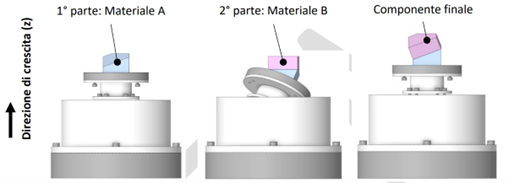
How does it work?
The technical core of the technology is the possibility of breaking free from the different types of powder deposition systems on the construction platform and focusing on the possibility of spatial orientation of the latter, exploiting the simple direction of growth. This approach allows the possibility of combining PBF-LB technology with traditional production methods, thus combining parts produced with subtractive methods with parts produced with additive methods.
The technology therefore focuses on the creation of a construction platform that can be rotated in space around three main directions, in order to make the surfaces of the components on which the transition between two different materials is to be made flat and perpendicular to the direction of growth.
Applications
The proposed solution can be integrated into existing PBF-LB systems, as a possible upgrade to be sold to the machine owner, or directly integrated into newly manufactured and/or designed systems.
Advantages
- Simplicity of implementation;
- No contamination between metal powders of different materials;
- High geometric resolution of multi-material components, which is not reduced and/or altered by the simultaneous distribution of multiple metal powders with different characteristics (e.g., particle size, flowability) on the build platform;
- Possibility of applying all necessary post-operations on multi-material components produced (e.g., heat treatments, intermediate and final mechanical finishing processes);
- Possibility of integrating components produced using traditional subtractive technologies (e.g., turning, milling, etc.) with additive technologies (e.g., hybrid manufacturing);
- Possibility of reducing the presence of supports during the production of components with “over angle.”
ADDITIONAL DETAILS
PATENT OWNERS
INFN
PRIORITY NUMBER
IT 102025000030064
TECHNOLOGY SECTOR
Additive Manufacturing
TT CODE
P_25.095
CONTACT US
For more information about this technology, WRITE TO US

