








Correlation Plenoptic Microscopy (CPM). Plenoptic imaging devices allow for acquiring an image of a scene while simultaneously determining the direction of light propagation; this results in the ability to refocus, post-acquisition, parts of the scene that were initially out of focus and to reconstruct the 3D image of the scene itself. Of particular interest is their use in microscopy for biological applications, where plenoptic microscopy has enabled three-dimensional, real-time (>10 images/sec) analysis of neuronal activity in invertebrates and fish larvae.
Despite growing use in fields such as industrial inspection, plant monitoring, and space imaging, state-of-the-art plenoptic devices are inherently limited by a strong trade-off: the loss of image resolution is proportional to the gain in resolution for measuring light direction. The effective use of current devices is therefore severely limited, especially in contexts where microscopic resolutions and/or 3D reconstructions are required.
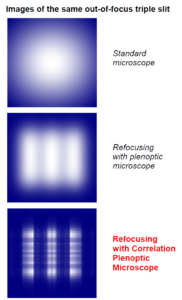
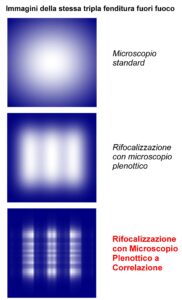
Indeed, the trade-off inherent in conventional plenoptic imaging devices stems from using a single sensor for acquiring both the scene image and the light propagation direction, through light intensity measurement. The proposed technology, called Correlation Plenoptic Microscopy (CPM), is based on a completely different operating principle: the measurement of quantum, spatio-temporal correlations intrinsic to light. This measurement is performed using two separate sensors: one dedicated to acquiring the scene image, one to acquiring directional information. This gives CPM the ability to overcome the limitation inherent in conventional plenoptic imaging devices, and to achieve an unprecedented compromise between image resolution and depth of field.
INFO
PROJECT MANAGER
Milena D’Angelo
FACILITIES INVOLVED
TECHNOLOGY SECTORS
Optics
RELATED TECHNOLOGIES
P_18.003
CONTACTS
For more information about the project, WRITE TO US

