








Method for making an accelerating cavity of the superconductive or normal-conductive type of particles, comprising: a wire printing step followed by a finishing step on the inner surface of said cavity.
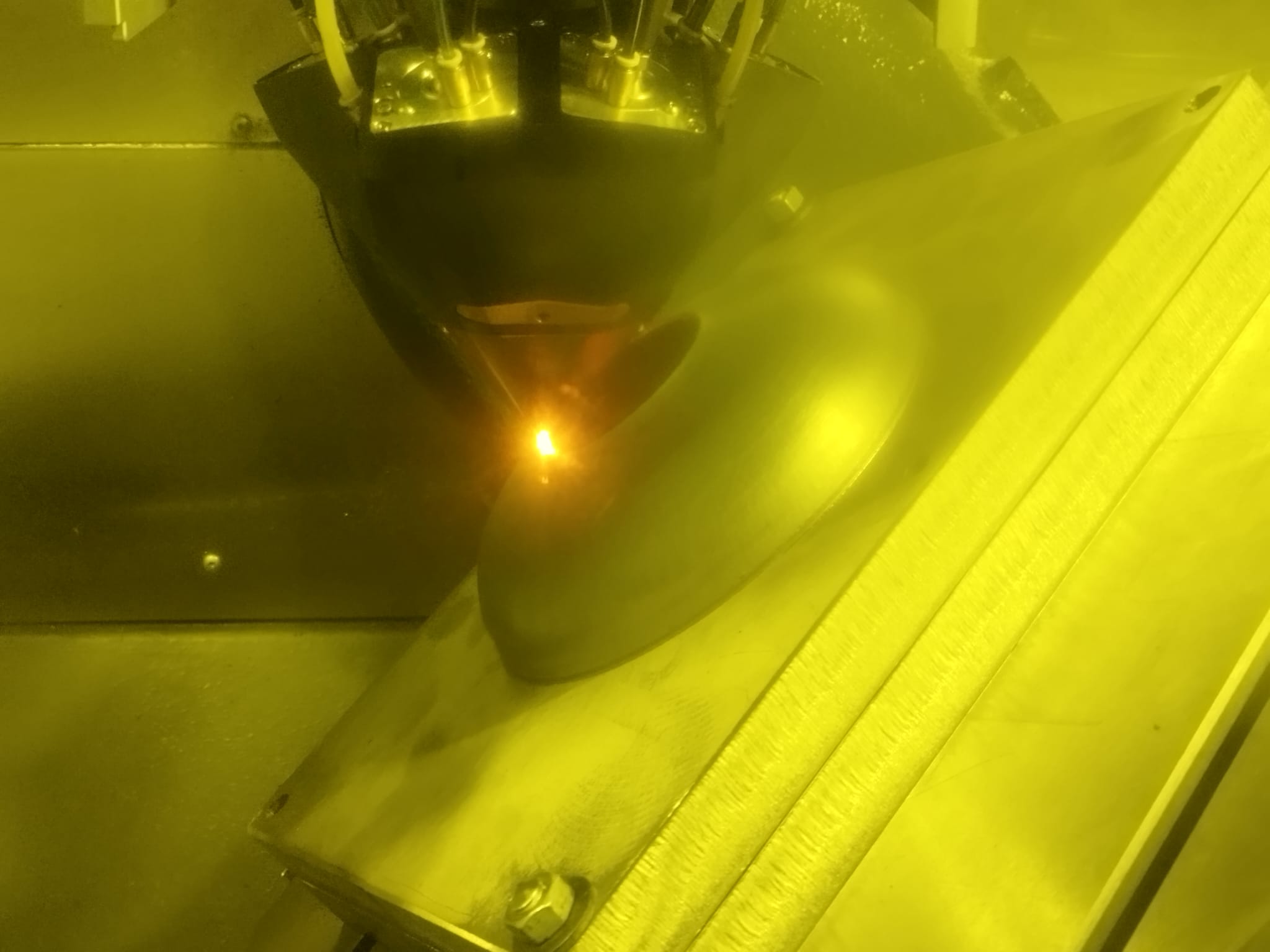
How does it work?
The proposed invention aims to solve a critical problem in the production of superconductive accelerating cavities for particle accelerators. The currently approved technology for the production of these cavities involves welding the half-cells by plate turning and the electron beam welding in vacuo. However, welding creates surface discontinuities, which in the presence of high accelerating fields can generate the emission of secondary electrons. These electrons cause localized heating on the surface and, in cascade, lead to the loss of superconductive performance, a phenomenon that compromises the effectiveness of the cavities.
To overcome these problems, the invention proposes an innovative technique for producing accelerating cavities without using welds, using wire printing combined with a robotic mechanical arm. The mechanical arm is essential for finishing and accurately machining the inner and outer surfaces of the cavity, further reducing the possibility of defects. This new methodology allows the creation of single-material or multi-material accelerating cavities, taking advantage of wire printing to create the component. The process also allows the internal and external finishing of the cavity by material removal machining during the construction phase. This approach can be carried out both in inertised environments at atmospheric pressure and under vacuum conditions.
Applications
- Fisica delle particelle;
- Production of nuclear fusion devices;
- Medical applications such as MRI.
Advantages
- Elimination of welds;
- Improved surface finish;
- Possibility of creating larger cavities;
- Multi-material;
- Production in vacuo;
- Replacement of the traditional technique.
ADDITIONAL DETAILS
PATENT OWNERS
INFN
PRIORITY NUMBER
IT 102024000017647
TECHNOLOGY SECTOR
Accelerators
TT CODE
P_24.004
CONTACT US
For more information about this technology, WRITE TO US

