








The project aims to evolve the method of reading radiochromic films in real time, to optimize it in terms of dosimetry in the medical field (radio- and hadrontherapy, environmental and personal dosimetry) and of dose monitoring in radiation hardness tests on components and materials. Radiochromic films are self-developing films that change colour when exposed to ionizing radiation. The use of these films in dosimetry is traditionally based on a reading before and after exposure to ionizing radiation using commercial scanners that determine the level of blackening of the film. The manufacturer provides a radiation dose-dimming level calibration curve with which a quantitative measurement can be made.
However, this method does not allow to know the curve of the radiation dose accumulated over time, but only the integral of the dose accumulated by the film at the end of the exposure. In practice, if the film is exposed for one day to radiation and then it is found saturated, one will not know how long it took to reach saturation dose, only that it took less time than the interval between the two readings. In addition, a sufficient film surface must be exposed for reading by scanner (usually at least 1 cm2) and access to the site must be possible before and after irradiation.
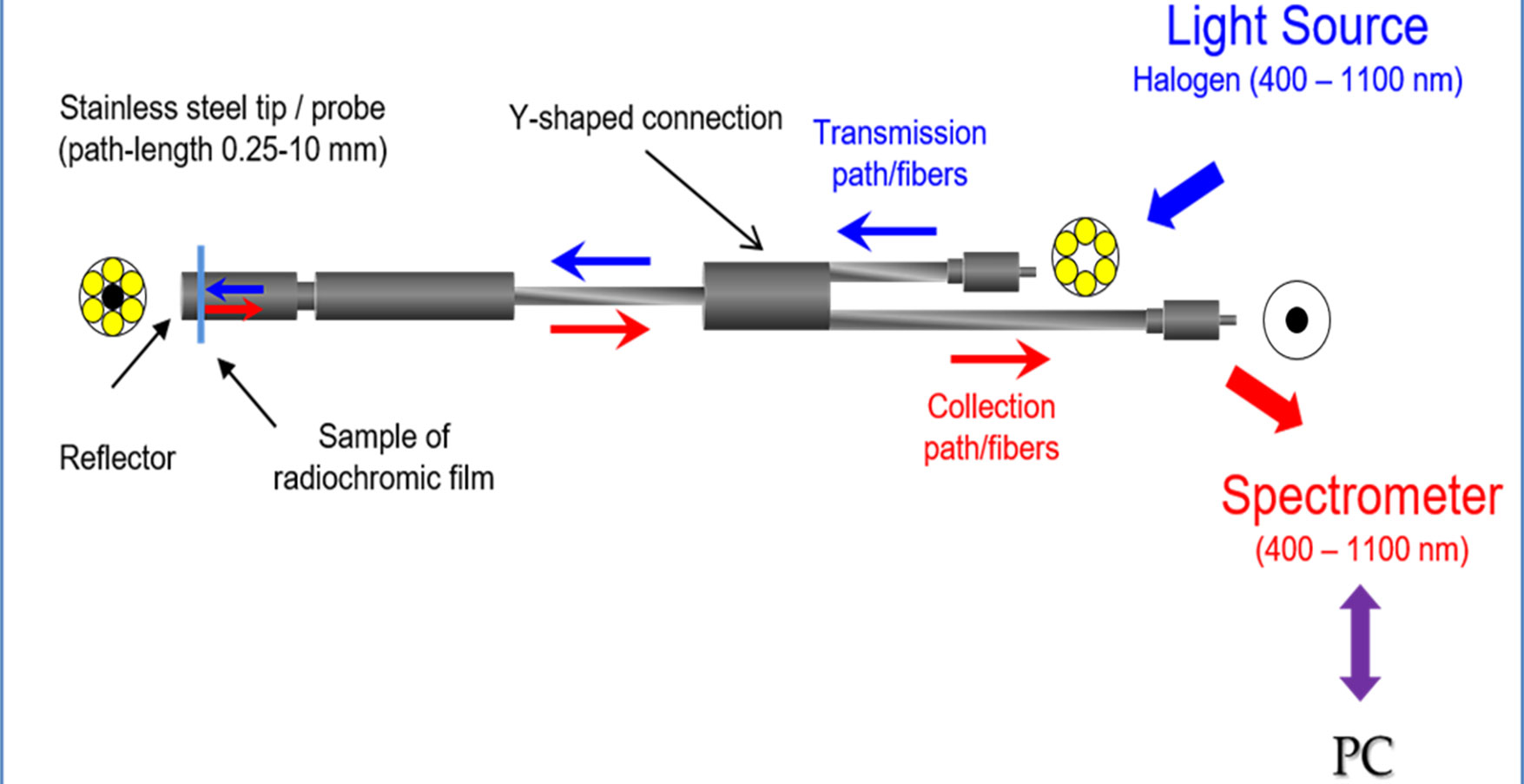
The project aims to overcome the limitations of traditional reading and proposes a fibre-optic system that allows the determination of the characteristics by reading in real time and from a remote station. The invention consists of illuminating the radiochromic film during exposure to ionizing radiation, and reading the change in colour of the film due to the dose of radiation accumulated during exposure to the radiation. One or more optical fibres act as an illuminator of the film, while other optical fibres act as readers of the light backscattered by the film or by appropriate materials. During exposure to ionizing radiation the film darkens and as a result the light reading fibres pick up a weaker signal. By measuring the return light signal during exposure, the change in the optical properties of the film and thus the absorbed dose of ionizing radiation can be determined.
As the fibres are micrometre-sized, the required size of radiochromic film for measurement is very small, and therefore also the costs related to material consumption are extremely small compared to known systems.
INFO
PROJECT MANAGER
Pierluigi Casolaro
YEAR
2019
FACILITIES INVOLVED
TECHNOLOGY SECTORS
Radioactivity
RELATED TECHNOLOGIES
CONTACTS
For more information about the project, WRITE TO US

