








The intraoperative probe is able to localise tumour residues labelled with appropriate beta-emitting radiopharmaceuticals during surgery. By making it easier to identify any residues, the use of the device contributes to the better success of surgical procedures for removing tumour masses.
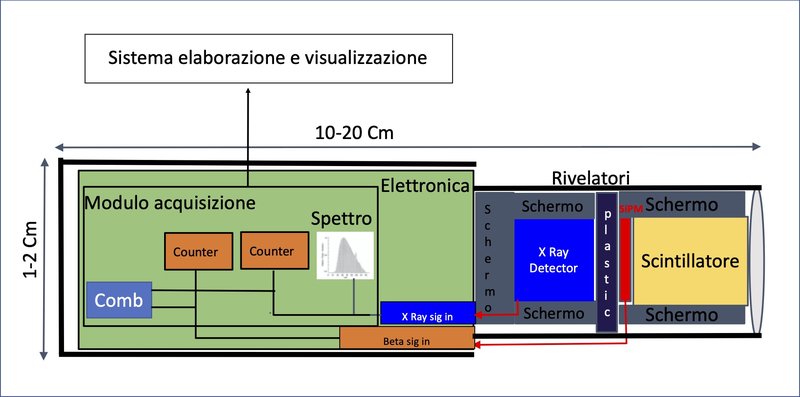
How does it work?
Beta-emitting radionuclides, when passing through biological tissue, release their energy in 2-10 mm. This feature of low penetration (short range) allows the detection of tumour residues exclusively in the immediate vicinity of the tumours themselves. In order to detect any residues at a greater distance, it is also of interest to detect the secondary radiation of bremsstrahlung, emitted by beta particles, which is able to penetrate for several centimetres although it is not very intense.
The intraoperative probe that is the subject-matter of the invention detects radiopharmaceuticals based on beta-emitting radionuclides, and thus the tumour residues to which they are bound, and consists of two selective sensors one for bremsstrahlung radiation (X-rays, 10-100 keV) for spatial detection per centimetre (1-10 cm), the other for subsequent point detection, sensitive to primary (beta) radiation.
Applications
- Radiotherapy;
- Detection of small to medium-sized tumour lesions;
- Detection of hidden beta or gamma sources.
Advantages
- Highly manageable;
- Can be integrated into laparoscopic/robotic surgery apparatuses;
- Use of commercially available sensors;
- Ability to identify beta emitters within a tissue at distances of a few centimetres.
ADDITIONAL DETAILS
PATENT OWNERS
INFN
PRIORITY NUMBER
IT 102015000040903
TECHNOLOGY SECTOR
Radiobiology
TT CODE
P_14.019
CONTACT US
For more information about this technology, WRITE TO US

