








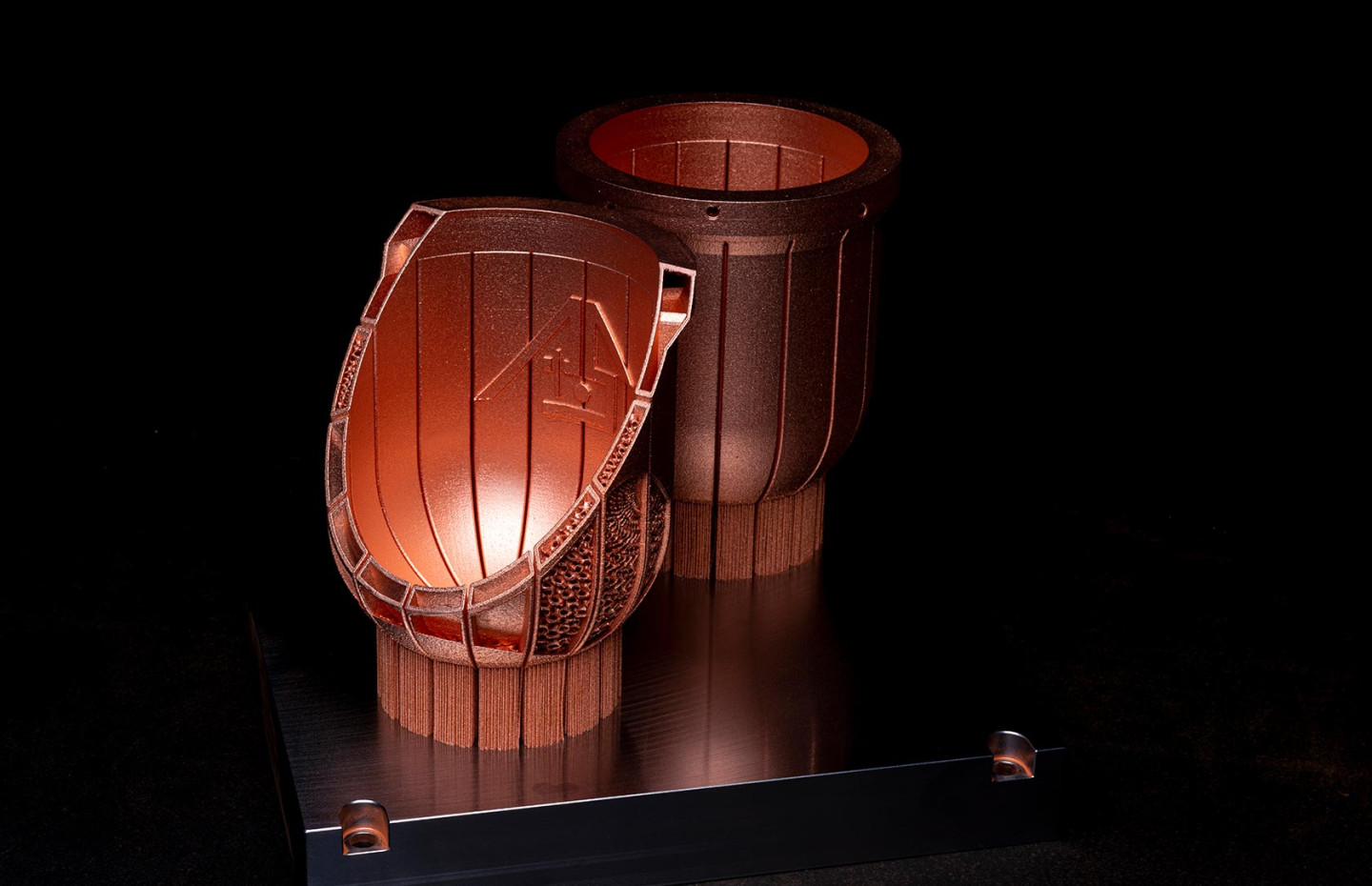
The technology concerns the manufacture of crucibles for cold casting of pure metals and metal alloys, carried out under vacuum or in an inert atmosphere. The invention allows the use of refractory alloys, which normally require high resistance to high temperatures.
How does it work?
This technology uses the principle of electromagnetic induction to melt the metal material. The system uses a metal crucible surrounded by a conducting coil, crossed by an alternating electric current of appropriate intensity and frequency, generated by a special external source. The crucible is made with longitudinal slits that allow the oscillating magnetic field to penetrate into it.
The time-varying magnetic field induces eddy currents in the metal charge (located inside the crucible), known as Foucault’s currents. These currents, due to the Joule effect, generate enough heat to bring the charge to melt, thus forming the “melt”.
Although the metal crucible is also subject to induction heating, it does not reach melting point thanks to an effective cooling system, based on water or other fluids, which keeps its temperature under control.
Applications
- Jewellery field;
- Automotive or aereospace;
- Biomedical sector;
- Oil and Gas;
- Sports market.
Advantages
- High melt handling;
- Increased levitation force;
- Decreased energy costs;
- High melting capacity;
- Colate a purezza estremamente elevata;
- Easy-to-maintain crucible.
ADDITIONAL DETAILS
PATENT OWNERS
INFN
PRIORITY NUMBER
IT 102021000024227
TECHNOLOGY SECTOR
Processing and materials
TT CODE
P_21.053
CONTACT US
For more information about this technology, WRITE TO US

