








Aqueous phosphorus-based solution specifically for electropolishing copper and its alloys, which allows for better results than the traditional chemical or electrochemical polishing techniques.
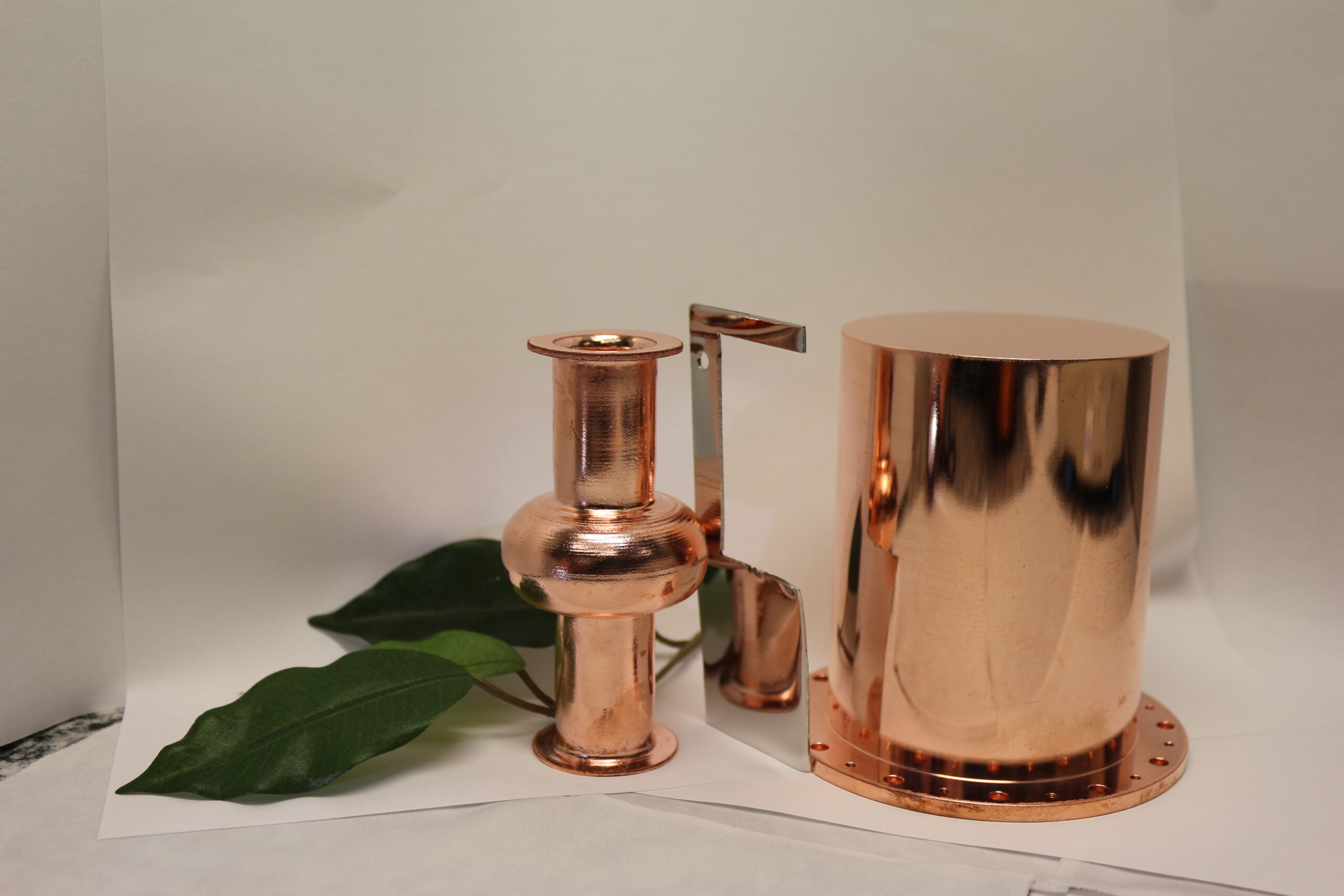
How does it work?
The invention allows a homogeneous polishing of Copper and its alloys via plasma electrolytic polishing whose results are comparable or better than those of traditional electropolishing. Polishing means increasing the reflective coefficient, the glossy effect of the surface, and decreasing micro- and macro-roughness values; in particular, this technology enables Ra<50 nm roughness values to be achieved.
Plasma electropolishing is an electrochemical polishing technique that, unlike standard electropolishing, works in a different regime, at higher currents and potentials, using more dilute solutions than the standard chemical or electrochemical techniques.
Applications
- Aesthetic use or as a substrate for the jewellery industry;
- Copper is a substrate or an intermediate layer in various scientific and industrial applications and is used
frequently thanks to its perfect thermal and conductive properties. For example, heat exchangers
or boilers are often made of copper; - Chemical industry, as a preliminary treatment step, can use copper in electroforming and electroplating. After machining, the chemical or electrochemical deburring may be applied to bulk Cu materials. As an advantage of this electropolishing, the corrosion resistance is often long-lasting, guaranteeing a longer-lasting aesthetic appearance and mechanical and physical properties of the copper material.
- Cu alloys, such as brass, are used in tap fittings
Advantages
- A greener and safer chemical composition: free of toxic and highly hazardous concentrated acids that are complex to dispose of. The traditional polishing treatments always include concentrated solutions of phosphoric acid. The invention in question is instead composed of various aqueous solutions,
with low concentration. - Approximately 10 times faster process speeds than the conventional methods (erosion rate up to 25 µm/min, on average 10-15 µm/min).
- More effective smoothing effect. More effective smoothing effect. The smoothing effect already occurs at minimum material thicknesses. For the same amount of material removed, a reduction in roughness Ra is approximately 2 times higher than with the classic chemical and electrochemical Cu polishing treatments.
ADDITIONAL DETAILS
PATENT OWNERS
INFN, GSSI
PRIORITY NUMBER
IT 102023000010539
TECHNOLOGY SECTOR
Detectors
TT CODE
P_22.145
CONTACT US
For more information about this technology, WRITE TO US

