








11 Jun Basic physics as a driver for technological development: the case of advanced mechanics
At the Legnaro National Laboratories and the Padua Division of the INFN, the need to develop advanced technological solutions for particle accelerators has fostered the creation of knowledge and material processing methods with profound impacts on the industrial fabric.
Vacuum brazing, advanced surface treatments, and additive manufacturing are just some of the high-tech services available at the INFN Legnaro National Laboratories and the INFN Padua Division. Tools and methods designed to solve problems posed by basic research can also find practical applications in various fields, from the mechanical industry to life sciences, and from aerospace to energy.
From basic physics to materials technology
Scientific research requires complex experimental apparatus: increasingly powerful particle accelerators and high-performance detectors are fundamental for the advancement of knowledge, but they often require entirely new manufacturing solutions that must be invented from scratch. Technical work therefore goes hand in hand with scientific work, which the INFN addresses not only by designing and building its own instruments in-house, but also by developing and inventing construction and processing methods.
The technological challenge begins with materials. The heart of a particle accelerator consists of cavities—suitably shaped metal “tubes” to which a radiofrequency field is applied to accelerate the particle beam. Constructing these objects using traditional metalworking techniques is a complex and expensive process, which is why new paths are constantly being sought.
The DIAM (Developments and Innovations on Additive Manufacturing) laboratory is active at the Padua Division of the INFN, dedicated to the technological development of additive manufacturing of copper and high-melting-point metals, such as niobium, a superconducting metal used for accelerating cavities.
DIAM’s activity is not limited to accelerator components but also extends to the creation of complex metal objects for various applications. The know-how gained in the additive manufacturing of high-melting-point metals, such as niobium and tantalum—which are typically difficult to process and therefore rarely handled by commercial workshops and 3D printing services—can be employed in advanced industrial sectors, such as aerospace or nuclear fusion, where these materials are becoming increasingly important.
Moving from traditional to additive manufacturing requires more than just a change in equipment; it also implies a rethinking of how the part is designed to exploit all the advantages of the new construction technique. DIAM’s expertise, therefore, goes beyond simple knowledge of process parameters, extending to all processing stages, from design for additive during the planning phase to the selection of correct post-processing procedures.
Whether produced using traditional techniques or additive manufacturing, an accelerating cavity requires surface finishes with very stringent specifications: extremely low roughness and an almost total absence of defects or contamination are necessary to sustain the high electric fields that generate the particle beam.
Commonly used chemical and electrochemical polishing techniques work, but they are slow and utilize concentrated acids, the handling of which is risky for both the operator and the environment. For this reason, at the Legnaro National Laboratories, the Surface Technology and Superconductivity Service has improved an existing but underutilized technology, plasma electropolishing, by devising and patenting new recipes that use low-concentration salt solutions, which are safer to handle and have a lower environmental impact. In this way, it has been possible to achieve excellent polishing results with a faster, safer, and greener process.
Initially conceived for copper and niobium, these methods can also be applied to precious metals, titanium, and stainless steel, paving the way for their use in the jewelry sector and for polishing aesthetic or functional components.
The Surface Technology and Superconductivity Service also has extensive experience in the deposition of thin coatings using PVD (Physical Vapor Deposition) techniques based on plasmas, such as sputtering, high power pulsed magnetron sputtering, and cathodic arc deposition. Originally employed in the field of particle accelerators by coupling a copper cavity with a thin layer of superconducting niobium deposited on its internal surface, these technologies have been extended to various applications. The laboratory now possesses the theoretical and practical knowledge to create coatings for a wide range of materials, from thick anti-wear multilayer coatings to transparent anti-reflective coatings, as well as functional or decorative metallic and ceramic coatings.
Vacuum and high temperatures for welding materials
The construction of experimental apparatus often requires complex shapes, uncommon materials, and the joining of materials that cannot be welded together. In these cases, brazing is used—a process in which two parts are joined together by introducing a third material with a lower melting point than the pieces to be joined.
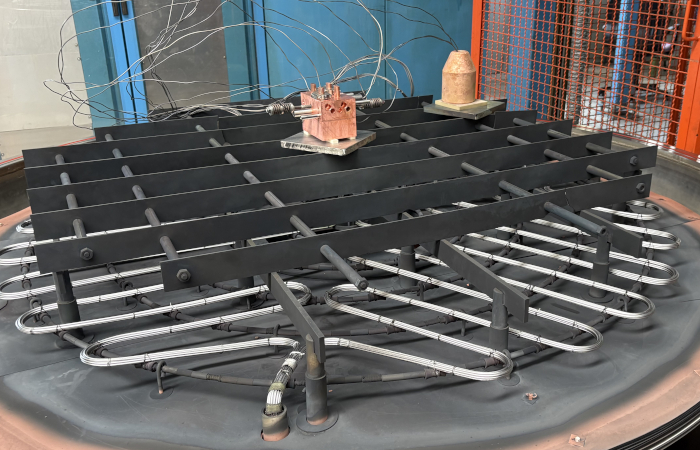
The Legnaro National Laboratories possess a special vacuum furnace built specifically for brazing. Using a furnace, rather than localized heating, allows for uniform heating of the entire part, avoiding distortions or residual stresses caused by thermal gradients. It is also possible to reach the high temperatures required for special high-melting-point brazing alloys.
Vacuum heating, on the other hand, ensures the absence of contamination and oxidation of the part, an important condition for high-temperature brazing of components for special uses. This allows for high-quality, controllable joints. Furthermore, the furnace can be used for a series of heat treatments on metallic materials, such as annealing, tempering, stress relieving, and hardening.
Advancing research by developing technology
Whether it involves improving something existing or creating entirely new solutions, what distinguishes the INFN is being not only a research institution with world-renowned scientific value, but also an advanced technology provider and a reliable partner in public-private collaborations.
Learn more about
If you are interested in INFN technologies and would like more information, you can contact the Technology Transfer Service
The website of the INFN Padua Division
The website of the Legnaro National Laboratories

