








09 Jan Application
Scientific research does not only increase the humanity culture, but also originates real, and sometimes unexpected, positive effects on the society
Science is not just theoretical exploration or academic research: the potential of knowledge acquired in laboratories emerges when it is concretely applied in the real world. In this context, technology transfer procedures play a crucial role, making it possible to accelerate or even make possible the transformation of years of scientific research into tangible solutions to solve industrial problems, optimize production processes and create innovative products, with an impact on society. A significant example of this approach is represented by the National Institute of Nuclear Physics (INFN), which through technology transfer highlights the strategic importance of technological application as an engine for economic and industrial growth.
How can a lab technology find its way to the market?
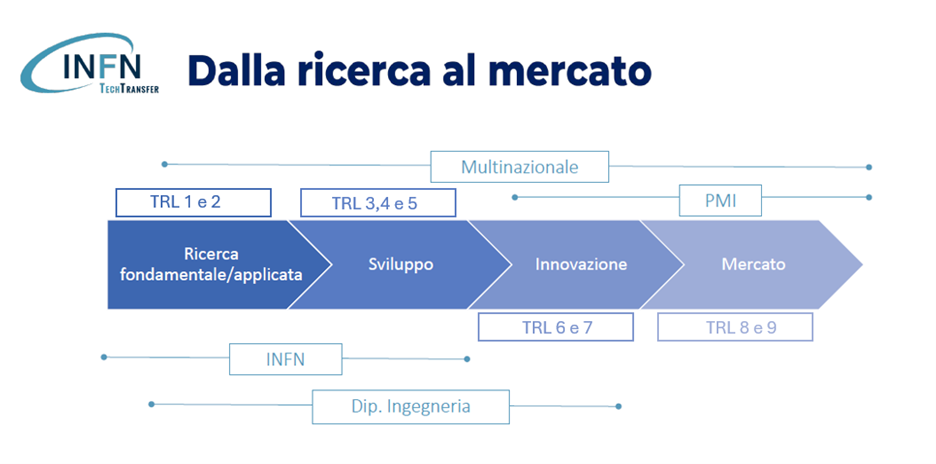
The transfer of a technology from the R&D phase to industrial use is a complex but fundamental process, which can be described through Technology Readiness Levels (TRLs). These levels, ranging from TRL 1 (basic principles observed) to TRL 9 (system demonstrated and validated in an operational environment), represent the steps that a technology must pass in order to move from the laboratory to the market. Each level indicates a different degree of technological maturity, starting from initial experimentation to large-scale practical demonstration.
An example of this path occurs in the transition from TRL 4, which involves the validation of the technology in the laboratory, to TRL 6 or 7, in which the prototype is demonstrated in relevant or operational environments. This transition represents a crucial moment for the interaction between the world of research and industry. This is where the main challenges emerge, such as adapting the technology to the specific needs of the industrial sector and validating its application potential. There are two crucial steps: between TRL 3 and 4 and between TRL 6 and 7.
A success case, inside INFN is the Pixirad detector development.
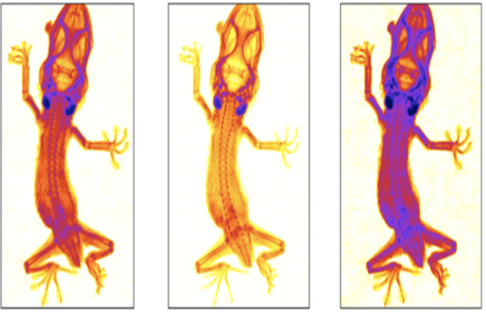
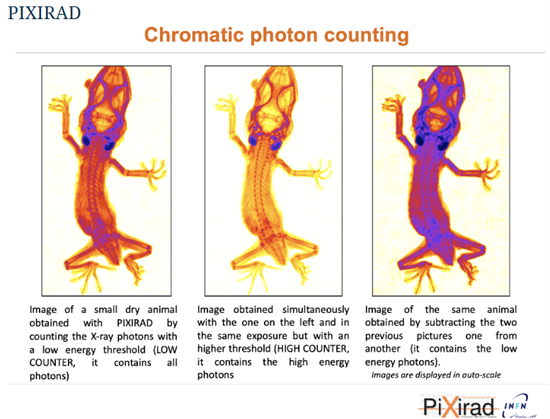
Born within the Pisa Section of the INFN, Pixirad is the result of advanced skills gained in the field of detector physics and is based on the innovative technology of spectroscopic single photon counting. The insight to combine pixel sensors with VLSI processors made it possible to design an X-ray detector capable of offering high sensitivity with a low radiation dose, a crucial advantage for both industrial and medical applications.
Initially validated in the academic field, this technology has passed the development phase thanks to the birth in 2012 of the spin-off Pixirad S.r.l., founded by five INFN researchers. The spin-off initially operated within the INFN, exploiting advanced facilities such as clean rooms for development and production on an industrial scale. This phase, which required a strong collaboration between research and industry, made it possible to adapt Pixirad to the concrete needs of the application sectors.
The innovation and potential of this technology emerged strongly in 2017, when Malvern Panalytical, an international leader in X-ray analysis systems, acquired Pixirad. This agreement, which included the transfer of patents and technological know-how by the inventors and INFN, marked the definitive entry of the technology into the global market. Today, Pixirad is synonymous with technological excellence, revolutionizing the imaging industry thanks to its ability to combine high sensitivity and low radiation dose, a crucial element for industrial and medical applications.
The results?
Pixirad’s story demonstrates how technology transfer, driven by an effective synergy between research, development and innovation, can lead to concrete solutions that revolutionize entire industrial sectors. At the same time, this case highlights the crucial role of institutions such as the INFN, capable of transforming advanced scientific results into successful technologies on the market, generating a significant economic return and strengthening their position as a catalyst for innovation at a global level.

