








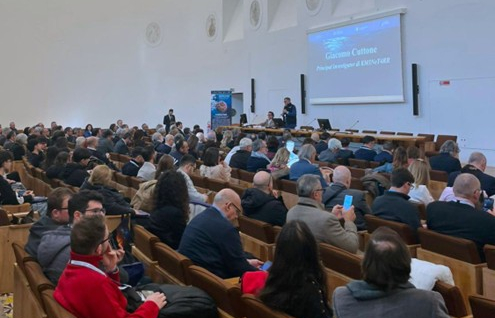
05 Mar KM3NeT4RR: the concluding event of the PNRR project between industry, institutions, and research excellence held in Catania
The meeting represented a moment of synthesis not only for the scientific results achieved but also for the significant impact generated by the project on the entrepreneurial fabric.
The concluding event of KM3NeT4RR was held on February 23, 2026, at the Benedictine Monastery of San Nicolò l’Arena (Catania). This project, funded by the National Recovery and Resilience Plan (PNRR), has strengthened the underwater infrastructure of KM3NeT, one of the most advanced neutrino observatories in the world.
High-tech companies as protagonists of the event
A distinctive element of the event was the presence of companies supplying high technology for the construction of the underwater infrastructure: the project managed purchase orders for highly specialized technological content worth tens of millions of euros.
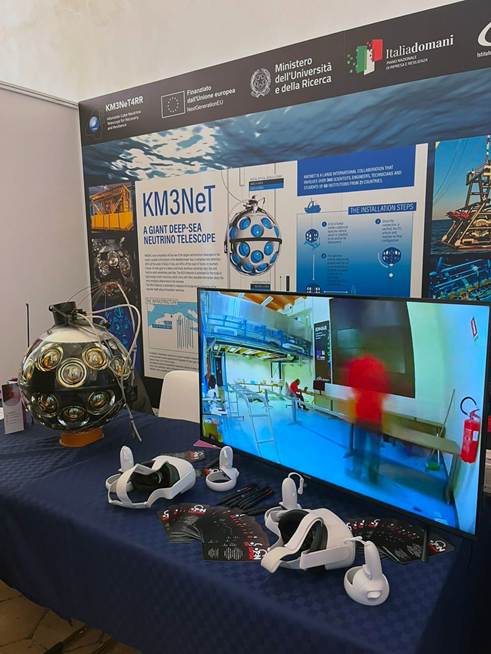
The companies brought the “Clock Corridor” to life with their exhibits, an exhibition space that allowed participants to explore engineering solutions, advanced components, and optical and electronic systems developed to operate at depths of thousands of meters off the coast of Capo Passero, Sicily.
The role of the supplier companies was highlighted during the presentations by the project Work Package leaders. Each illustrated, within their respective fields, positive experiences of co-development between the research world and businesses, which integrated complementary experiences and know-how essential for achieving the results.
KM3NeT4RR has indeed activated high-tech supply chains, consolidating industrial skills that are transferable to other sectors, from offshore to advanced electronics, as well as precision mechanics and sensing.
From procurement to communication: the keys to success
The round tables highlighted several determining factors for the project’s success.
Particular attention was dedicated to Public Administration procurement procedures and the best practices implemented with the PNRR: the competent management of public tenders proved essential for supporting large research infrastructures, encouraging qualified participation from companies, and, above all, ensuring compliance with project timelines.
Alongside this, the importance of communication emerged strongly in making the impact of basic research visible to society and the economy, both locally and beyond. Explaining the technological complexity of an observatory that intercepts signals from the most energetic cosmic events from the bottom of the sea means strengthening awareness of the value of public investment in basic research.
Finally, the role of project management was recognized as a central element in coordinating scientific, industrial, and administrative activities within a complex international framework and in compliance with PNRR milestones.
Strong support from institutions
The institutional participation was surprisingly heartfelt and sincere, a sign of awareness regarding the infrastructure’s strategic potential. An observatory capable of exploring the Universe from the depths of the abyss represents a powerful symbol of the country’s ability to combine scientific excellence, technological innovation, and industrial development.
“From the depths of the abyss to the Universe” effectively summarizes the spirit of the project: a bridge between fundamental research and high-tech applications, and between the local territory and the global scientific community.
A piece of a long-term scientific journey
KM3NeT4RR is part of a research path initiated years ago within the KM3NeT infrastructure and its predecessors, strengthening its capabilities thanks to PNRR funding. It is not a final destination, but rather a fundamental stage in a scientific trajectory that is already consolidated and projected toward new challenges.
The Catania event confirmed how large research infrastructures can be engines of innovation and growth, capable of activating industrial skills, generating frontier knowledge, and enhancing the strategic role of collaboration between public research, businesses, and institutions.
“KM3NeT4RR has demonstrated how a large research infrastructure can grow thanks to an integrated vision that combines scientific excellence, management solidity, and institutional cooperation capacity,” emphasized Giacomo Cuttone, research director at the INFN Southern National Laboratories and principal investigator of the project. “The study of cosmic neutrinos represents one of the most advanced frontiers of contemporary physics, offering a unique perspective on the most energetic and remote astrophysical phenomena occurring in the cosmos. We are opening a new chapter in the deep understanding of our universe, from which we will derive important information to find answers to the big questions, such as those regarding its origin and destiny,” Cuttone concludes.
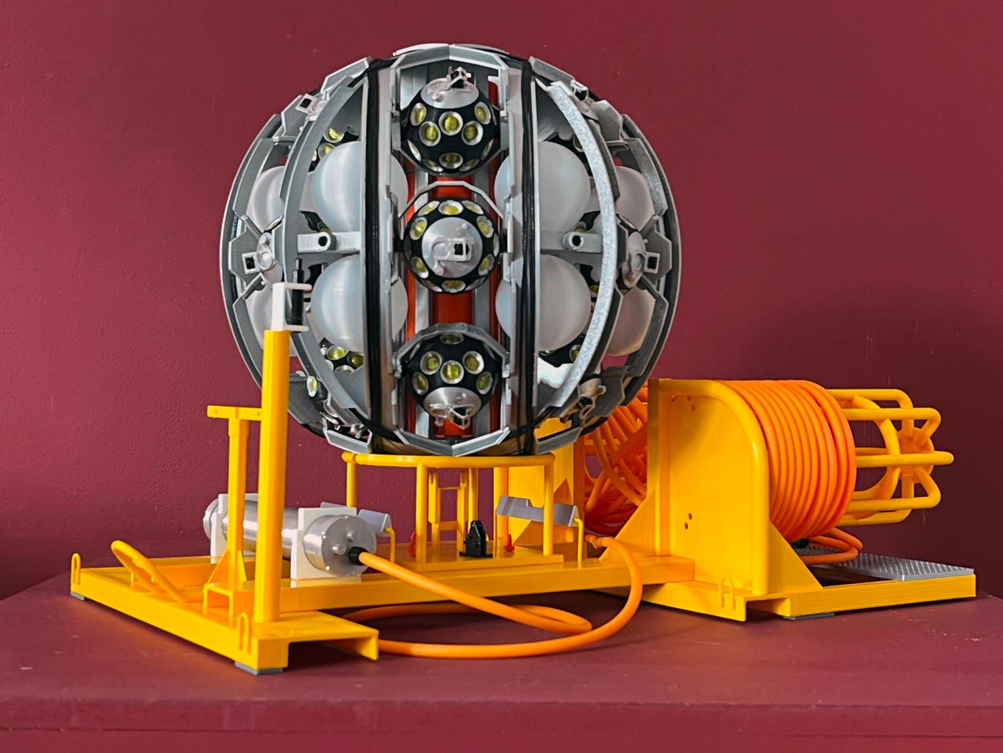
KM3NeT (Cubic Kilometre Neutrino Telescope) is a European research infrastructure located on the bed of the Mediterranean Sea. It houses underwater Čherenkov-type telescopes designed to detect and study neutrinos from distant astrophysical sources as well as from our atmosphere.
Grids composed of thousands of optical modules detect the faint Čherenkov light produced by charged particles generated in neutrino interactions with water near the detector. The position and direction of the optical modules, along with the arrival time of the light on the photomultipliers inside them, allow for the reconstruction of the trajectories of the detected particles.
The KM3NeT project involves the construction of multiple detectors in the depths of the Mediterranean Sea. Off the coast of Toulon, France, the KM3NeT-Fr site hosts the ORCA (Oscillation Research with Cosmics in the Abyss) detector, while off the coast of Portopalo di Capo Passero in Sicily, Italy, the KM3NeT-It site hosts the ARCA (Astroparticle Research with Cosmics in the Abyss) detector.
Recently, ARCA detected the most energetic neutrino ever observed (KM3NeT detects a record-breaking neutrino – National Institute for Nuclear Physics).

