








14 May From the laboratory to field measurements: INFN’s commitment to radiological safety
The Laboratory for Environmental and Medical RAdiation Physics (LEMRAP) is active at the INFN Frascati National Laboratories for the measurement of ionizing radiation.
Next-generation wearable dosimeters
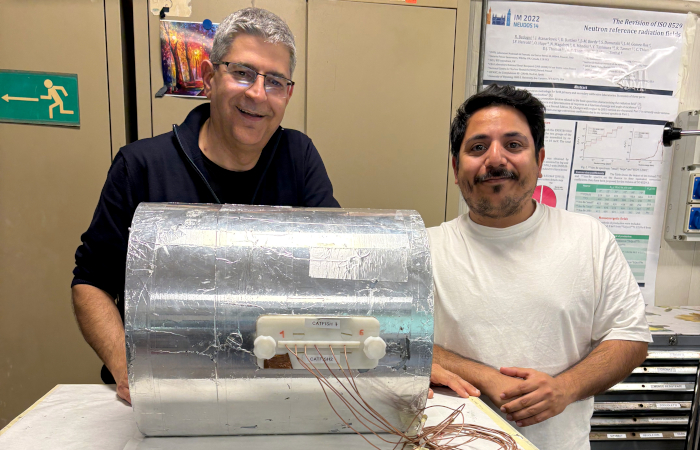
Ivan Castro, a young researcher at the Frascati National Laboratories, proudly shows the latest version of the DOIN wearable neutron dosimeter, developed and patented by the LEMRAP laboratory. “It is smaller, lighter, and easier to carry,” he says, “and it also has a new display.”
“We already have an improved version in the works,” adds Roberto Bedogni, senior researcher at the Frascati National Laboratories and head of the laboratory. “Digitech, the company we collaborate with, has proposed redesigning the electronics to make them even more compact.”
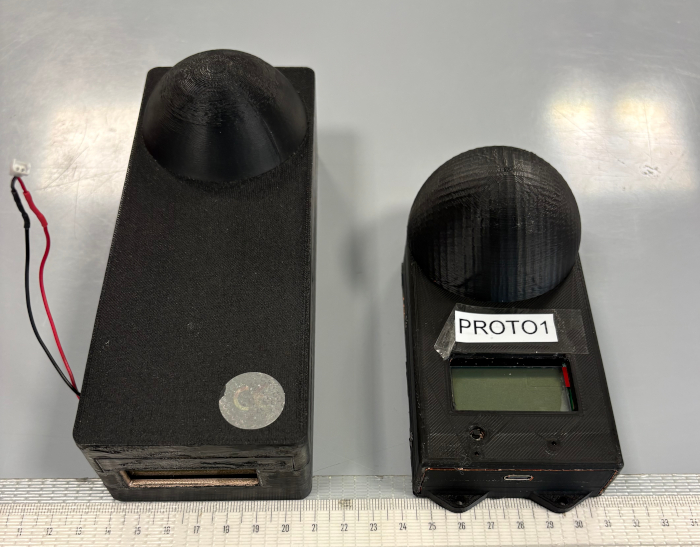
DOIN is the result of a series of R4I projects through which the INFN National Committee for Technology Transfer funded its development and subsequent improvements. “Active neutron dosimeters should meet the IEC 61526 standard, but the very few products on the market have very limited performance,” explains Bedogni. “DOIN fills this gap; in fact, it meets IEC accuracy criteria over a wide range of energy and angles of incidence.”
“We have presented the dosimeter at various industry conferences, receiving good feedback and valuable suggestions,” continues Castro, “such as integrating a second sensor to simultaneously provide neutron and gamma ray doses, a feature that has now been added.”
“Now we just have to process the data sent to us by the test users which, at a first analysis, seem very positive,” concludes Bedogni.
The collaboration with Digitech SRL (Peccioli, ITALY), formalized within the most recent R4I project, has made it possible to produce a pre-industrial mini-series of dosimeters, distributed to selected early adopters who were able to use them free of charge in real conditions in exchange for data sharing.
The prototypes created by Digitech were delivered to users in the fields of nuclear fusion (ENEA), aerospace (ITA IEAv Brazil), hadron therapy (Clinica Universitaria de Navarra – Madrid), and fission nuclear energy (Bruce Power Canada), in order to cover the market segments of interest for DOIN. Thanks to the feedback obtained, it will be possible to further improve the product and plan the industrial scale-up.
Portable neutron spectrometers
LEMRAP’s activities do not stop at wearable dosimeters.
“A service we provide that is increasingly in demand is the characterization of neutron sources used to calibrate instruments,” says Bedogni, “which we can perform directly in situ with a spectrometer we developed that, compared to traditional Bonner spheres, accelerates measurements by at least a factor of five.”
The portable system belongs to the family of single-moderator spectrometers with an extended energy range. It is a polyethylene moderator cylinder that includes a collimator and a series of detectors placed at different positions corresponding to different levels of moderation. It is exposed to the source at a distance of 1-2 m. The variation of the signal in the different detectors contains the spectrometric information on the incident field. A multi-channel acquisition board designed at LEMRAP allows for the acquisition of the signal from the detectors. The raw data are then processed with the FRUIT code, developed at LEMRAP and used worldwide, which provides the energy spectrum of the source.
Ivan jokes while showing the instrument: “It’s a bit dented because it has traveled a lot; the last trip was to Switzerland for a contract with the PSI.” But the number of measurement campaigns carried out, in addition to testifying to the robustness of the instrument, demonstrates how much the skills and services provided by the group are requested and valued worldwide. This reputation has also been established thanks to scientific collaborations.
“The need to have qualified sources leads us to collaborate with ENEA,” says Bedogni, “with the Frascati Neutron Generator and the HOTNES thermal irradiator of the Frascati Research Center, where we test neutron systems, and with the Casaccia Research Center, for which we built a neutron spectrometer for the National Institute of Metrological Research (INRIM) and a high-dose gamma monitoring system for the Calliope irradiation plant.”
Monitoring of environmental radioactivity
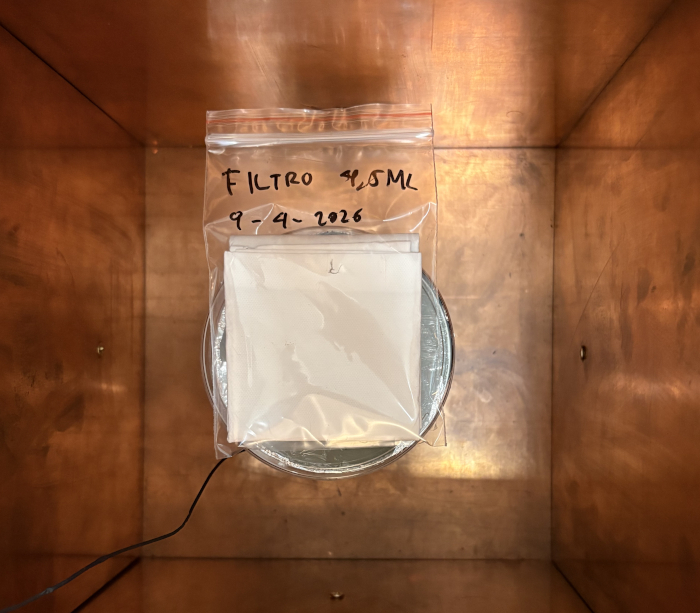
LEMRAP is part of Eyerad, a network managed by INFN that monitors airborne environmental radioactivity through a series of stations installed in various sections and laboratories of the Institute. The measurement is carried out by sampling large volumes of air which is passed through a filter capable of trapping dust particles. At regular intervals, the filters exposed in the EYERAD environmental station at LNF are collected and placed in a very low-background gamma spectrometer designed by LEMRAP. The system is sized to detect very small variations in airborne radioactivity, with particular attention to isotopes that could indicate releases of radioactivity into the atmosphere due to radiological or nuclear accidents.
An application-oriented vision
Roberto Bedogni’s vision is clear: to carry out high-level scientific research while always keeping an eye on the needs of society; to keep alive the idea of curiosity-driven research, while remaining aware of real-world problems and the solutions a research institution like INFN can provide, without distorting the primary mission of increasing knowledge, but complementing it with a commitment to the transfer of technologies to society.
Learn more about:
If you are interested in LEMRAP activities, contact us
For more information on the DOIN dosimeter, click here

