








22 Oct Particle Accelerators Serving Society
Applications for cultural heritage
Particle accelerators find their natural application in unique experimental settings, and typically occupy large volumes and cannot be transported outside physics laboratories. The National Institute of Nuclear Physics operates several particle accelerators in its laboratories, dedicated not only to the study of fundamental physics but also to applied purposes, such as life sciences and the study of cultural heritage.
In the field of cultural heritage conservation, nuclear techniques are used to non-invasively study the composition of the materials that make up a work of art and to date organic finds using the radiocarbon method, through micro-sampling.
Three major families of applications can be distinguished: ion beam analysis (IBA), accelerator mass spectrometry (AMS) dating, and techniques based on synchrotron light.
Analysis of cultural heritage with ion beams
In IBA techniques, a beam of charged particles, typically protons with energies of a few MeV, strikes the object under study. The interaction between the protons in the beam and the atoms that make up the object induces the emission of various types of radiation, which “signature” the chemical elements present:
- PIXE (Particle Induced X-ray Emission): exploits the emission of X-rays characteristic of each element and makes it possible to identify pigments, metal alloys, glass, and gemstones.
- PIGE (Particle Induced Gamma-ray Emission): exploits the emission of gamma rays and is useful for identifying light elements such as sodium, fluorine, and boron.
- RBS/EBS (Rutherford/Elastic Backscattering Spectrometry): analyzes beam particles scattered backward and provides information on composition as a function of depth, for example on the thickness of patinas and corrosion layers.
- DPAA (Deep Proton Activation Analysis): based on the production of radioactive isotopes following nuclear reactions induced by the beam’s protons on the atomic nuclei that make up the object under examination, allowing the analysis to be focused on the object’s inner region.
The decisive element for the analysis of cultural heritage is the so-called external beam line (external beam): instead of placing the object in a vacuum chamber, the beam exits the line through a thin window and travels the final stretch toward the object in air. This makes it possible to analyze objects of any size, even fragile ones, without sample collection, and by ensuring the beam intensity is low enough not to leave visible marks, measurements can be carried out in a completely non-invasive way.
The Laboratory of Nuclear Techniques for the Environment and Cultural Heritage (LABEC), hosted at the INFN Florence division and managed in collaboration with the Department of Physics and Astronomy of the University of Florence, has beam lines dedicated to cultural heritage and has collaborated for years with museums, heritage authorities, and restoration institutes. Operational since 2004, LABEC is equipped with a 3 MV Tandetron electrostatic accelerator and is among the pioneers of external beam techniques.
The strength of this approach, known as Total-IBA, lies in performing PIXE, PIGE, and RBS/EBS together at the same point, where they complement one another. Moreover, by changing the beam energy (differential PIXE), for example from 3 to 1 MeV, different depths can be probed to obtain stratigraphic information, which is particularly useful for paintings, where pigments are applied in overlapping layers.
In the study of works of art, collaboration with museums and conservation institutes is essential.
Collaboration with the Opificio delle Pietre Dure in Florence, for example, has over the years led to the study, using the LABEC accelerator, of masterpieces such as the Trivulzio Portrait by Antonello da Messina, the Madonna and Child by Mantegna, and the Madonna of the Yarnwinder by Leonardo. However, this type of analysis is limited by the difficulty, or impossibility, of transporting masterpieces to the laboratory, an operation that entails considerable risks in terms of logistics, costs, and the safeguarding of the work itself. For this reason, in recent years, most analyses have been carried out directly at the Opificio’s own laboratories using portable X-ray instrumentation (X-ray fluorescence) developed by the Florence division. This instrumentation obviously does not have the “power” of a particle accelerator, but it represents a good compromise for providing information without having to move the artwork.
MACHINA: a portable accelerator for cultural heritage
To achieve performance comparable to that of accelerators installed in physics laboratories, but without having to transport the artworks, INFN and CERN, together with the Opificio delle Pietre Dure, developed the MACHINA (Movable Accelerator for Cultural Heritage In-situ Non-destructive Analysis) project.
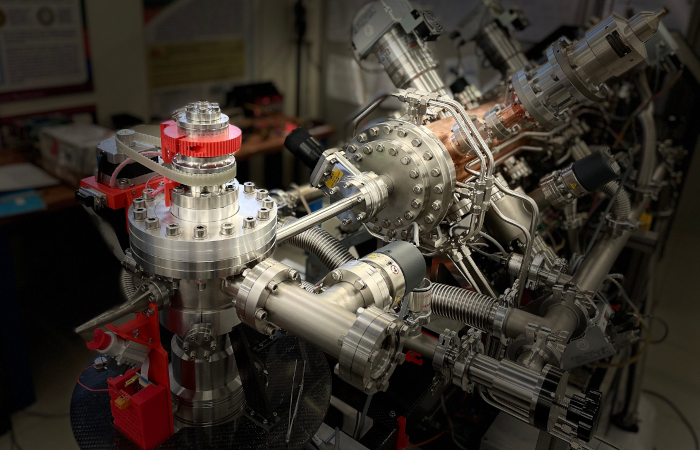
MACHINA is the first transportable particle accelerator dedicated to the study of cultural heritage through IBA techniques. It consists of a radiofrequency accelerating cavity about one meter long, based on a radiofrequency quadrupole.
Its reduced size and weight, together with its low power consumption, make it a tool suitable for installation even in settings very different from a physics laboratory, such as a restoration workshop. MACHINA will therefore be installed at the Opificio delle Pietre Dure, where it will be able to analyze the many works undergoing restoration there.
Because of these very characteristics, MACHINA can also be transported to museums and conservation sites to reach works that cannot be moved or are too fragile.
MACHINA accelerates a pulsed proton beam up to 2 MeV, weighs less than 1,500 kg in total, and has a footprint of less than 10 m². It consumes less than 15 kW of power and becomes operational about one hour after being switched on.
Safe in terms of radiation protection, thanks to solutions that greatly contain the radiation produced by the beam’s impact on the materials analyzed, it will revolutionize in-situ analysis techniques.
Accelerator mass spectrometry for dating cultural heritage
The radiocarbon dating method is based on measuring carbon-14, a radioactive isotope present in organic materials. Accelerator mass spectrometry (AMS) makes it possible to measure the residual concentration of radiocarbon while minimizing the mass of sample to be analyzed and obtaining results in a short time.
This type of analysis requires taking a sample, even if of very small mass (tens of milligrams), generally without compromising the integrity of the object. All organic materials are suitable for dating, such as fragments of plant or animal tissue, fragments of wood and charcoal, paper, or parchment. Several INFN sites have laboratories dedicated to the AMS technique, which are also active in the archaeological and art-historical fields.
A particular application of AMS dating involves the analysis of contemporary artifacts. An emblematic case is that of Contraste de formes, a painting attributed to Fernand Léger and held at the Peggy Guggenheim Collection in Venice, suspected of being a forgery ever since its acquisition in the 1960s and never exhibited. LABEC, together with INFN Ferrara, dated a sample taken from the back edge of the canvas: the result indicates a date later than 1959, which is after Léger’s death in 1955.
Synchrotron light
A synchrotron is an accelerator in which electrons are accelerated along a circular path. As they curve under the action of magnetic fields, the electrons emit extremely intense, highly collimated radiation with wavelengths ranging from infrared to X-rays. By exploiting the very high intensity of this light, experiments that are impossible with conventional sources can be carried out.
Applications to cultural heritage include:
- X-ray fluorescence and elemental mapping: to see how different elements are distributed across an entire painted surface and to identify pigments and traces of underlying layers.
- X-ray absorption spectroscopy and diffraction: to understand not only which elements are present, but also in what chemical and crystalline form, information that is essential for interpreting degradation processes.
- High-resolution X-ray tomography: to explore the inside of fragile objects such as fossils, archaeological finds, and composite artifacts without opening them.
Although synchrotron light is now produced mainly in dedicated facilities, it is intrinsically linked to the physics of particles accelerated along curved trajectories. For this reason, it can also be collected and exploited in machines built for other purposes.
An emblematic case of this synergy is the DAFNE-Luce laboratory at the Frascati National Laboratories. DAFNE was originally built as a collider for the study of high-energy physics; however, the electrons and positrons traveling at very high speed in its rings emit synchrotron radiation that is used for interdisciplinary research, including cutting-edge applications in cultural heritage.
A recent case concerns the restoration of the painting Spitz-Rund (1925) by Wassily Kandinsky, from which a non-original varnish was removed. The varnish was identified as a ketone resin, probably applied from the 1950s onward as a replacement for natural resins, and was responsible for altering the brilliance intended by the artist. The intervention, resulting from collaboration between the GAMeC in Bergamo, the “La Venaria Reale” Conservation and Restoration Centre, and the Department of Chemistry of the University of Turin, was preceded by tests on samples that reproduced the painting’s technique and stratigraphy. The contribution of the DAFNE-Luce laboratory involved reflection FT-IR spectroscopy analyses, carried out with portable instrumentation before and after cleaning. The data confirmed the complete removal of the resin and the return to visibility of the original binder, confirming how physics and restoration can work together to define effective and safe protocols even for contemporary works.
The CHNet network
All the activities described above are carried out within the framework of the INFN-CHNet (Cultural Heritage Network), which coordinates INFN’s initiatives and projects on cultural heritage. To respond more effectively to the questions raised by professionals in the field, such as archaeologists, art historians, restorers, and conservators, the network is structured as a multidisciplinary infrastructure that includes organizations with expertise complementary to that of INFN, such as leading restoration laboratories, university departments, and museums. Overall, the network comprises more than 20 Italian and international research groups and cultural institutions.
The network is engaged in numerous activities, including:
Analysis: together with professionals in the field, the network’s researchers develop and apply the best methodologies to answer questions concerning artifacts and finds of historical and artistic interest.
Research: this is a fundamental pillar for the network, which promotes interdisciplinary studies combining advanced scientific techniques with the needs of the cultural heritage community, fostering the development of new analytical tools, innovative methodologies, and digital solutions.
Communication and outreach: the network’s activities are communicated through the website and through participation in trade fairs and sector events. CHNet organizes training courses and outreach events for students, young researchers, and cultural heritage professionals.
Basic research for cultural heritage
The meeting of particle physics and cultural heritage is a successful example of cross-disciplinary collaboration, drawing on the development of techniques and instrumentation for the safeguarding of historical and artistic heritage. Accelerators make it possible to read the history written within matter itself: in the atoms of a pigment, in the impurities of a gem, in the proportion of an isotope, while respecting the integrity of a work of art or artifact. The techniques and tools available are many, and they make it possible to carry out non-invasive or micro-destructive analyses, revealing answers hidden by time and preserving historical and artistic heritage for future generations.

