






15 Jan Go-To-Market
how to transform an invention to a market-ready product
What does Go-To-Market mean?
Go-To-Market (GTM) is a strategic approach used to develop a product or service that will be launched on the market, reaching customers and gaining a competitive advantage over competitors. From the point of view of applied research, it is essential to keep in mind the needs or requirements that new technology will address, improving people’s lives in their private and professional spheres.
GTM is linked to the Technological Readiness Level (TRL), which indicates the maturity level of the developed technology. Every project is classified on a maturity scale and assigned a TRL score ranging from 1 to 9. Once feasibility tests have been passed and TRL 3 has been reached, it’s time to move on to the prototyping phase in order to demonstrate its functionality in a specific application area, developing a proof-of-concept model that represents the starting point for the next development steps
Go To Market at INFN
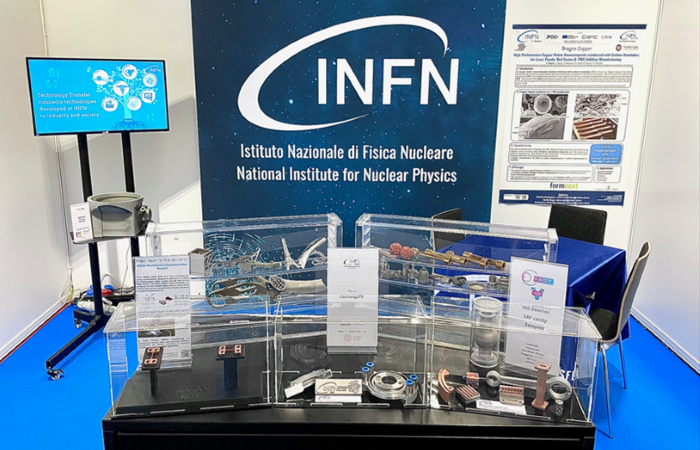
This is where the INFN Technology Transfer Service comes into play, which is responsible for protecting and enhancing the results of research, taking care of the filing and management of trademarks and patents, the stipulation of contracts with companies and other activities to enhance the technological portfolio. In addition, it provides technical support to the research community for the protection of intellectual property, relations with companies and the creation of spin-offs. Inspired by the principles of Open Innovation, promotion and dissemination in society and in the production world, the Institute strengthens the relationship between basic research and industry, promoting enhancement paths through licensing of know-how and patents.
INFN’s expertise meets the technological needs of companies that constantly try to expand their product or service offerings and reach new customers. To bridge the gap between research and market, INFN has been promoting calls for funding since 2018 for research projects aimed to raise the TRL of its research results. INFN staff can benefit from these funds, including collaborations in which they participate with their own resources and know-how.
Identifying a new technology
INFN is the national public research institute dedicated to studying the elementary constituents of matter and the fundamental laws of the universe. However, it often generates technological spillovers in various fields, such as materials science, life sciences, ICT and electronics, security and the protection of cultural heritage and environment. With such a broad technological portfolio, identifying new technology that can effectively enter the market is a complex task that goes beyond simply assessing TRL. Beyond technological maturity, it is crucial to understand whether and how the technology can meet a real market need and whether the size of that market justifies the efforts. Another aspect to consider is the willingness of inventors or creators to undertake the valorization process. Any technology transfer from the laboratory to the market is greatly facilitated when the inventor is actively involved with tech transfer structures.
Available tools: Licensing and Spin-Offs
From a GTM perspective, INFN’s Tech Transfer Service can act in two directions: through licensing the technology to a company interested in its commercialization or by supporting the creation of a spin-off firm.
The licensing contract is an instrument that allows the economic exploitation of the technology or intellectual property covered by the agreement, giving a company the right to exploit and commercialize it, under certain conditions, for a predetermined period of time and on the basis of an agreed economic consideration. In this way, the INFN does not lose ownership of the technology, product or service, protecting the interests of the institution and the researchers who worked on a given invention. By establishing a collaborative relationship, even prior to the licensing itself, the Institute and the company both take on the risk of research although with different interests.
Spin-off firms are businesses created from ideas or activities originating within an existing organization – in this case INFN – with the goals of promoting and commercializing research results. INFN promotes the creation of spin-off companies by involving its own research to improve technologies development during experimental activities. In these companies, INFN employees are involved in various functions to find applications for the knowledge and technologies generated by the Institute..
How INFN is committed to promote research and what Tech Transfer Service does
INFN’s GTM tools represent a meeting point between laboratory, research and market. The Tech Transfer Service is the office that manages the relationship between scientific research and commercialization, protecting its researchers and know-how while supporting companies in a win-win perspective. These tools also represent a mechanism to fully promote research, creating and distributing value thought country’s economy. Innovation is the meeting point between knowledge and enterprise, where great ideas come to life and change the world thanks to the indispensable role of Tech Transfer Service.

