








25 Sep An INFN technology enables the first-ever production of copper-67 in Italy
The isotope is among the most promising in the fight against cancer
An important milestone
The collaboration among the INFN Legnaro National Laboratories, the University of Ferrara, and the IRCCS Sacro Cuore Don Calabria Hospital in Negrar (VR) has reached an important milestone for Italian nuclear medicine, opening new prospects for the domestic production of theranostic radionuclides: the first production, in our country, of copper-67 (67Cu), one of the most promising radionuclides for the diagnosis and treatment of various oncological conditions.
The result stems from the CUPRUM-TTD project, funded by National Scientific Committee 5 (CSN5) of INFN, and developed at the Legnaro National Laboratories. The project’s goal is to develop innovative technologies to produce 67Cu through the direct activation route by using particle accelerators.
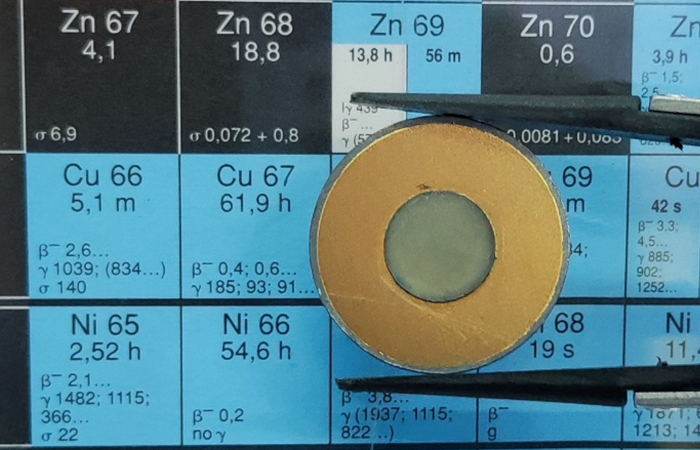
Production of the radionuclide relies on high-purity solid targets irradiated with a proton beam. Following irradiation, the material undergoes a nuclear reaction that leads to the formation of the radioactive isotope of interest. In this case, the starting material is zinc highly enriched (over 98%) in its isotope with atomic mass 70 (70Zn), which in turn is converted, through a chemical process, into zinc oxide (70ZnO).
The SPES project
A fundamental contribution came from the group of the SPES project at the Legnaro National Laboratories, which works on developing innovative radioisotopes for medicine. After years of research and development, it designed and produced the 70ZnO targets, using a proprietary technology based on the process known as Spark Plasma Sintering (SPS). The SPS system was developed in-house, in collaboration with the group that worked on the TT-SINTER experiment of INFN Pavia Division.
The targets were subsequently transferred to the Radiopharmacy Unit of the IRCCS Sacro Cuore Don Calabria Hospital, where they were irradiated with an 18 MeV proton beam produced by the institute’s cyclotron. At the end of irradiation, the resulting 67Cu was chemically separated and purified through specific radiochemical procedures developed at the University of Ferrara.
Why produce copper-67
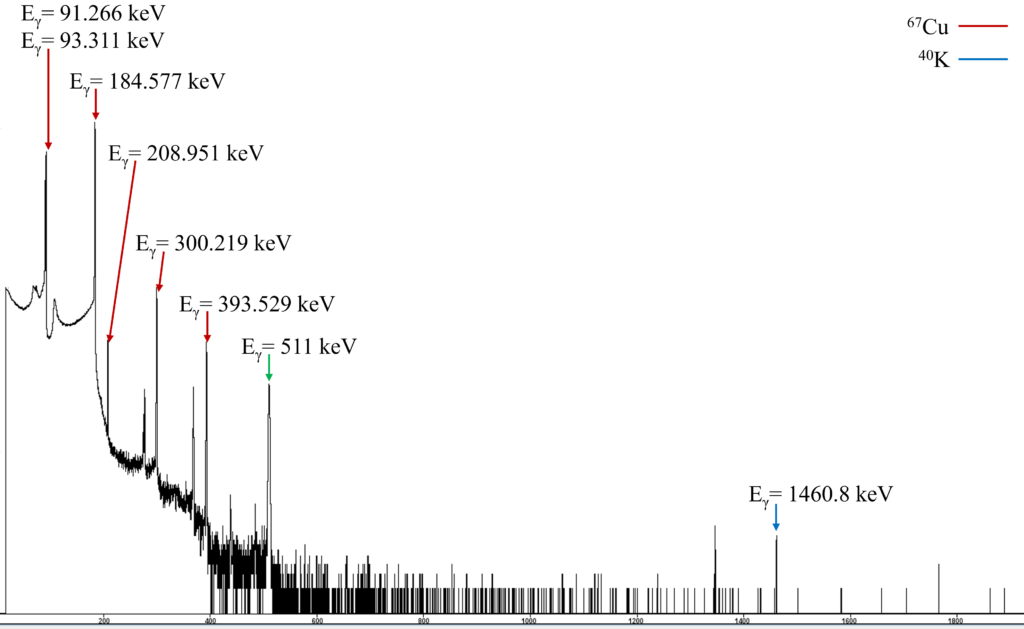
The 67Cu is one of the theranostic radionuclides of greatest international interest, thanks to its distinctive physical and radiobiological characteristics. It has a half-life (T1/2) of 61.8 hours, and its main feature is that it decays by emitting both β– particles and γ rays of suitable energy. These unique characteristics make it suitable for both therapy and medical imaging. The emission of β– particles, in fact, has an energy that allows its use in the treatment of various oncological conditions, while the concurrent emission of γ photons enables the acquisition of SPECT (Single Photon Emission Computed Tomography) images, a 3D imaging diagnostic system that makes it possible to assess the drug’s biodistribution, monitor therapy and perform dosimetry. Its use is particularly promising in the field of personalized nuclear medicine, especially for the treatment of tumors such as prostate cancer and glioblastoma.
INFN’s technological role
INFN has for years been engaged in research in physics applied to the life sciences, with projects ranging from the development of accelerators for medical applications, to dosimetry, to the production of radionuclides for tumor diagnosis and treatment. In this context, the Legnaro National Laboratories are completing the construction of the SPES radioisotope production facility, based on a cyclotron capable of accelerating proton beams up to a maximum energy of 70 MeV, and will also be dedicated to the production of radioisotopes of medical interest.
The SPES facility will enable the production of radioisotopes through two complementary technologies: on-line isotope separation and direct activation on solid targets, significantly expanding the possibilities for research and production of innovative radionuclides. A distinctive element of these activities is the expertise developed in-house by INFN in the field of Spark Plasma Sintering (SPS), a technology that makes it possible to produce advanced multi-material targets which may be used for production of radionuclides based upon the direct activation process. That is further complemented by the portfolio of proprietary patents covering the production process of various radioisotopes, including copper-67.
Once operational, the SPES facility will make it possible to produce radionuclides directly at the Legnaro National Laboratories and, thanks to the high energies available, to develop more efficient and selective production processes. In the case of 67Cu this will make it possible to increase the yield and improve its radionuclidic purity.
These ongoing activities represent an important strategic investment for the future of nuclear medicine in Italy and lay the groundwork for making innovative radionuclides available for preclinical studies and future clinical applications. At the same time, they confirm the role of the INFN and Legnaro National Laboratories as leading players in the development of advanced technologies and infrastructure serving biomedical research and health.
Learn more
To have more information on the radionuclides production using the direct activation method, go to the LAboratory of RAdionuclides for MEDicine (LARAMED) website.
Here you can find an insight article about the application of accelerators in ife science.
The INFN for Life science website describes INFN programs on life sciences.
If you want ti collaborate with INFN on projcet concerning madical radionuclides, write us.

