








30 Jan INFN technology in COSMO-SkyMed satellites
The third satellite of the COSMO-SkyMed Second Generation constellation, recently launched, is equipped with positioning systems developed by INFN
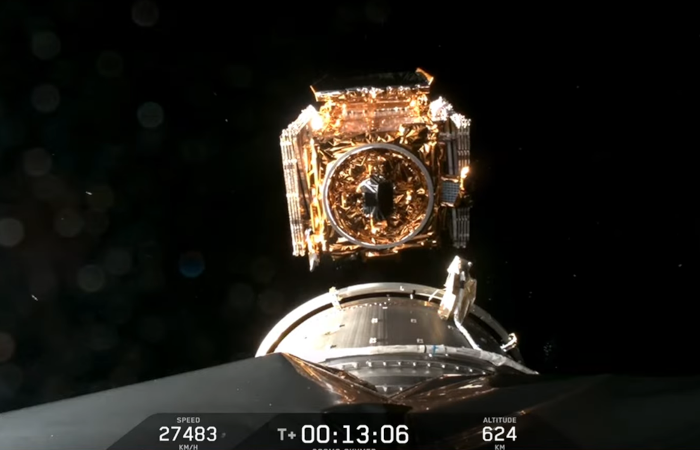
The first launch of 2026 by SpaceX was dedicated to an Italian Earth Observation satellite, whose constellation is equipped for the first time with laser retro-reflectors for orbital tracking, developed and produced by INFN.
On the night of January 3 at 3:09 AM (Italian time), the third satellite of the Italian constellation COSMO-SkyMed Second Generation was successfully launched from Vandenberg Space Force Base in California aboard a Falcon 9 rocket, consolidating Italy’s role among the world leaders in Earth observation.
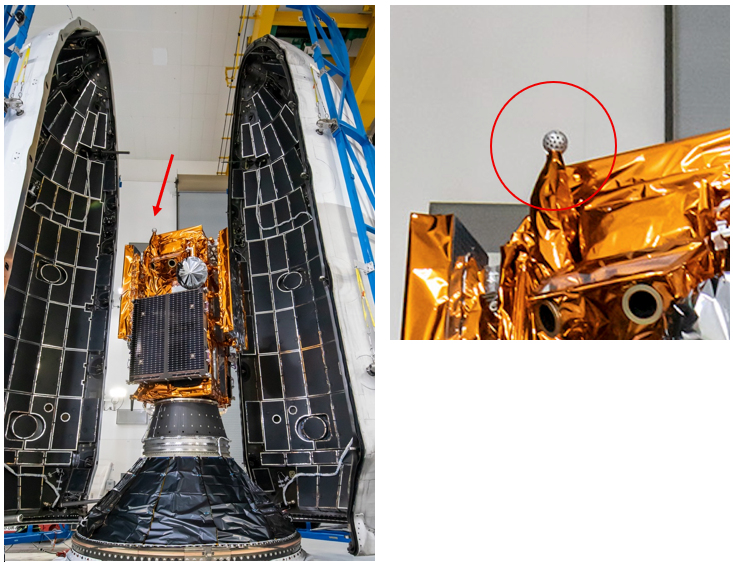
One of the innovations introduced in the satellite just placed in orbit is CORA-S, COsmo-skymed laser Retroreflector Array – Sphere, developed and produced by SCF_Lab at the INFN National Laboratories in Frascati (INFN-LNF).
CORA-S is an array of laser retro-reflectors: a set of optical prisms that reflect laser signals sent from ground stations (such as the Matera Laser Ranging Observatory of ASI), allowing the measurement of the satellite’s distance with millimetric precision. The measurement precision derived from CORA-S not only improves the satellite’s orbital models but also helps enhance the quality of acquired radar data and the calibration of onboard sensors, increasing the reliability of observations and data generated in the so-called “georeferencing,” that is, the determination of the absolute (and accurate) position of both the satellite and its valuable maps of the Earth’s surface, relative to the international and standard terrestrial metric reference system.
SCF_Lab is an R&D laboratory of INFN dedicated to the design, construction, characterization, and space qualification of laser retro-reflectors installed on satellites for their precision positioning through the laser tracking technique (Satellite Laser Ranging), which is the accurate measurement of the time of flight of short laser pulses. SCF_Lab, coordinated by Simone Dell’Agnello, has a strong partnership with the Italian Space Agency (ASI) and collaborates with the European Space Agency (ESA), American (NASA), and other international and national agencies and industries on missions and studies concerning Earth and the rest of the Solar System.
Resulting from the collaboration between the Ministry of Defense and the Italian Space Agency (ASI), the COSMO-SkyMed Second Generation program will be completed in 2027 with the launch of a fourth satellite. With the technological innovations introduced in the Second Generation, compared to the 4 satellites of the First Generation, Italy reaffirms its leading role in high-precision terrestrial monitoring systems. These satellites, in fact, are equipped with Synthetic Aperture Radar (SAR) operating in the X-band, allowing the mapping of the Earth’s surface with meter precision regardless of weather conditions (less than a meter in dedicated mode). The COSMO-SkyMed mission is designed for the observation of terrestrial, marine, and coastal territories, with particular attention to the Mediterranean basin, as well as environmental and climatic phenomena, to provide strategic information for security, civil protection, emergency management, and environmental protection.
COSMO-SkyMed data are also distributed within the Copernicus services, the Earth observation program of the European Commission, in fact COSMO-SkyMed is one of the flagship missions of the Copernicus Contributing Missions. Copernicus and Galileo, the European global satellite navigation system, are the two “flagship” space programs of the European Union, aiming to ensure strategic autonomy for Europe.
The development and integration of CORA-S demonstrate INFN’s ability to transfer advanced expertise gained in fundamental research to space applications with significant operational and scientific impact. The presence of this instrument on board a strategic satellite like COSMO-SkyMed Second Generation confirms the Institute’s role as a leading player in the national and international technological landscape, capable of making a concrete contribution to the evolution of Italian space infrastructures and European space flagships.
Learn more about
The ASI article on the launch

