






05 Feb Interview with MuonLab founders
We interview the four MuonLab founders: Lorenzo Bonechi, researcher at INFN-Florence and Roberto Ciaranfi, technician at INFN-Florence as well; Vitaliano Ciulli and Raffaello D’Alessandro, professors at Florence’s University and INFN associates.
Tell us what MuonLab is and what it is doing
MuonLab is an innovative startup, spin-off of INFN and Florence’s University which was founded in July 2025. It provides 2D and 3D imaging services done using muon radiography, a technology we studied and developed during our research activity at INFN and University.
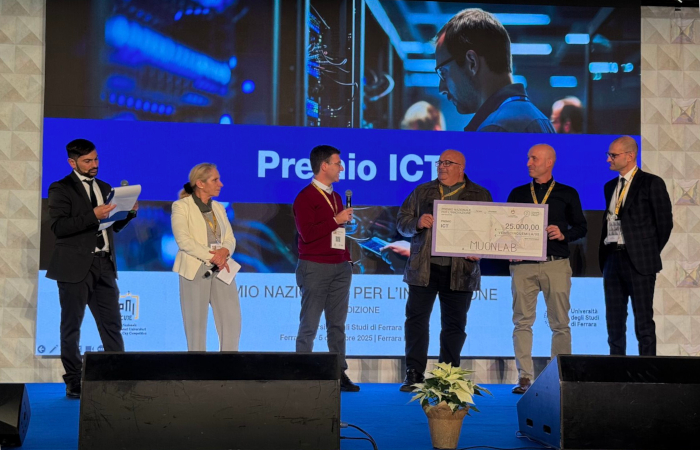
On last December, you won the first prize in ICT category at Italian National Prize for Innovation, and also the special awards SearchOn We Make Future and Venture CDP. Tell us something about.
Lorenzo: MuonLab is a spin-off both INFN and Florence’s University, and thanks to University we werw ivolved in Start Cup Regione Toscana. This event happened just after the spin-off, formal creation in July 2025, so it was a great opportunity to reach a great audience.
Raffaello: we passed a first selection phase based on the business plan, ad we got the access to the regional final in Pisa, where we did a five-minutes pitch. We won the Società Addì Special Award and we got the fourth place in the absolute classification, which granted us the participation to the national finals in Ferrara. We had to reduce the pitch to three minutes and i mus say we did a good job, even if explaining what muography is in such a short time, to an audience of non-experts, was tough.
Lorenzo: al di là dei premi, che ci hanno ovviamente fatto molto piacere, vorrei sottolineare che dopo la presentazione a Ferrara abbiamo ricevuto molti complimenti sia da investitori che da giurati delle altre categorie, che non erano coinvolti nella valutazione di MuonLab. Siamo quindi molto soddisfatti di questa esperienza che pensiamo abbia portato a risultati più che positivi, sia per l’azienda che per INFN e Università.
Given the experience gained in brief but effective presentations, I ask you to describe the technology behind MuonLab in a few words
Lorenzo: the idea is to be able to see through large thicknesses of materials, as our vision states: see through, see inside, using muonic radiography as a methodology, which is similar to what is commonly done with X-rays, but using natural radiation that originates from cosmic phenomena and reaches Earth. Part of this radiation consists of elementary particles, muons precisely, which can penetrate the Earth’s crust for hundreds of meters. By exploiting this phenomenon, we can perform radiographs of large volumes of material, such as architectural structures and mines, using instrumentation developed by us over the years during our work as researchers, whose technology has been patented and is now licensed to MuonLab. These instruments, properly positioned, allow us to perform radiographs of large structures with measurements lasting a few weeks, also measuring the average density of materials traversed by muons.
In the final pitch at the National Innovation Award, you say you developed your technology thinking about archaeological research, but then you moved toward mining applications. Why this change of direction?
Vitaliano: Archaeological application was the first application of muography, in 1970 by Nobel Prize winner Luis Alvarez, and it certainly fascinates the public the most, but from a commercial standpoint, the mining field is certainly more promising. In this regard, we were advantaged by contact with a group of geologists from both the University of Florence and the Institute of Geosciences and Earth Resources of CNR in Pisa (IGG-CNR), which allowed us to conduct a very thorough test at the Temperino mine. The ideal positioning of our measurement apparatus is below the area of interest, so working on already open mines allows us to easily detect empty areas or areas with different density compared to the surrounding rock, opening up very great potential. In this historical moment, mineral prospecting is also of great interest because, despite extractive activity in Italy being very limited, it has been understood, also based on the EU’s raw material act, that we cannot depend on non-European countries for the supply of critical materials, and therefore there are plans for opening and reopening mines in Italy.
There’s also the sustainability aspect: conducting more targeted research thanks to your imaging system reduces the environmental impact, which is never small for the mining sector
Lorenzo: exactly, exploration relies heavily on invasive methods like core drilling, so the idea of replacing them, at least in the first phase of identifying areas of interest, goes precisely in the direction of a lower environmental impact.
Vitaliano: there’s also the other aspect we’re exploring, namely that of mining dams, which unfortunately have an enormous environmental impact and pose considerable risks to the environment and people living in the surrounding territory. A non-invasive investigation methodology that allows monitoring of dams containing mining waste could therefore represent a very important tool from a safety standpoint.
Let’s return to your story: when did you become aware that the technology behind MuonLab could have an industrial and commercial outlet in addition to research?
Lorenzo: it’s an awareness that arose quite far back in time, after verifying that the test measurements were of interest even outside our research groups. We received excellent feedback from groups of geologists who were very impressed by our results. From that point on, it was no longer about conducting research activities, but applicative measurements that required considerable resources, and so the idea was born to establish a company that could perform them outside the INFN and university context.
Was there a precise moment in your history when you understood that founding a company could make sense?
Lorenzo: I would say the experience at the Temperino mine. We were collaborating with geologists who saw the results and told us they didn’t expect such a level of performance. We had already had experiences in archaeological and volcanological fields, but the mining experience made us understand the commercial potential of our technology.
Raffaello: from my point of view, the trigger was when we started the pre-incubation path with the university; activities of that type help make a decision, one way or another. Similar stimuli also came with the mentoring path promoted by INFN in collaboration with Cassa Depositi e Prestiti in 2024.
How is the company structured at the moment?
At this moment there are the four of us founders and an external CEO who has business management skills. We founders cover all the technical skills necessary for measurements, but we have contacts with young researchers whom we would like to involve when MuonLab’s commercial activities begin.
How do you evaluate the support that INFN has given you for creating the spin-off?
Raffaello: there’s a uniqueness in this spin-off which is the recognition from both INFN and the University of Florence. INFN’s close collaboration with the academic world has yielded excellent results.
Roberto: the first step was the R4I funding which allowed us to increase the technological advancement level of our solution, then we participated in the training path provided by the Graduate School of Management of Politecnico di Milano (GSoM POLIMI) through the INFN-Cassa Depositi e Prestiti collaboration, which allowed us to acquire managerial skills we didn’t have. INFN therefore supported us in these two fundamental phases and also allowed us to gain greater confidence in the quality of our technology as well as our commercial proposal. In light of this and the first signs of interest we are gathering, I didn’t feel alone, but I perceived that INFN accompanied us in this adventure.
Vitaliano: As a university employee, I experienced the path more from that side, but I found the GSoM POLIMI training very useful, especially regarding the tutoring part. Beyond that, all the interaction with INFN’s Technology Transfer Service, which helped us in choices and in how to set up all our activity, was definitely useful.
Lorenzo: when we thought we were ready to found the company, INFN involved us in a training and mentoring path organized with GSoM POLIMI and CDP; this made us postpone the spin-off establishment by one year but gave us new tools and skills, allowed us to create a more sustainable business plan and a more effective pitch for presentations to investors.
What are the biggest challenges you have encountered so far?
Lorenzo: the path was certainly not painless; for us coming from the research environment, it wasn’t simple to adapt to thinking like entrepreneurs. There were difficulties in familiarizing ourselves with official documents, from interpreting regulations to defining contracts. In the end, however, thanks to collaboration with the two TTOs, we managed to create a business plan that could be presented to investors.
Roberto: for me the biggest challenge is moving from studying technical details to a perspective oriented toward providing results to people who are not interested in the technology per se, but in what they can obtain through its use.
Vitaliano: one of the biggest difficulties for me was managing intellectual property: doing research, one tends to underestimate the problem, but once you approach the entrepreneurial world, you must face it. This was an aspect that required the greatest number of interactions, even just to define which and how much knowledge should be transferred to the spin-off, and with what tools. So advice is to start thinking about these aspects as early as possible, even when conducting basic research projects.
This is a message that the TT Service strives to convey: even those working in research must address the issue of intellectual property, not necessarily with the idea of creating a spin-off but simply recognizing that the knowledge generated through one’s work, when it leaves the laboratory, can bring benefit to society
Instead, the greatest satisfaction?
Vitaliano: certainly winning the PNI was the greatest recognition, then every positive feedback from outside is a stimulus and satisfaction.
Lorenzo: personally, seeing expert geologists who recognized how impactful our results were was the greatest satisfaction.
How do you see MuonLab in the future and where do you see yourselves, more in research or more in business?
Raffaello: our strength is that over these years we have trained young people, so if the company grows there will already be trained people ready to come aboard and make MuonLab take off.
Congratulations again, and thanks for your time.[/vc_column_text][/vc_column][/vc_row]

