








30 Apr Stay close to the tools: why technological proximity is the key to technology transfer at INFN
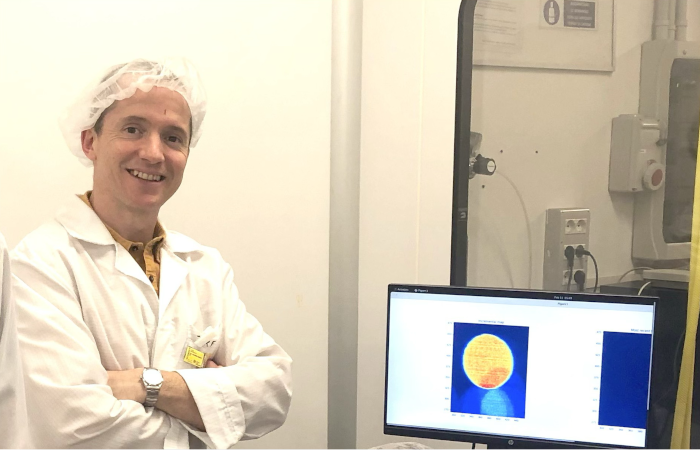
The perspective of Manuel Rolo, INFN researcher and member of the National Committee for Technology Transfer
When problems exceed the boundaries of the known, incremental innovation is not enough: it is necessary to create the unprecedented, even without the certainty that a solution is possible. The technology that INFN develops in the pursuit of its primary mission of fundamental physics research is often disruptive.
In a historical era where rapid technological changes – particularly in the field of artificial intelligence – can quickly render high-level strategies obsolete, research and development work at INFN allows us to stay close to the tools. This approach encourages direct and continuous involvement with the technical aspects of our work. From my perspective, the organization of research at INFN thus promotes a social and epistemic proximity that is unique in the European landscape. It is the responsibility of the National Committee for Technology Transfer (CNTT) to create the conditions so that this invaluable tacit knowledge can transform into innovation with high economic and social value.
The INFN community is broad and highly integrated, comprising engineers, technicians, administrative staff, and both theoretical and experimental physicists. Together, these figures conceive, design, and build innovative accelerators and detectors. The work takes place in laboratories that are true spaces of knowledge production, where aspects of scalability, cost, and the robustness of supply and production chains are addressed from the earliest stages—essential elements for the realization of high-performance machines and detectors.
By carefully observing this ecosystem and this working model, it clearly emerges how INFN is one of the research institutions in Europe with the highest potential for creating innovative start-ups, equipped with a technological portfolio of excellence. Furthermore, in many cases, the path toward industrialization can be glimpsed in advance while the research community carries out its daily work.
I therefore believe a shift in focus is necessary: moving from a concept of technology transfer centered mainly on licensing to a vision more oriented toward business creation, where INFN is an active participant not only in the ideation phase but also in the industrialization of the technology. Much is already being done in this direction. One example is the entrepreneurial training program launched in collaboration with Cassa Depositi e Prestiti and the Graduate School of Management of the Politecnico di Milano, aimed at INFN personnel. The feedback has been positive: some of the eight groups that participated in the courses have already founded particularly interesting companies.
On the technological scouting front, the CNTT has for several years been funding projects aimed at increasing the technology readiness level.
Among these, the R4I call, which reached its ninth edition in 2026, is currently under revision with the aim of actively involving companies from the early stages of the projects. Beyond concrete results, the support of the CNTT is fundamental for spreading a culture of technology transfer within INFN, particularly among younger staff, fostering a vision in which basic research and practical application are not antithetical worlds, but can coexist and cross-fertilize each other.
Combining the inventiveness of INFN personnel and the technological strength of the Institute with Italian genius and entrepreneurial skill, giving life to new companies based on disruptive technologies capable of responding innovatively to the needs of the market and society: this is my idea of technology transfer.
Manuel Rolo works at the Turin Division; he served for years as the Technology Transfer Coordinator for his Division and is now a member of the National Committee for Technology Transfer.

