








12 Feb A Year of Technology Transfer
A few weeks before the beginning of 2026, we evaluate the results achieved by technology transfer during the past year and lay the foundations for future objectives.
Patent
In 2025, the TT Service filed 11 priority patent applications, thus bringing to 96 the technologies currently patented, of which INFN is the sole or joint owner. The technological sectors range from advanced detectors for scientific and medical purposes, to cryogenics, to additive manufacturing, up to the use of cosmic muons to monitor building stability. [/vc_column_text][/vc_column][/vc_row]
Spin-off
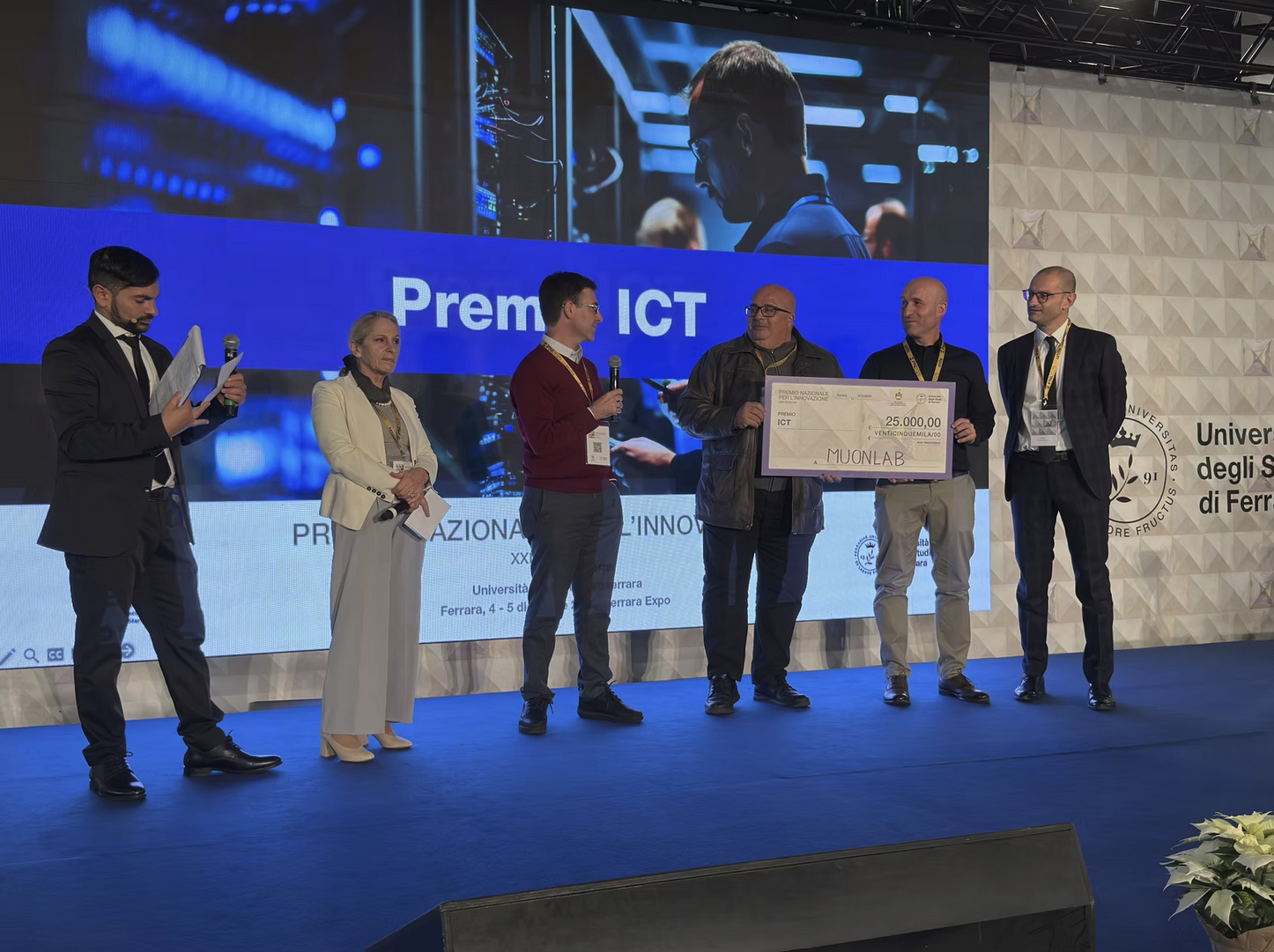
And precisely muon imaging, but using a different technology developed by the founding group and patented in 2015, is the focus of MuonLab, INFN’s most recent spin-off, the seventh, recognized jointly with the University of Florence on July 25, 2025.
See through, see inside, the company vision, summarizes the idea behind MuonLab: using muons, particles that compose cosmic rays, as an investigation tool to perform radiographs of large architectural and mining structures, in a way similar to how X-rays are used for radiographs.
Thanks to the technology developed during research work at INFN and the University and licensed to MuonLab, the company is able to highlight density differences within the analyzed structures, reconstructing 2D and 3D images that can provide indications on the stability of artifacts, the presence of voids, and their internal structure. Although very young, the company has already received an important recognition, winning the National Innovation Award (PNI) in the ICT category.
Licenses
The licensing activities carried out by the TT Service are also concentrated in the start-up field. All license agreements stipulated by INFN in 2025 have recently established companies as counterparts. In addition to MuonLab, which acquired an exclusive license for the patent relating to muon detection technology and the know-how relating to image reconstruction, INFN has stipulated license agreements with two other spin-offs.
BeamX, founded by David Alesini and Luigi Faillace of the Frascati National Laboratories, deals with the construction of compact accelerators for industrial applications. It has acquired a license for a technology patented by INFN for the realization of ultra-high vacuum radiofrequency sealed connections that do not require welding, as well as the know-how relating to the design and construction of particle accelerators and ion sources for the accelerators themselves.
Radiantis Research, a company established in 2024 on the initiative of Francesco Collamati from the INFN Rome 1 Section, produces a probe for radioguided surgery capable of helping the surgeon in the complete removal of tumors whose technology was developed within INFN and is the subject of patent and know-how licensing.
Remaining in the life sciences field, in 2025 INFN stipulated an agreement with Rilemo, an innovative start-up founded by a former Institute collaborator, which guarantees the option for licensing a patent regarding a diagnostic imaging system based on microwaves instead of X-rays, which therefore does not subject the patient to ionizing radiation.
Radiation of a completely different kind is instead the basis of the patented technology granted to Entrokey, a young American company that deals with cryptography. This is, in fact, a patent regarding a device that exploits cosmic muons for the generation of random numbers that can be used in tamper-proof encryption algorithms.
Collaborations
2025 has also seen the strengthening of strategic collaborations for technology transfer activities, through the renewal of two framework agreements. The first, with Trentino Sviluppo – ProM, establishes a technological partnership in the field of additive manufacturing, through the sharing of resources and expertise; the second, with Cassa Depositi e Prestiti, aimed at capacity building to support the development and implementation of Technology Transfer activities and processes.
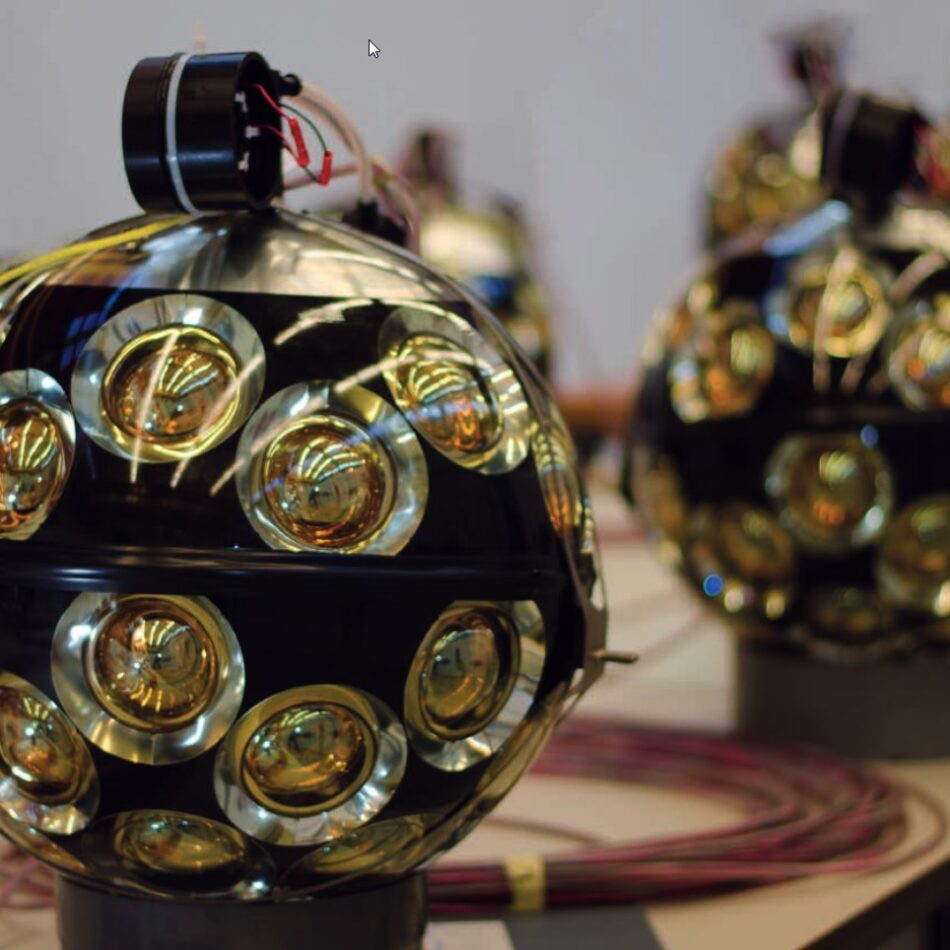
INFN’s role of excellence, not only for the high level of research produced, but also as a technology provider, goes beyond national borders and is also expressed through the numerous research or service contracts stipulated with foreign entities, among which the supply to Brookhaven National Laboratories (USA) of 5 detection units similar to those used by the Km3Net-ARCA neutrino observatory stands out. These are 5 long “strings” each formed by 18 spherical elements the size of a beach ball and spaced 40 m apart, for a total length of about 700 m, designed and built by INFN to work at 3,500 m depth on the sea floor. Each element of the string contains numerous ultra-sensitive sensors capable of measuring the weak Cherenkov light generated by the interaction of neutrinos with matter.
New Technologies

In addition to valorization efforts, INFN has also committed to developing promising technologies that are not yet market-ready, particularly through the R4I program aimed at raising the TRL of innovations with high application potential. In the 2025 edition, the eighth, four projects have been funded: WIDMapp, which aims to develop a wearable dosimetric system for use on patients undergoing radiometabolic treatments; DEMOTrack, dedicated to creating an ionoacoustic sensor for calibrating particle beams used in research or hadron therapy; nMicrortube, which seeks to build a high-sensitivity cylindrical neutron sensor, and DOIN_LM which further develops a wearable personal dosimeter project for neutrons. Among these, DOIN_LM has led to collaboration with a company for the production of a small batch of dosimeters that are currently under evaluation and data collection with a selected group of users.
Building on what has been achieved so far and the experience gained, in 2026 we aim to strengthen INFN’s recognizability and increase the impact that technologies generated within the institute and transferred externally can have on society and industrial reality. We therefore aim to establish lasting relationships of mutual growth with companies, to extend the technological portfolio and to increase its exploitation through license agreements and strategic collaborations.

